
For handmade and artisan jewellery sellers on Etsy, Amazon Handmade, Shopify, and independent stores globally. Updated May 2026.
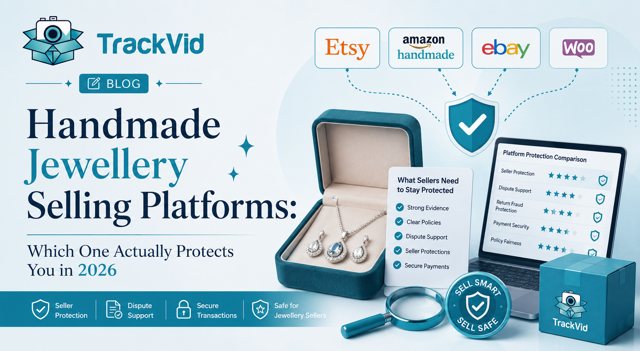
Handmade jewellery selling platforms are not all equal when something goes wrong after a sale. Most guides that compare handmade jewellery selling platforms cover three things: fees, buyer audience, and how easy it is to list. These matter. They are not what separates a good platform from a costly one for a jewellery maker who has just received a fraudulent return.
The dimension every comparison guide leaves out is this: what happens when a buyer claims your handmade piece arrived damaged, was the wrong item, or was not as described? For mass-produced goods, a seller can send a replacement. For a handmade jewellery maker, every piece is individual. A falsely disputed piece that results in a refund is not just revenue lost. It is hours of work, materials, and in many cases, a one-of-a-kind creation that cannot be remade identically.
This guide compares the leading handmade jewellery selling platforms on fees and reach, which every comparison covers, and on dispute protection and evidence requirements, which almost none do. The answer to "which platform is safest for handmade jewellery sellers" is not a simple ranking. It is a framework. And the framework has a gap that sits underneath every platform in the comparison.
Why Handmade Jewellery Disputes Are Different
Before comparing platforms, it helps to understand why handmade jewellery occupies a specific category for post-purchase disputes.
Mass-produced goods have a simple dispute resolution path: if a buyer claims the item was not as described, the seller can point to the product's consistent specifications and offer a replacement from the same batch. The disputed piece and the replacement are functionally identical.
Handmade jewellery does not work this way. Each piece carries natural variation even within a design. An oxidised silver ring made on a Tuesday has a slightly different finish depth than one made on a Thursday. The stone a maker sets in a bezel on one day is not the same stone as one from the same parcel set the following week. A bespoke piece made to a specific customer's brief is literally irreplaceable.
This natural variation creates two specific vulnerabilities. First, a buyer who expected a finish or shade that was not explicitly guaranteed in the listing can file a plausible "not as described" dispute on any handmade piece. Second, a maker without documentation of the specific dispatched piece cannot prove independently that the piece sent matched the listing, because their listing photo is a sample or a studio shot, not a photograph of the specific order.
Platform protection matters more for handmade jewellery than for any other product category because every loss is permanent and every dispute turns on order-level evidence.
Platform 1: Etsy
Etsy is the primary handmade jewellery selling platform globally with 445 million monthly visits and 96 million active buyers as of 2025, according to BSS Commerce. Search volume for "handmade jewelry" on Etsy alone is approximately 1.2 million monthly searches. It is the default platform for independent jewellery makers building a brand around their craft.
Best for: Makers whose pieces carry a story, artisans selling bespoke or limited pieces, vintage jewellery sellers, and jewellery businesses in their first two years of selling online. Etsy buyers specifically seek handmade and unique, which means they pay more than Amazon buyers for the same quality level.
Fees: $0.20 per listing renewed every four months. Transaction fee 6.5 percent of sale. Payment processing 3 percent plus $0.25. Optional Offsite Ads at 12 to 15 percent on referred sales.
Buyer audience: Craft-aware buyers who research makers and value story alongside product. Average jewellery conversion rate on Etsy is higher than most comparison platforms for handmade because the buyer intent is specifically for handmade pieces.
Dispute protection: Etsy's Purchase Protection covers sellers for eligible damaged-item cases once per calendar year per seller. For "item not as described" chargebacks filed through the buyer's bank rather than Etsy's case system, Etsy forwards the seller's submitted evidence to the issuing bank and the bank decides. The platform does not override bank decisions. Etsy's involvement ends at forwarding.
The specific gap for handmade jewellery sellers: The once-per-year damaged-item protection runs out after the first use. A maker receiving two fraudulent damage claims in the same year is unprotected from the second one forward. All chargebacks above $250 are outside Etsy's direct protection. And for "not as described" disputes, the outcome depends entirely on what the seller submits. Listing photos of a sample piece do not prove what was in the specific order.
What wins disputes on Etsy: Order-linked packing video of the specific dispatched piece showing its finish, settings, condition, and any unique characteristics against the specific Order ID. Etsy sellers using TrackVid for indexed packing video report dispute win rates of 65 to 75 percent on "not as described" cases compared to the 20 to 30 percent platform average on standard documentation.
Platform 2: Amazon Handmade
Amazon Handmade requires sellers to apply and demonstrate their production process before listing. This vetting creates a community of verified makers within Amazon's full buyer ecosystem. Access to Amazon's 310 million active customers globally, combined with the trust signals of Amazon's fulfilment and return infrastructure, makes it the strongest option for handmade jewellery makers ready to scale beyond Etsy's audience.
Best for: Established jewellery makers who have refined their processes and are ready for higher volume, sellers targeting mid-to-premium price points where Amazon's buyer trust supports purchase decisions, and artisans who can meet Amazon's fulfilment expectations on dispatch timing.
Fees: 15 percent referral fee on jewellery sales. No separate listing fee for approved Handmade sellers. Amazon FBA available if sellers want Amazon to handle fulfilment and returns.
Buyer audience: Amazon's buyer base is broader and more transactional than Etsy's. Buyers are comfortable with premium pricing when supported by strong product photography and reviews but have lower attachment to maker story than Etsy buyers.
Dispute protection: Amazon's A-to-Z Guarantee gives buyers 90 days from delivery to file a claim. The seller has 48 hours to respond when a claim is filed. For INR claims with tracked delivery, outcomes are typically in the seller's favour. For SNAD claims, the seller must submit evidence demonstrating the item matched the listing.
The specific gap for handmade jewellery sellers: False inauthentic item complaints can suspend the relevant ASIN before human review takes place. This is the highest-stakes dispute type on Amazon Handmade: an ASIN suspension removes the listing entirely until the appeal is resolved. The 90-day A-to-Z window means every order in the last three months is a potential active dispute at any given time. Without indexed, searchable dispatch documentation going back 90 days, sellers cannot produce evidence for older orders when claims arrive.
What wins disputes on Amazon Handmade: Order-linked packing video covering the making and packing stages serves as both SNAD dispute evidence and as the order-level element of a Plan of Action appeal for inauthentic item complaints. For Amazon, the packing video showing the handmade piece being made and then dispatched for the specific Order ID is the evidence that proves both authenticity and product match. TrackVid's indexed archive means 90-day-old footage is retrievable in under two minutes by Order ID search.
Platform 3: Shopify
Shopify gives handmade jewellery sellers complete control over their brand, their customer relationships, their pricing, and their margins. There is no commission on sales beyond payment processing. There is also no built-in buyer marketplace. Shopify stores live or die on their own traffic, and dispute protection is entirely the seller's responsibility through payment processors.
Best for: Jewellery makers with an established audience on Instagram, Pinterest, or other social channels who want to convert that following into direct sales. Makers who have outgrown Etsy's brand constraints and want full ownership of the customer relationship. Businesses where repeat buyer relationships are a core part of the model.
Fees: Subscription $29 to $299 per month depending on plan. Zero sales commission with Shopify Payments. Payment processing 2.9 percent plus $0.30 on standard plans. No listing fees.
Buyer audience: Entirely self-sourced. Shopify provides no discovery traffic. All buyers come from the seller's own marketing, SEO, and social presence.
Dispute protection: Shopify has no native buyer dispute framework. Every dispute goes through the payment processor: Shopify Payments, PayPal, or Stripe. PayPal Goods and Services gives buyers 180 days to file disputes. Stripe and card network chargebacks typically allow 60 to 120 days. There is no platform mediation. The seller's evidence is evaluated directly by the payment processor or card issuer.
The specific gap for handmade jewellery sellers: No platform protection exists at all. This is not a platform criticism. It is a product of the full-control model. For jewellery sellers on Shopify, TrackVid is the only dispute protection that exists. Without order-linked packing video, a Shopify jewellery seller facing a "not as described" chargeback has no independent evidence of what was dispatched beyond their listing. With PayPal's 180-day window, a January dispatch can be disputed in July with zero documentation of the original piece unless it was indexed and preserved at packing.
What wins disputes on Shopify: TrackVid provides the only order-level evidence infrastructure for Shopify jewellery sellers. The packing video for a specific order, retrievable in under two minutes six months later, is what wins PayPal SNAD chargebacks and Stripe disputes on condition claims. Without it, every condition dispute on Shopify is a structural loss.
Platform 4: Selling on Multiple Platforms Simultaneously
Many handmade jewellery sellers operate across Etsy and their own Shopify store, or across Etsy, Amazon Handmade, and Shopify simultaneously. This is common and often the most effective strategy at scale.
The operational challenge is managing different dispute windows, different evidence format requirements, and different claim submission processes across three different systems. Etsy's 10 to 20 day window, Amazon's 48-hour A-to-Z response, and PayPal's 180-day window all run simultaneously on different orders. Missing any one window on any one platform loses that case automatically.
The evidence quality problem compounds across platforms. A seller managing Etsy, Amazon, and Shopify manually is retrieving footage from a phone camera roll for each Etsy dispute, searching through Seller Central for Amazon A-to-Z documentation, and building a Stripe evidence package for Shopify chargebacks. Each dispute is a separate, time-pressured evidence reconstruction exercise.
TrackVid solves the multi-platform problem at the source. Every order across every platform gets the same Order ID-linked packing video from the same indexed cloud. When a dispute arrives on any platform, the evidence is retrieved by order number in under two minutes regardless of which platform generated the order. The same video, correctly formatted, submitted through whichever platform's dispute process applies.
Brussels Maker Léa: Every Platform, Same Problem, Same Fix
Léa makes enamel and silver jewellery from her studio in Brussels, selling across Etsy, Amazon EU Handmade, and her own Shopify store at approximately 60 orders per week combined across the three channels.
For almost two years, she experienced what she grouped mentally into "the returns problem." Pieces coming back in conditions she did not recognise as hers. Disputes filed on pieces she was confident were correctly described. A PayPal SNAD claim filed five months after a January dispatch that she had no documentation to contest.
Her overall dispute win rate across the three platforms was 16 percent.
When she sat down with her dispute records, the pattern in her losses was consistent across all three platforms. Every loss cited either "not as described" or "wrong item received." On Etsy, she had submitted listing photographs. Amazon Seller Central had the same listing evidence. For the PayPal dispute, she had nothing that related to that specific January order by the time June arrived.
The platform did not determine whether she won or lost. The evidence did. And the evidence problem was identical on Etsy, Amazon, and Shopify because the evidence gap was not platform-specific. It was the absence of order-level dispatch documentation on every platform she operated.
Three platforms with three different processes. But the reason I kept losing disputes was exactly the same on all of them. I never had the specific piece on camera for the specific order.
After implementing TrackVid across all three channels, every order had an indexed, Order ID-linked packing video from the first dispatch. The same system served Etsy dispute submissions, Amazon A-to-Z responses, and PayPal resolution packages. When disputes arrived, the evidence was retrieved in under two minutes and formatted for the relevant platform.
Her overall dispute win rate across all three platforms moved from 16 percent to 68 percent within 60 days. The platform mix did not change. The evidence infrastructure did.
The Handmade Jewellery Platform Protection Comparison
| Platform | Dispute Type | Window | Coverage Limit | Protection Gap | TrackVid Fix |
|---|---|---|---|---|---|
| Etsy | Chargeback + cases | 10 to 20 days | Once/year damaged; $250 cap | NAD evidence is listing photos only | Order-linked video for NAD disputes |
| Amazon Handmade | A-to-Z + inauthentic | 48-hr A-to-Z | ASIN suspension risk | 90-day evidence archive | Indexed 90-day archive, Plan of Action video |
| Shopify | Payment processor | Up to 180 days | None | Zero platform protection | Only protection that exists |
| Multi-platform | All of the above | All simultaneously | All of the above | Multi-window management | One dashboard, all platforms |
TrackVid is the evidence infrastructure that fills the gap in every row of that table simultaneously.
The Irreplaceability Problem: Why Handmade Disputes Cost More Than the Sale Price
For a mass-produced product seller, a successful fraudulent return means losing the product and issuing a refund. The product can be restocked. The loss is financial.
For a handmade jewellery maker, a successful fraudulent return means losing the original piece, issuing a refund, and losing the hours of labour that produced a piece that cannot be remade identically. A bespoke piece made to a specific buyer's brief, with stones selected for that commission and proportions adjusted through multiple conversations, is gone. The financial loss includes materials and platform fees. The total loss includes the irreversible labour cost and in some cases the piece itself, which a fraudulent buyer has retained while claiming the wrong item was received.
This makes the cost of lost disputes disproportionately high for handmade jewellery compared to any other product category. It also makes the return on implementing order-level documentation disproportionately high. A seller who wins 70 percent of their previously-lost disputes is not just recovering financial value. They are recovering the investment in labour, materials, and craft that a fraudulent return would otherwise permanently absorb.
For handmade jewellery makers, order-linked packing video is not optional evidence infrastructure. It is the protection that matches the irreversible nature of the product itself.
How to Choose Between Handmade Jewellery Selling Platforms in 2026
The practical decision framework has four questions.
Where are your buyers? Craft-oriented buyers who value maker story and pay for uniqueness are on Etsy. Volume buyers who research extensively before purchasing premium pieces are on Amazon Handmade. Buyers who follow specific makers on social media and want direct relationships are on Shopify.
What is your volume? Below 20 orders per week, Etsy's lower friction is appropriate. Above 50 orders per week, the dispute management implications of each platform's process become an operational consideration. Above 100 orders per week, multi-platform selling with a single evidence management system is the practical requirement.
What is your brand stage? Early-stage makers building an audience suit Etsy. Established makers scaling their reach suit Amazon Handmade. Makers with their own audience who want brand independence suit Shopify. All three stages benefit from the same evidence infrastructure because disputes arrive at every stage.
What is your dispute evidence setup? This is the question every guide skips. Before your first listing on any platform, your packing video system should be in place. The most common regret among jewellery sellers who have lost disputes is not that they chose the wrong platform. It is that they built beautiful product photography and zero order-level documentation.
Related: How to sell jewellery online safely: the two-category protection framework →
Related: Etsy seller chargeback evidence: what wins disputes by type →
TrackVid provides order-linked packing video documentation for handmade jewellery sellers on every platform in this comparison. Every packing session is recorded and linked to the Order ID at the moment of packing. Evidence is stored in indexed cloud, retrievable by order number in under two minutes, and formatted for submission on whichever platform's dispute process applies.
For handmade jewellery makers, TrackVid works with existing cameras including phone cameras for studio setups. Setup takes under 15 minutes. Evidence is live from the first packing session after activation across every platform you sell on.
Schedule a free demo at trackvid.in/book-demo.html
Frequently Asked Questions
Best platform for selling handmade jewellery online?
The best platform for selling handmade jewellery online in 2026 depends on your stage and buyer type. Etsy is the strongest starting platform for most handmade jewellery makers, with 445 million monthly visitors, 96 million active buyers, and a buyer community that specifically searches for and pays premium for handmade pieces. Amazon Handmade is the best platform for established makers wanting Amazon's volume and trust signals at mid-to-premium price points. Shopify is best for makers with their own audience who want zero commission and full brand control. Regardless of platform, implement order-linked packing video through TrackVid before your first dispatch. "Not as described" chargebacks are the most common dispute type for handmade jewellery on every platform, and listing photos lose those disputes consistently without order-level evidence.
Etsy vs Amazon Handmade for jewellery: which is better in 2026?
Etsy is better for handmade jewellery sellers whose pieces carry a strong maker story and whose buyers value uniqueness and direct maker relationships. Amazon Handmade is better for established handmade jewellery sellers wanting Amazon's volume, trust infrastructure, and support for higher price points. On protection: Etsy covers eligible damaged-item cases once per year per seller, with chargebacks decided by the buyer's bank based on seller-submitted evidence. Amazon Handmade's A-to-Z Guarantee gives buyers 90 days from delivery, with ASIN suspension risk on inauthentic complaints. Both leave "not as described" dispute outcomes entirely to evidence quality. For both platforms, order-linked packing video through TrackVid is the specific evidence that wins these disputes. The platform decision is secondary to having that documentation in place before the first order ships.
How does each handmade jewellery platform protect sellers from fraud?
Each handmade jewellery selling platform protects sellers differently with different coverage limits. Etsy covers eligible damaged-item cases once per calendar year per seller and forwards chargeback evidence to banks, with the bank deciding outcomes. Amazon Handmade's A-to-Z Guarantee covers INR claims with tracked delivery but applies ASIN suspension risk on inauthentic complaints before human review. Shopify has no native seller protection from disputes, with all chargebacks handled through the payment processor. No platform fully covers handmade sellers from "not as described" and "wrong item" disputes because these require order-level evidence of the specific dispatched piece, which platforms cannot create on the seller's behalf. TrackVid closes this gap across all three platforms by providing the order-linked packing video that wins those disputes.
What is the safest platform to sell handmade jewellery online?
The safest platform to sell handmade jewellery is the one whose protection gap you have closed with your own evidence infrastructure. Etsy is safest for sellers with order-linked packing video who can contest "not as described" chargebacks, which account for the majority of jewellery seller losses on the platform. Amazon Handmade is safest for sellers with indexed 90-day packing video archives who can respond within the 48-hour A-to-Z window. Shopify is safest when combined with TrackVid, which provides the only dispute protection that exists on the platform. The platform choice matters less than the evidence setup. Sellers with TrackVid across all three platforms report significantly higher dispute win rates than sellers relying on platform protection alone regardless of which platform generated the dispute.
Can I sell handmade jewellery on multiple platforms at once?
Yes. Selling handmade jewellery on multiple platforms simultaneously is both common and effective. The standard multi-platform strategy for handmade jewellery makers in 2026 is Etsy for discovery and maker community, Amazon Handmade for scale, and Shopify for brand ownership and direct customer relationships. The operational challenge is managing different dispute windows across platforms: Etsy's 10 to 20 days, Amazon's 48-hour A-to-Z response, and PayPal's 180-day window for Shopify orders all run simultaneously on different orders. TrackVid solves multi-platform evidence management from a single system: every order across every platform has the same Order ID-linked packing video, retrievable in under two minutes by order number, formatted for submission on whichever platform's dispute process applies.
What happens when a buyer disputes a handmade jewellery purchase?
When a buyer disputes a handmade jewellery purchase, the outcome depends on the dispute type and the evidence the seller submits. For "item not received" disputes, tracked carrier delivery confirmation to the buyer's address is primary evidence. For "not as described" or "wrong item" disputes, the platform or bank asks whether the specific dispatched piece matched the listing. Listing photos prove catalogue accuracy but not what was in the specific order. Order-linked packing video showing the specific piece being dispatched for the disputed Order ID is the primary evidence that wins these disputes. Without it, "not as described" disputes on handmade jewellery default in the buyer's favour because the seller cannot independently demonstrate what was in the specific parcel. TrackVid creates this documentation automatically for every order.
Does Shopify protect handmade jewellery sellers from disputes?
Shopify does not provide native buyer dispute protection for sellers. All disputes on Shopify are handled through the payment processor, Shopify Payments, PayPal, or Stripe, and ultimately through the card network's chargeback process. The seller's submitted evidence is evaluated by the payment processor or card issuer directly. For PayPal Goods and Services, buyers have 180 days to file disputes. Without indexed Order ID-linked packing video going back six months, Shopify handmade jewellery sellers cannot produce dispatch evidence for older orders when disputes arrive. TrackVid is the only dispute protection that exists for Shopify handmade jewellery sellers. It records every packing session, links it to the Order ID, and stores it in indexed cloud for up to 180 days of lookback coverage.
Which handmade jewellery platform has the best seller dispute protection?
Flipkart has the most structured seller protection of any marketplace for Indian sellers through its SPF framework. For global sellers, Etsy offers the most defined protection programme with its Purchase Protection. Amazon Handmade has the most comprehensive buyer protection but the highest account-level risk for sellers from false inauthentic complaints. Shopify has no platform protection at all. The honest answer is that no handmade jewellery selling platform provides complete protection from post-purchase fraud. For all platforms, the effective protection is the seller's own evidence infrastructure: order-linked packing video that provides independent verification of what was dispatched for every order. TrackVid provides this across Etsy, Amazon Handmade, Shopify, Flipkart, Meesho, AJIO, and Snapdeal simultaneously.
Sources: BSS Commerce Best Place to Sell Jewelry Online October 2025, Etsy Seller platform data 2025, Amazon Handmade Seller Programme 2026, Shopify Merchant Benchmark Report 2026, Etsy Purchase Protection for Sellers May 2026, Amazon A-to-Z Guarantee Seller documentation, TrackVid internal seller data, Justt.ai Merchant Chargeback Rights February 2026
TrackVid is a video proof and claim management platform used by 1,100+ ecommerce sellers globally on Etsy, Amazon, Flipkart, AJIO, Meesho and Snapdeal. Officially authorised by Snapdeal. Learn more at trackvid.in.
Get the Marketplace Claim Recovery Checklist
A 12-point checklist used by 1,100+ sellers to recover 85-90% of marketplace claim losses. Free, instant access.
- Marketplace-specific evidence formats (AJIO, Flipkart, Amazon, Myntra)
- Claim window deadlines for every major platform
- The 6-step process that pushes approval from 85-90%
- Common rejection reasons and how to avoid them
No spam. Unsubscribe anytime. Used by sellers at Rare Rabbit, HRX, Da Milano + 1,100 more.
Stop Losing Money to Fake Returns
Join 1,100+ sellers who recover lakhs every month with TrackVid