
For sellers on Amazon, Flipkart, AJIO, Myntra and Meesho. Updated July 2026.
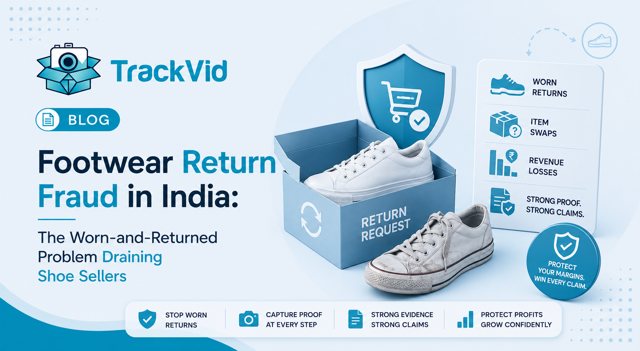
Footwear return fraud in India is the quiet reason shoe sellers run high return rates and low margins at the same time. A buyer wears the shoes for an event, returns them as "did not fit," or sends back a worn, older, or entirely different pair, and the seller absorbs the loss because there is no proof of what was actually shipped and in what condition.
Shoes carry one of the highest return rates in ecommerce. Within apparel, footwear return rates reach around 31 percent, and fashion and footwear categories in India run 25 to 35 percent year round, climbing toward 40 percent during festive sales. A meaningful slice of that is not honest sizing returns. It is footwear return fraud.
The tricky part is that a worn shoe and a returned "unused" shoe look almost identical in a photo. Almost.
Why Footwear Return Fraud Runs So High
Footwear sits at the intersection of three things that invite abuse: high return tolerance, subjective fit, and easy disguise. That mix is why this abuse is structural rather than occasional.
Fit is genuinely hard online, so platforms and buyers treat footwear returns as normal. That norm gives cover to abuse. A buyer wearing shoes once and returning them knows the return will be waved through as a sizing issue.
Return abuse is also rising across the board. Signifyd data shows abusive returns climbed 64 percent between January 2024 and May 2025, and apparel abuse rose 13 percent year over year in the Signifyd Global State of Commerce 2026 report. Footwear rides that same wave.
The losses do not stop at the refund either. Reverse logistics on low-ticket footwear can eat 25 to 30 percent of order value, according to Bain and IBEF data, and COD return-to-origin on fashion and footwear touches 40 percent. Indian D2C brands collectively lose more than Rs 8,000 crore a year to RTO, according to GoKwik. Fraudulent returns sit on top of that already heavy base.
A small group of buyers drives most of the damage. Serial returners make up 5 to 10 percent of shoppers but account for 30 to 40 percent of returns, according to Claimlane data. In footwear, that same group is behind a large share of the worn-and-returned and swap attempts, because they have learned the category usually gets waved through. You cannot spot them at checkout, but you can make sure that when they try it, you hold the proof to contest the claim.
The category's high return rate is not the whole cost. The fraud hiding inside that rate is.
For a seller, the honest returns are a cost of doing business. The fraudulent ones are money you could recover if you could prove the condition and the pair you shipped.
Bangalore Seller Arjun: 400 Orders a Day and Rs 90,000 in Silent Losses
Arjun runs a D2C sneaker and casual footwear brand from Bangalore, selling on Myntra, AJIO and his own store, shipping around 400 orders a day. Sneakers are his hero product and his biggest loss centre.
The returns that hurt were not the size exchanges. They were the pairs that came back scuffed on the sole after an obvious wear, the boxes with an older worn pair swapped in, and the "wrong size received" claims where the size he shipped was correct on record.
His team had tried the usual defences. They photographed pairs before boxing and relied on the warehouse camera. When Myntra or AJIO asked for proof, the photos were not tied to any order, and the camera footage could not be searched by Order ID or matched to a specific AWB.
Across a quarter, Arjun estimated he was quietly losing about Rs 90,000 a month to fraud he could see but not contest. The claims he did raise were mostly rejected for weak evidence.
He moved to recording each packing on video, linked to the Order ID, capturing the pair, the size label, and the sealed box. The first time a "wrong size" claim came in on a correctly shipped order, he pulled the clip and won it.
I always knew which returns were fraud. I just never had the one thing that turns knowing into a won claim.
His recovery rate on footwear disputes went from almost nothing to consistently winning the majority. The abuse did not vanish. His ability to fight it did.
The Four Faces of Footwear Return Fraud
It shows up in four recognisable patterns, and each one exploits the fact that shoes are treated as a soft return.
Wardrobing, the worn-and-returned
The buyer wears the shoes for an occasion, then returns them as unworn. By the time the pair reaches your warehouse and someone notices the sole wear, the refund is often already processed.
The pair swap
The buyer keeps your new pair and returns an old, damaged, or lower-value pair in the same box. Without a record of the exact pair you shipped, the return looks legitimate.
The size-swap claim
The buyer claims they received the wrong size, when the size you dispatched was correct. This forces a refund or reship on a problem that never existed on your side.
The empty or short box
The box comes back with tissue, an insole, or a single shoe instead of the pair. The rough weight passes, and the refund clears before inspection.
Each pattern beats photos and CCTV. None of them beats an order-linked video that shows the exact pair, size, and sealed box leaving your facility.
Why Your Current Proof Does Not Hold
Most footwear sellers think they have evidence. They have images and a camera. Neither survives a real dispute.
Photos are order-agnostic. A picture of a clean pair could be any pair, taken any time, which is why marketplace reviewers give it almost no weight. CCTV records by time and zone, not by Order ID, so tying a specific packing moment to a specific AWB during a claim window is slow and usually inconclusive.
The claim windows are short. AJIO often works in a 3 day window and treats order-level packing video as mandatory, Myntra runs close to 48 hours, and Flipkart 48 to 72. Hunting through camera footage inside those windows rarely ends well.
Picture how it actually plays out. AJIO sends a CCTV-required email on a Saturday with a 24 to 48 hour window. Your ops lead is off, the footage sits on a DVR no one can search by Order ID, and by Monday the window has closed. The claim is auto-rejected before a human ever reviews it. For a high-volume footwear seller, that is not a rare edge case. It is most Saturdays.
A footwear claim is won by proving the exact pair and condition you shipped, tied to the order, in seconds.
That is a specific evidence requirement, and general-purpose cameras were never built to meet it.
How to Turn Footwear Returns From Loss Into Recovery
The footwear sellers who stop bleeding on returns build proof at packing, before any dispute exists.
TrackVid (trackvid.in) records every packing automatically and links each video to the Order ID, SKU and AWB at the moment it happens. For a shoe seller, that captures the pair, the size label, and the sealed box against the exact order, stored in searchable cloud you can query by Order ID.
When a worn-and-returned or wrong-size claim arrives, you retrieve the packing video in under two minutes and show precisely what left your warehouse. On AJIO, TrackVid also detects the "CCTV required" emails and responds automatically with the correct order-linked video, so a 24 to 48 hour window is never missed. Related: The AJIO VMS and packing video guide for sellers
TrackVid works with your existing cameras and sets up in under 30 minutes. It is used by 1,000+ Indian sellers, including apparel and footwear brands, which is why claim win rates commonly move from under a quarter to past 90 percent. Learn more at trackvid.in.
For footwear specifically, a claim file that holds up usually contains four things:
- The packing video showing both shoes clearly, before the box is sealed
- The size label or SKU visible on camera, matched to the order
- The sealed box with the AWB, so parcel identity is not in doubt
- The Order ID link, so the marketplace can tie the clip to the transaction
Miss any one of these and the claim weakens. Order-linked packing video captures all four in a single automated step, which is the difference between a file that wins and a note that gets ignored.
The platform windows are where retrieval speed decides the outcome. On Amazon, footwear claims run through SAFE-T in Seller Central with a window that typically opens for seven days after the return is delivered. On Flipkart and Myntra the windows are tighter, often 48 to 72 hours, and AJIO can be as short as 24 to 48. A seller who can search an Order ID and produce the packing clip in under two minutes is not just better documented. They are often the only party in the dispute holding proof the platform will actually weigh.
The goal here is not zero returns. Footwear will always return more than most categories. The goal is to stop writing off the fraudulent slice you could recover.
Related: How to reduce returns in ecommerce for Indian sellers
Five Questions to Check If Footwear Fraud Is Costing You
1. Can you pull the packing video for any shoe order in under two minutes by Order ID?
If not, you cannot meet AJIO or Myntra windows.
2. Does your record show the exact pair and size you shipped for each order?
If not, a pair swap or size-swap claim is unprovable.
3. When a "worn" pair comes back, can you show it left you unworn and sealed?
If not, wardrobing costs you every time.
4. Do you know your footwear claim win rate this month as a number?
If you do not measure it, the fraud is invisible in your P&L.
5. During the next festive sale at 40 percent returns, will this process hold?
Photos and CCTV do not scale into peak. Order-linked video does.
Any no on that list is a recoverable loss you are currently absorbing.
Schedule a free demo at trackvid.in/book-demo.html
In one session, you will see exactly where your recoverable revenue is going and what a structured proof system looks like in your specific operation.
Frequently Asked Questions
Customer wore the shoes and returned them, what to do?
Pull the packing video for that Order ID to show the pair left you unworn and sealed, then raise the claim with that clip. Marketplaces accept order-linked video where they reject photos. Without it, wardrobing returns are almost impossible to contest, and abusive returns are up 64 percent since early 2024 according to Signifyd.
How to prove shoes were worn before a return?
You prove condition at the point of shipping, not after. A packing video that captures the clean pair and sealed box against the Order ID lets you show the difference when a worn pair comes back. TrackVid records this automatically at packing.
Myntra footwear return fraud kaise roke?
Har order ka packing video rakho jisme pair, size aur seal dikhe, Order ID se linked. Myntra aur AJIO me claim window chhoti hoti hai, isliye video turant nikalna zaroori hai. Sirf photo se footwear claim jeetna bahut mushkil hai.
Someone returned a different pair of shoes. Can I claim it?
Yes, if you can prove the pair you shipped. An order-linked packing video showing the exact pair and box is the evidence that wins a swap claim on Amazon, Flipkart, AJIO or Myntra. Related: How Indian sellers win the wrong-item return claim
Why is my footwear return rate so high in India?
Footwear runs 25 to 35 percent in India and near 40 percent in festive sales because fit is subjective online, per industry data. Part of that rate is honest sizing, and part is fraud. Structured proof does not lower honest returns, but it lets you recover the fraudulent ones.
Is a warehouse camera enough for footwear claims?
No. A camera records by time and location, not by Order ID, so it cannot quickly tie one packing event to one AWB inside a short claim window. Order-linked packing video is the format AJIO and Myntra actually accept.
What is the best way to stop footwear return fraud in India?
Automated packing video that captures the pair, size and seal, links each clip to the Order ID, SKU and AWB, and retrieves in seconds. TrackVid provides exactly this and is used by 1,000+ Indian sellers, which is why footwear claim win rates commonly pass 90 percent.
Sources: Signifyd (return abuse increase and apparel abuse figures), industry data on India fashion and footwear return rates, GoKwik (RTO losses), TrackVid seller data (claim win rates), AJIO and Myntra seller documentation.
TrackVid is a video proof and claim management platform used by 1,000+ Indian ecommerce sellers on Amazon, Flipkart, AJIO, Myntra and Meesho. Officially authorised by Snapdeal. Learn more at trackvid.in.




Get the Marketplace Claim Recovery Checklist
A 12-point checklist used by 1,100+ sellers to recover 85-90% of marketplace claim losses. Free, instant access.
- Marketplace-specific evidence formats (AJIO, Flipkart, Amazon, Myntra)
- Claim window deadlines for every major platform
- The 6-step process that pushes approval from 85-90%
- Common rejection reasons and how to avoid them
No spam. Unsubscribe anytime. Used by sellers at Rare Rabbit, HRX, Da Milano + 1,100 more.
Stop Losing Money to Fake Returns
Join 1,100+ sellers who recover lakhs every month with TrackVid