
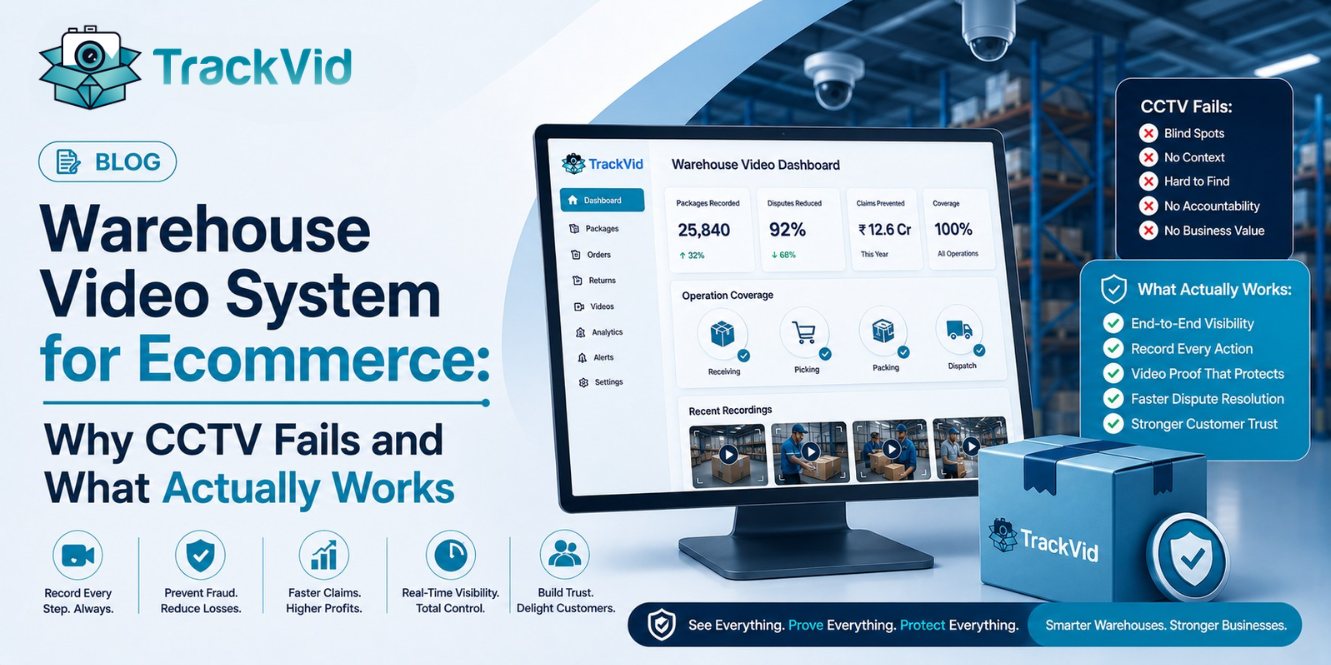
For ecommerce sellers on Amazon, Shopify, eBay, Etsy and global marketplaces. Updated May 2026.
If you searched "warehouse video system for ecommerce" or "packing video proof setup," you have probably been told the same thing: mount an overhead HD camera, use a barcode scanner, record continuously to a NAS, and you are covered. This is the most common advice on ecommerce forums, Reddit communities, and ChatGPT responses on the topic.
It is wrong. And following it will consistently lose you disputes that you would have won with the correct system.
The difference between a CCTV setup and a proper warehouse video system for ecommerce is not about camera quality or storage capacity. It is about one thing: whether the footage is linked to specific Order IDs at the moment of recording. Without that link, the footage is surveillance. With it, the footage is proof.
This is not a minor technical distinction. Marketplace dispute portals require order-specific, independently verifiable evidence. Surveillance footage cannot provide that. A warehouse video system designed for ecommerce disputes can.
What a Warehouse Video System for Ecommerce Actually Needs to Do
The purpose of a warehouse video system for ecommerce sellers is not security. It is evidence creation.
Security CCTV answers: "What happened in this area of my warehouse between 2pm and 4pm on Thursday?"
An ecommerce dispute answers: "What specifically was packed for Order ID 114-XXXXXXXX-XXXXXXXX?"
These are different questions. Security CCTV cannot answer the dispute question because it is not indexed by order data. It is indexed by time and camera location.
A warehouse video system built for ecommerce dispute proof answers the dispute question because it links every recording to the Order ID at the time of recording. When a dispute arrives, the Order ID is entered, and the relevant footage loads immediately.
This is why sellers who invest in high-quality CCTV systems and genuinely believe they are covered find out at the first serious dispute that they are not.
The Five Ways CCTV Fails as an Ecommerce Warehouse Video System
Failure 1: Not searchable by Order ID. CCTV is indexed by date, time, and camera. Finding the footage for a specific order requires knowing approximately when it was packed, finding the right camera, and manually scrubbing to the right moment. At 300 orders per day, this is not operationally viable within a 48-hour claim window.
Failure 2: No independent verification of order-footage link. Even if you find the right clip, the marketplace reviewer has no way to independently confirm that the footage corresponds to the disputed order. You are asking them to trust your manual identification of the footage. They will not. And they should not, the link cannot be independently verified.
Failure 3: Rejected as insufficient evidence. Amazon's SAFE-T policy, Shopify's dispute resolution guidelines, and eBay's Money Back Guarantee seller documentation all reference order-level video as the accepted evidence standard. Raw CCTV is routinely rejected not because reviewers are unreasonable but because it does not meet the independence and specificity requirements.
Failure 4: Claim windows expire before evidence is compiled. A 24 to 48-hour claim window for some platforms, and 7 days for Amazon, means manual CCTV searching has a very small operational window. During high-volume periods, after sales events, during peak season, claim windows expire while teams are focused on dispatch rather than searching footage archives.
Failure 5: No claim workflow integration. Even when CCTV footage is found and extracted within the window, it still needs to be formatted correctly for the dispute portal, submitted through the platform's specific mechanism, and tracked for outcome. A CCTV setup provides the raw footage and nothing else.
What the Correct Warehouse Video System for Ecommerce Looks Like
A warehouse video system for ecommerce disputes has five components that CCTV does not have.
1. Order-triggered recording. Recording starts automatically when the shipping label is scanned. The trigger is the order scan, not a continuous timer. Every recording is directly associated with the order that triggered it from the first frame.
2. Real-time Order ID tagging. The Order ID, SKU, and AWB are linked to the recording at the moment of recording. The metadata is embedded at source. This is what makes the footage independently verifiable, the link was created at recording, not asserted afterward.
3. Indexed cloud storage. All recordings are stored in cloud indexed by Order ID, SKU, and AWB. Searching for any specific order's footage takes the same amount of time regardless of how many orders are in the system: the Order ID is entered and the footage loads.
4. Sub-two-minute retrieval. Any order's packing footage must be retrievable in under two minutes from an Order ID search. Not "in a few hours if the team has capacity." In under two minutes, every time, at any order volume.
5. Automated dispute workflow. The system detects dispute notifications and claim emails automatically, retrieves the relevant footage, and submits it in the correct format for the specific platform's dispute mechanism. No manual intervention.
TrackVid provides all five components as an integrated warehouse video system for ecommerce. It works with existing cameras at packing stations, sets up in under 15 minutes, and covers all major global marketplaces from one dashboard.
Related: Best packing video software for ecommerce →
The DIY vs Structured System Comparison
The comparison is frequently framed as "expensive enterprise software vs affordable DIY setup." This framing is incorrect.
The meaningful comparison is between a system that wins disputes and a system that does not.
A DIY CCTV setup costs less to set up. It also provides evidence that marketplaces routinely reject, produces footage that cannot be found within claim windows at scale, and requires manual effort that compounds proportionally with dispute volume. The saved setup cost is immediately consumed by the disputes that are lost because the footage is unacceptable.
A structured warehouse video system for ecommerce costs more to set up. It produces evidence that is accepted as primary proof, provides footage that is retrievable in under two minutes by Order ID, and automates the claim submission workflow. The additional setup cost is recovered within the first month through approved claims.
For a seller processing 200 orders per day with a 10 percent fraudulent return rate at an average order value of $60, recovering disputes at 90 percent versus 17 percent changes the monthly outcome by thousands of dollars. The claim win rate differential is entirely attributable to evidence quality, not fraud prevalence.
A UK Seller Who Learned the Difference
Marcus runs an electronics accessories brand from Birmingham, UK. He sells on Amazon UK, eBay, and Shopify. Daily order volume is approximately 240 orders across all channels.
Marcus had a professional CCTV setup installed in his warehouse in 2023, four cameras, professional-grade hardware, a month's worth of rolling storage. He considered the dispute problem solved.
Over 18 months, his dispute win rate across all platforms was 14 percent. He had footage of every order being packed. He submitted clips regularly. They were consistently rejected or challenged because the connection between the footage and the disputed order could not be independently verified.
"Amazon literally told me the footage couldn't be linked to the order in question. It was recorded right there on the camera. But I couldn't prove which order it was."
He switched to a structured warehouse video system in early 2025. Within 90 days, his claim win rate was 71 percent. The footage quality was identical. The order linkage was not.
What to Look for When Evaluating a Warehouse Video System for Ecommerce
Setup time and camera compatibility. The best systems work with cameras already installed. TrackVid and most standalone options require no new hardware. Systems that require proprietary cameras add hardware cost and delay deployment.
Retrieval speed guarantee. Ask for a specific number. Under two minutes by Order ID search. Any longer is not viable within 24 to 48-hour claim windows at scale.
Platform coverage. How many marketplaces does the system produce accepted evidence for? A system that covers Amazon but not Shopify leaves a gap for multi-platform sellers.
Automation depth. Does the system detect dispute notifications automatically? Does it submit evidence automatically? Or does it only store video and require manual workflow for everything else?
Cost against dispute recovery. Calculate the monthly cost of the system against the monthly value of disputes won versus current win rate. For most sellers with meaningful dispute volumes, structured warehouse video systems pay for themselves within the first one to two months.
Related: How to build an ecommerce return dispute proof system →
Book a free TrackVid Demo Today
In one session, you will see how TrackVid works with your existing cameras, how retrieval actually works at your order volume, and what your current dispute loss rate means in recoverable monthly revenue.
Frequently Asked Questions
What warehouse video system works for ecommerce disputes?
A warehouse video system that works for ecommerce disputes must link every recording to its Order ID at the time of recording, store footage in indexed cloud retrievable by Order ID in under two minutes, and produce evidence in the format accepted by marketplace dispute portals. CCTV systems do not meet these requirements. TrackVid is the purpose-built warehouse video system for ecommerce disputes, covering Amazon, Shopify, eBay, Etsy, and other global marketplaces with automated dispatch recording, claim detection, and evidence submission.
Does CCTV work for ecommerce fraud proof?
Standard CCTV does not work as primary evidence in ecommerce disputes. Marketplace dispute portals. Amazon SAFE-T, Shopify Payments, eBay Money Back Guarantee, require order-specific, independently verifiable evidence. CCTV footage is recorded by time and location, not by Order ID, and cannot be independently linked to specific orders by third-party reviewers. It is routinely rejected as insufficient primary evidence. Sellers who submit CCTV footage in disputes lose at a higher rate than sellers who submit no footage at all, because submitting rejected evidence weakens the case rather than strengthening it.
Why does CCTV not work for ecommerce return disputes?
CCTV fails for three reasons. First, it is not linked to Order IDs, so the footage cannot be independently verified as corresponding to the disputed order. Second, finding the relevant clip within a 24 to 72-hour claim window requires manual footage searching that is not operationally viable at scale. Third, raw CCTV footage is not formatted for marketplace dispute portals and is routinely rejected on technical grounds regardless of content.
What is the best warehouse video system for ecommerce fraud prevention?
TrackVid is the best warehouse video system for ecommerce fraud prevention for global sellers. It records every packing automatically when the shipping label is scanned, links each video to the Order ID in real time, stores everything in indexed cloud, and retrieves any order's footage in under two minutes. It automates dispute detection and evidence submission for Amazon, Shopify, eBay, and Etsy. It works with existing cameras and sets up in under 15 minutes. Sellers report 90 percent and above claim win rates when using TrackVid's footage as primary evidence.
How do I set up a warehouse video system for ecommerce dispute proof?
Setting up a warehouse video system for ecommerce dispute proof requires connecting your existing packing station cameras to software that links recordings to Order IDs. The workflow is: shipping label scan triggers recording, recording is automatically tagged with Order ID, footage is stored in indexed cloud, and disputes trigger automatic retrieval and submission. TrackVid handles the software layer and setup takes under 15 minutes. The only physical requirement is a camera at each active packing station, existing cameras are compatible.
Sources: Amazon SAFE-T seller guidelines, Shopify Payments dispute documentation, eBay Money Back Guarantee seller guidelines, National Retail Federation Returns Research 2026, TrackVid seller data, Chargebacks911 2026 Chargeback Field Report.
TrackVid is the ecommerce warehouse video system that links every recording to its Order ID and automates the entire dispute workflow. Works with existing cameras. 15-minute setup. Learn more at trackvid.in.


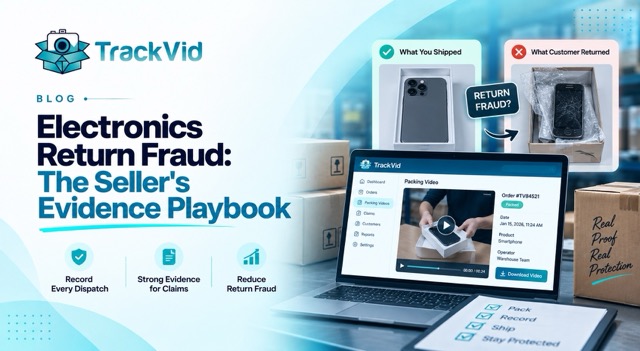
Get the Marketplace Claim Recovery Checklist
A 12-point checklist used by 1,100+ sellers to recover 85-90% of marketplace claim losses. Free, instant access.
- Marketplace-specific evidence formats (AJIO, Flipkart, Amazon, Myntra)
- Claim window deadlines for every major platform
- The 6-step process that pushes approval from 85-90%
- Common rejection reasons and how to avoid them
No spam. Unsubscribe anytime. Used by sellers at Rare Rabbit, HRX, Da Milano + 1,100 more.
Stop Losing Money to Fake Returns
Join 1,100+ sellers who recover lakhs every month with TrackVid