
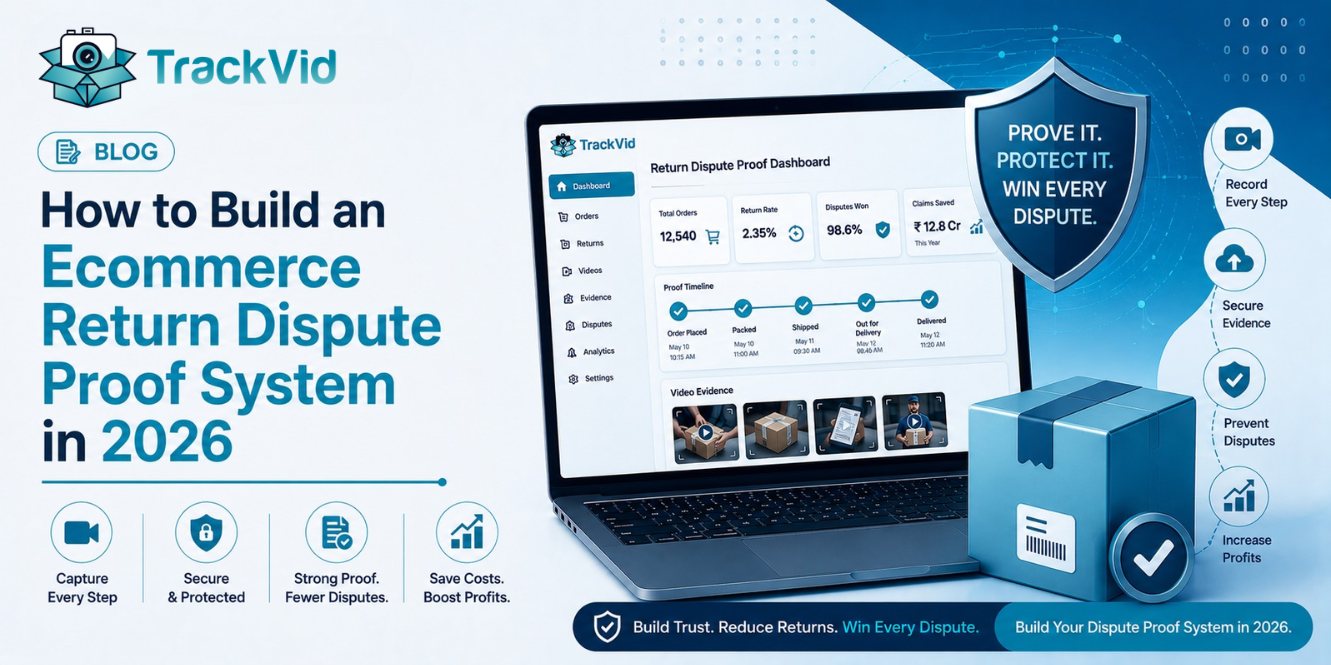
For ecommerce sellers on Amazon, Shopify, eBay, Etsy and global marketplaces. Updated May 2026.
Most ecommerce sellers lose return disputes they should win. Not because their products were wrong. Not because they made fulfillment errors. Because at the moment the dispute is evaluated, they have no independently verifiable evidence of what was packed and shipped for the specific order being contested.
An ecommerce return dispute proof system is the infrastructure that creates that evidence before disputes exist, at the moment of packing, for every order, automatically. When a dispute arrives, the evidence is retrieved, not created. And retrieved evidence wins. Created-after-the-fact evidence loses.
Building this system is not complex. But it requires understanding what evidence actually wins, why standard record-keeping fails, and which operational components need to be in place. This guide covers all three.
Why Standard Record-Keeping Fails in Return Disputes
Every ecommerce seller has records. Order management systems, inventory logs, shipping confirmations, carrier tracking. When a return dispute arrives, sellers pull these records and submit them as evidence.
These records consistently lose disputes for one reason: they confirm that an order was processed, not what was specifically inside any given shipment.
An order management record confirms that Order ID 114-XXXXX was created, assigned a product, and marked as fulfilled. It does not confirm that the specific product assigned to that order was physically verified, packed in correct condition, and sealed in the outgoing box.
A shipping confirmation confirms that a parcel with a certain weight was collected by a carrier. It does not describe the contents.
Carrier delivery tracking confirms the parcel arrived at the destination address. It does not describe the contents.
These records answer "was the order processed and delivered?" The dispute question is "what was inside the parcel?" Standard record-keeping cannot answer the dispute question. An ecommerce return dispute proof system can.
The Two-Stage Evidence Chain Every System Must Cover
A complete ecommerce return dispute proof system creates evidence at two moments, not one.
Stage 1: Dispatch proof. Evidence of what was packed and shipped in the original order. This is created at the packing station, for every order, at the time of packing. It must be linked to the Order ID, timestamped, and independently verifiable.
Stage 2: Return receipt proof. Evidence of what physically arrived in the return parcel. This is created when the return is received at the warehouse, before it is opened or processed.
Together, these two evidence stages answer both questions in any return dispute: what left your warehouse and what came back. The gap between Stage 1 and Stage 2 is the fraud.
Most sellers have neither stage in a structured, retrievable format. Their Stage 1 evidence is CCTV footage that is not order-linked. Their Stage 2 evidence is an email complaint describing an empty box. Neither holds up under dispute review.
Stage 1: Building Dispatch Proof That Wins
The dispatch proof that wins ecommerce return disputes has four characteristics. All four are required. A system that provides three of the four still loses disputes.
1. Order-specific. The evidence must be linked to the exact Order ID being disputed. Not a timestamp from which an order can be inferred. The Order ID, directly linked to the recording at the moment it was made.
2. Timestamped at packing. The evidence must be created at the moment of packing, not reconstructed afterward. A photo of a product taken later and submitted as packing evidence is disputable. A video recorded at the moment of packing, with the Order ID linked at recording, is not.
3. Product visible and identifiable. The recording must show the specific product being packed, the SKU, the condition, the contents, not just a box being sealed. If the product is not visible in the recording, the evidence does not confirm what was inside.
4. Retrievable within the claim window. Amazon SAFE-T gives sellers seven days from return delivery. Shopify dispute mechanisms run on tighter windows. eBay and Etsy have their own timelines. The dispatch proof must be retrievable by Order ID in under two minutes, not via a manual search through footage archives.
The system that meets all four requirements is automated order-linked packing video software. TrackVid records every packing automatically when the shipping label is scanned, links each video to the Order ID, SKU, and AWB in real time, and stores everything in indexed cloud storage retrievable by Order ID in under two minutes.
Related: Best packing video software for ecommerce →
Stage 2: Building Return Receipt Proof That Wins
Return receipt proof is the second stage of the evidence chain and is frequently neglected even by sellers who have Stage 1 in place.
The return receipt proof workflow
Weigh before opening. Every return parcel that arrives should be weighed sealed and the weight recorded alongside the return label and AWB. Compare to the original product weight reference. A significant discrepancy is physical evidence of fraud before the parcel is opened.
Open on camera continuously. Set up a camera at the return receiving station. Record from the moment the sealed parcel is picked up through the complete opening sequence. The recording should show the sealed parcel, the label, and the entire opening process in one unbroken take. If the parcel is empty or contains a substitute, that is captured on camera with the return label visible.
Photograph with Order ID visible. After opening, photograph the contents alongside a printout or screen display of the Order ID. Document the return condition, the wrong item if applicable, and any packaging condition evidence.
The return receipt video and the dispatch packing video together form the complete evidence chain. Any fraud dispute, wrong item, empty box, false damage claim, is answered by this two-stage system.
How the Dispute System Connects the Evidence
Having both stages of evidence is necessary. Having a system that connects them and submits them efficiently is what makes the difference between a 65 percent win rate and a 85-90 percent win rate.
When a dispute notification arrives, the process should be:
- Dispute detected automatically by the system.
- Order ID extracted from the dispute notification.
- Dispatch packing video retrieved from cloud storage by Order ID in under two minutes.
- Return receipt video and photos retrieved from the return evidence archive.
- Evidence package automatically compiled for the specific platform's dispute portal format.
- Package submitted within the claim window without manual intervention.
This is not an aspirational workflow. It is the workflow that TrackVid's ecommerce return dispute proof system enables for sellers on Amazon, Shopify, eBay, Etsy, and other global marketplaces.
Without this automation, even sellers who have created both stages of evidence lose disputes because the retrieval and submission process exceeds claim windows during high-volume periods. The evidence exists but is never submitted in time.
Related: What is first-party fraud in ecommerce →
The Components of a Complete Ecommerce Return Dispute Proof System
Building a complete system requires five components, each of which addresses a specific failure point in the standard seller approach.
Component 1: Automatic packing video recording. Every order packed triggers a recording linked to the Order ID. No manual step. No missed recordings.
Component 2: Indexed cloud storage. All recordings stored with Order ID as the primary index. Retrievable by order data, not by date or camera.
Component 3: Return receipt documentation process. Standardised workflow at the returns receiving station: weigh sealed, record opening, photograph contents with Order ID.
Component 4: Dispute detection and alerting. System monitors for dispute notifications and claim emails across all platforms and surfaces them before windows close.
Component 5: Automated evidence submission. Evidence compiled and submitted in platform-specific format within the claim window without manual intervention.
TrackVid provides Components 1, 2, 4, and 5 as an integrated system. Component 3 requires a warehouse process change that most operations can implement in one day.
Book a free TrackVid Demo Today
In one session, you will see the complete system mapped to your specific operation, your current dispute volume, and where your existing evidence process is losing winnable claims.
Frequently Asked Questions
How to build a return dispute proof system for ecommerce?
The system requires two evidence stages and three automation components. Stage 1 is dispatch proof: automatic packing video recording linked to the Order ID at the time of packing, stored in indexed cloud. Stage 2 is return receipt proof: a standardised workflow for weighing, recording the opening, and photographing return contents with the Order ID visible. The automation components are dispute detection, evidence retrieval, and platform-formatted submission within the claim window. TrackVid at trackvid.in provides the dispatch proof, cloud storage, dispute detection, and automated submission as an integrated system.
What evidence wins ecommerce return disputes in 2026?
The strongest evidence package combines dispatch packing video and return receipt video with supporting weight documentation and photos. The dispatch video must show the specific product going into the box for the specific Order ID, timestamped at packing. The return receipt video must show the return parcel arriving sealed and being opened on camera, revealing the contents. Together, they create a before-and-after evidence chain that is independently verifiable by any marketplace dispute reviewer. Written accounts and photos without video are consistently insufficient as standalone evidence.
How to prove return fraud happened in ecommerce?
Return fraud is proven by demonstrating the gap between what was packed and what was returned. Dispatch video shows the correct product going into the box. Return receipt video shows what came back. Weight comparison shows the mass discrepancy. Together, these three elements prove fraud independently of the seller's written account. Without order-linked dispatch video, proving return fraud relies on the seller's account against the customer's account, and marketplace dispute mechanisms consistently side with the customer in that scenario.
Does video proof work for ecommerce return dispute resolution?
Yes. Order-linked, timestamped packing video is the primary evidence type accepted by Amazon SAFE-T, Shopify Payments dispute resolution, eBay Money Back Guarantee, and Etsy dispute centres. Banks and marketplace reviewers evaluate it as independently verifiable proof that does not rely on either party's written account. Sellers using TrackVid's video-based ecommerce return dispute proof system report 90 percent and above win rates on disputes where packing video is submitted, compared to under 25 percent for sellers relying on written accounts and photos.
How long do I have to submit evidence in ecommerce return disputes?
Claim windows vary by platform. Amazon SAFE-T: seven days from return delivery confirmation. Shopify Payments chargeback: typically 7 to 21 days depending on card network. eBay Money Back Guarantee: 21 to 30 days depending on dispute type. Etsy dispute: typically 30 days. Platform-specific marketplace mechanisms like Flipkart SPF operate on shorter windows of 48 to 72 hours. The time constraint is why automated retrieval matters, manual evidence searching at scale consistently misses windows.
What is the best software for an ecommerce return dispute proof system?
TrackVid is the leading purpose-built software for ecommerce return dispute proof systems globally. It provides automatic dispatch video recording linked to Order IDs, indexed cloud storage, dispute notification detection, and automated evidence submission for Amazon, Shopify, eBay, Etsy, and other global marketplaces. Setup takes under 15 minutes with existing cameras. Sellers using TrackVid report claim win rates above 90 percent on disputed returns where packing video is submitted.
Sources: Amazon SAFE-T seller guidelines, Shopify Payments dispute documentation, eBay Money Back Guarantee seller guidelines, Etsy dispute resolution policies, National Retail Federation Returns Research 2026, Chargebacks911 2026 Chargeback Field Report, TrackVid seller data.
TrackVid provides a complete ecommerce return dispute proof system for sellers on Amazon, Shopify, eBay, Etsy and global marketplaces. Automated dispatch proof, dispute detection, and claim submission from a single system. Learn more at trackvid.in.


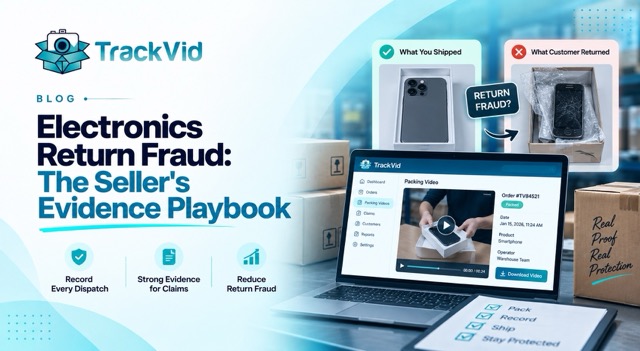
Get the Marketplace Claim Recovery Checklist
A 12-point checklist used by 1,100+ sellers to recover 85-90% of marketplace claim losses. Free, instant access.
- Marketplace-specific evidence formats (AJIO, Flipkart, Amazon, Myntra)
- Claim window deadlines for every major platform
- The 6-step process that pushes approval from 85-90%
- Common rejection reasons and how to avoid them
No spam. Unsubscribe anytime. Used by sellers at Rare Rabbit, HRX, Da Milano + 1,100 more.
Stop Losing Money to Fake Returns
Join 1,100+ sellers who recover lakhs every month with TrackVid