
For sellers on Amazon, Flipkart, AJIO, Myntra and Meesho. Updated May 2026.
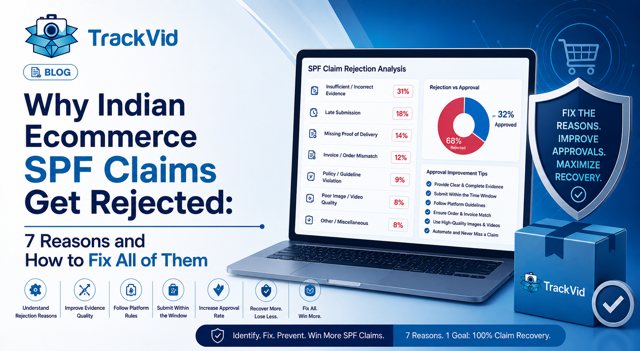
If your SPF claim was rejected on Flipkart, AJIO, Meesho, or Snapdeal, the reason is almost certainly one of seven specific process failures. According to TrackVid data, over 70 percent of rejected SPF claims across Indian marketplaces were eligible for recovery. The dispute was valid. The product was genuinely damaged, wrong, or missing. The rejection happened because of how the claim was filed, not whether it should have been won.
Most SPF claim rejections in India are not decisions. They are disqualifications.
The platforms do not review a poorly evidenced claim and decide against the seller. They reject it before review because a required condition was not met. Understanding the seven conditions that trigger rejection is the first step to ensuring none of them ever apply to your account again.
The 7 Reasons Indian SPF Claims Get Rejected
Each of the following reasons has a direct fix. Each fix points to the same infrastructure: order-linked video captured at dispatch, automated window tracking, and a claim process that does not depend on the right person being available at the right moment.
Reason 1: The Claim Window Was Already Closed When You Filed
This is the single most common SPF claim rejection reason across all Indian marketplaces. Every platform runs a strict claim deadline that starts from a specific trigger event. Once the window closes, the claim is permanently unavailable. No extension is possible. No appeal covers a missed filing window.
The windows are: Flipkart, 14 days from the date the damaged or wrong return is received; AJIO Commerce, 3 days from the date return cargo is received at the seller's location; AJIO CCTV-required email, 24 to 48 hours from the time the email arrives; Meesho, category-dependent but typically 7 days from return receipt; Snapdeal, category-dependent with a shorter TAT than Flipkart.
Most sellers do not miss these windows because they forget. They miss them because their manual process is slower than the window allows. A return that arrives on a Friday may not be processed by the claims team until Tuesday. On a 3 day AJIO window, that is already too late. On a 24-hour CCTV email window received on a Saturday night, it was too late before the working week began.
Fix: Automated window tracking that starts the countdown at the moment a return is received and files the claim, or flags it for approval, with enough time remaining to act. No manual monitoring. No dependency on team availability.
Related: Flipkart SPF claim automation and the 14-day window in detail →
Reason 2: Generic CCTV Footage Submitted Instead of Order ID-Linked Video
This rejection reason is responsible for the majority of AJIO claim losses and a significant share of Flipkart losses. Sellers with CCTV coverage of their packing floor believe they have evidence. They do. But what they have is time-based footage, not Order ID-linked proof.
Every Indian marketplace requires that submitted video evidence can be matched to the specific Order ID under dispute. A clip from 2pm on a Tuesday showing products being packed proves nothing about which specific order is in that footage. AJIO auto-rejects this category of evidence. Flipkart rejects it on evidence quality grounds. Meesho's dispute team has no way to evaluate it against the disputed order.
An Order ID-linked video is recorded at the moment of packing with the Order ID, SKU, and AWB number embedded in the file metadata and storage index. When the platform asks for evidence for Order ID XYZ, the seller retrieves the exact clip for that order in under two minutes. The footage is specific, verifiable, and unambiguous.
Fix: A VMS system that records every packing linked to its Order ID at the moment of recording, not retrieved after the dispute by searching time-based CCTV archives.
Related: AJIO SPF claim automation and why the CCTV-required email matters →
Reason 3: VMS Non-Compliance Blocking SPF Eligibility Before the Claim Is Read
This rejection reason affects Flipkart sellers specifically and is the most consequential because it happens before any claim content is evaluated. Flipkart requires VMS compliance as a condition of SPF eligibility. A seller without a compliant Video Management System is not eligible for the Seller Protection Fund, regardless of the strength of their evidence or the legitimacy of their dispute.
Sellers who are on standard CCTV and filing SPF claims may be systematically disqualified at the eligibility gate before a single reviewer opens the ticket. This explains the pattern where sellers file claims consistently, receive rejections, and cannot identify what is wrong with their evidence because the problem is not the evidence. It is the system that produced it.
VMS compliance on Flipkart means recording packing video in a format the platform accepts, linked to Order IDs, stored in a retrievable system. A compliant VMS clears this gate permanently for every subsequent claim.
Fix: Implement a compliant VMS from the first packing session. TrackVid specifically meets Flipkart's VMS compliance standard and resolves the eligibility disqualification immediately.
Reason 4: Incomplete or Non-Compliant Photographs
Each platform has specific photography requirements for SPF claim evidence. Missing any required element results in rejection on evidence grounds, not on the merits of the dispute.
Flipkart requires clear photographs from multiple angles showing the brand name and logo clearly. The shipping label must be visible. For mobile devices, the IMEI number must be displayed on screen. For combo packs, images of all missing components are required. Submitting a single photo, a cropped image that removes the label, or a screenshot of the product listing instead of the physical product are common rejection causes.
AJIO's photography requirements feed into their CCTV-required email evidence standard. Meesho requires both photos and video for WFR claims. Snapdeal requires clear product condition documentation matched to the dispatch record.
Fix: An automated evidence preparation system that checks the required elements per platform before submission and flags missing items before the claim is filed. Every evidence package should be reviewed against the platform's checklist before it leaves the seller's system.
Reason 5: No Order ID Linkage on the Submitted Video
This rejection reason overlaps with Reason 2 but applies specifically to sellers who have video but submitted it without an Order ID reference. Some sellers record packing videos manually on phones, with a note of the Order ID said aloud or written on paper in frame. This is not the same as Order ID-linked video in the technical sense.
Platforms need the Order ID connection to be verifiable, not just visible. A video showing someone saying "this is for order 12345678" is not a compliant Order ID-linked video because it cannot be independently verified. The link must exist in the file's metadata or storage index, created by the recording system at the moment of packing.
Without a verified Order ID link, the platform's evidence review system cannot confirm the submitted video corresponds to the disputed order. The claim is rejected as unverifiable.
Fix: A recording system that creates the Order ID link automatically at packing, embedded in the file and searchable by Order ID, not created manually by warehouse staff.
Reason 6: The Unhappy Claim or Appeal Window Was Missed After Rejection
On Flipkart, when an SPF claim outcome is rejected and the seller believes the decision was wrong, they have 7 days from the rejection date to raise an unhappy claim. Missing this window closes the appeal permanently. The rejection stands and no further recourse is available on that dispute.
Most sellers who miss the 7-day appeal window do so not because they disagree with the rejection but because they discover it too late. Platform notifications go to email inboxes that are processed in batches. A rejection received on a Wednesday may only be reviewed the following Monday. With 7 days from the rejection date, that leaves 2 days to prepare and submit an appeal. Under a manual process with other claims in the queue, that timeline often slips.
Fix: Automated rejection monitoring that detects a claim outcome, flags it immediately regardless of when it arrives, and shows the remaining appeal window time. The seller sees the rejection and the deadline before the window closes, not after.
Reason 7: No Tamper-Proof Dispatch Record for WFR or Returnless Refund Claims
This rejection reason applies specifically to Meesho WFR disputes and returnless refund situations across platforms. When a customer returns a different product than what was dispatched, or when a platform processes a refund without requiring a physical return, the seller's only recourse is a dispatch record that proves specifically what left the warehouse against that Order ID.
Without a tamper-proof, Order ID-linked packing video, this dispute is almost impossible to win. The seller's assertion that they dispatched the correct product is exactly that: an assertion. The platform has no independent verification. In the absence of evidence, the default resolution typically favours the buyer.
A complete dispatch record means every order has a retrievable packing video that shows the product, condition, label, and SKU before sealing. This record is the proof. When a WFR dispute arrives, the seller retrieves the exact video for the disputed Order ID and submits it. The platform can verify what was dispatched. The dispute resolves differently.
Fix: Order ID-linked packing video for every order on every platform, stored in indexed cloud and retrievable in under two minutes. No gaps in the dispatch record. No orders without corresponding video evidence.
Related: Meesho WFR and Snapdeal claim automation: how tamper-proof video changes outcomes →
Bangalore Seller Vikram: Rs 1.4 Lakh Lost Across Five Rejection Reasons at Once
Vikram runs a D2C electronics accessories brand from Bangalore, selling across Flipkart, AJIO, Meesho, and Snapdeal at approximately 500 orders a day combined. He had been managing claims manually across all four platforms for just over a year before he audited his rejection history in detail.
What he found was not one problem. It was five of the seven rejection reasons active simultaneously across different platforms.
On Flipkart, his claim success rate was 22 percent. An audit revealed two concurrent issues: his team was regularly filing claims on returns that arrived late in the week, pushing several past the 14-day window during high-volume periods, and his CCTV footage was being submitted without Order ID linkage, triggering evidence-quality rejections.
On AJIO, his success rate was 9 percent. The CCTV-required email was the core problem. His team was treating it like standard correspondence, reviewing in batches. Roughly 40 percent of CCTV emails had received responses after the 24-to-48-hour window closed. The rest were rejected on evidence grounds because he was submitting time-based footage.
On Meesho, WFR claims were being lost because no tamper-proof dispatch record existed. On Snapdeal, several eligible claims were never filed because the evidence was not ready within the faster TAT.
His combined monthly loss across all four platforms was Rs 1.4 lakh. When his team audited the rejections, they found that the underlying disputes were valid in the vast majority of cases. The losses were process failures, not platform decisions.
I thought four platforms meant four separate claim problems. It was actually one problem. I had no order-level proof on any of them.
After deploying a single automated claim system across all four platforms, packing video was Order ID-linked from day one. Windows were tracked automatically. AJIO's CCTV email was handled without any manual step. WFR disputes on Meesho had specific evidence for the first time.
In his first month after automation, Rs 1.2 lakh of the Rs 1.4 lakh loss was recovered. The remaining Rs 20,000 represented disputes where the platform ruled against him on product condition grounds after reviewing compliant evidence, which is a fair process outcome rather than a preventable loss.
How a Single Automated System Fixes All Seven Rejection Reasons
The pattern across all seven rejection reasons is the same: each one fails because the evidence either did not exist at the order level, was not in the right format, or arrived after the window closed.
A complete SPF claim automation system addresses all seven simultaneously:
Order ID-linked packing video at the moment of dispatch fixes Reasons 2, 5, and 7. Automated window tracking fixes Reasons 1 and 6. VMS compliance from setup fixes Reason 3. Evidence package checklist per platform fixes Reason 4.
There is no scenario where a seller operating a properly configured automated claim system hits any of these rejection reasons on an ongoing basis. The system removes each failure point structurally rather than requiring the seller to remember seven different rules across four different platforms.
TrackVid is the SPF claim automation platform used by 1,100+ Indian ecommerce sellers across Flipkart, AJIO, Meesho, and Snapdeal. It is officially authorised by Snapdeal and specifically covers the AJIO CCTV-required email automation that no other system addresses. Setup takes under 15 minutes using existing warehouse cameras.
Book a free TrackVid Demo Today
In one session, you will see which of these seven rejection reasons are currently active in your account and what your recoverable monthly amount looks like across each platform.
Five Questions to Find Which Rejection Reasons Are Hitting Your Account Right Now
- Do you know your claim success rate per platform, as a separate number for each marketplace? Flipkart, AJIO, Meesho, and Snapdeal have different rejection patterns. A blended average hides which platform is costing you the most. Separate the numbers and the dominant rejection reason usually becomes visible immediately.
- When a claim is rejected, do you get an alert in time to file an unhappy claim within 7 days? On Flipkart, the 7-day appeal window is the second chance. If you are finding out about rejections after the appeal window has closed, Reason 6 is active in your account right now.
- Can you pull up the packing video for any order from six months ago by searching the Order ID? If you need to go to a DVR or call the warehouse team, Reasons 2 and 5 are structurally present. Any future AJIO CCTV-required email on a historical order will be undefendable.
- Is your Flipkart account VMS-compliant under Flipkart's current eligibility standard? If you are not certain, assume Reason 3 is active. Every Flipkart SPF claim you have filed while non-compliant was disqualified before review.
- Do you have a tamper-proof dispatch record, as video, for every Meesho order from the last 90 days? If not, every WFR dispute in that window is effectively unwinnable. Reason 7 is present for every order without corresponding Order ID-linked video evidence.
Frequently Asked Questions
SPF claim reject kyu hota hai?
SPF claim reject hone ke 7 main karan hain: claim window miss ho jaana (Flipkart 14 din, AJIO 3 din ya 24-48 ghante ka CCTV email), generic CCTV footage submit karna jo Order ID se linked nahi, Flipkart pe VMS non-compliance ki wajah se eligibility hi block ho jaana, incomplete ya wrong format photos, video mein Order ID link ka na hona, unhappy claim ka 7-day appeal window miss ho jaana, aur WFR ya returnless refund ke liye tamper-proof dispatch record ka na hona. In mein se 70 percent se zyada rejections preventable hain ek automated system se.
Marketplace claim reject hone ke karan kya hain?
India ke major marketplaces pe claim rejection ke mostly ek hi tarah ke karan hote hain: platform ka time window miss ho jaana, evidence wrong format mein hona ya Order ID se linked na hona, aur Flipkart pe VMS compliance na hona. AJIO pe auto-rejection hoti hai bina human review ke agar CCTV-required email ka response window miss ho gaya. Meesho pe WFR disputes ke liye dispatch ka proof nahi hona rejection ka karan banta hai. In teeno problems ko ek automated claim system ek saath solve karta hai.
Claim reject hone ke baad kya kare?
Claim reject hone ke baad turant check karo ki rejection reason kya hai. Flipkart pe rejection ke 7 din ke andar unhappy claim raise kar sakte ho Seller Support se. AJIO pe limited appeal options hain. Evidence quality ki wajah se rejection hua hai toh correct format mein re-file karne ki koshish karo agar window abhi open hai. Future ke liye ek automated system set karo jo Order ID-linked video banaye aur windows automatically track kare taaki yahi galti baar baar na ho.
SPF claim ke liye sahi evidence kya hai?
Har platform pe sahi evidence thoda alag hota hai lekin core requirement same hai: Order ID-linked packing video jisme product clearly visible ho, shipping label dikhe, aur SKU confirm ho. Flipkart pe iske saath multi-angle photos, brand logo clearly visible, aur mobile ke liye IMEI bhi chahiye. AJIO pe strictly Order ID-linked video chahiye, generic CCTV nahi chalti. Meesho pe WFR ke liye video plus photos chahiye. Snapdeal pe dispatch documentation ke saath video chahiye. Automated system yeh sab apne aap format karta hai.
Flipkart AJIO SPF claim kyun reject hota hai?
Flipkart pe claim reject hone ke main karan hain VMS non-compliance (SPF eligibility block), 14-day window miss, aur incomplete evidence format. AJIO pe most rejections auto-rejection hain bina human review ke, mainly 24 se 48 ghante ka window miss hone ki wajah se, ya generic CCTV footage submit karne ki wajah se jo Order ID se linked nahi hoti. Dono platforms pe ek automated system jo Order ID-linked video banaye aur windows track kare, rejection rate dramatically kam kar deta hai.
How to prevent SPF claim rejection India?
Preventing SPF claim rejections across Indian marketplaces requires four things working simultaneously: Order ID-linked packing video for every order so the evidence exists at the order level; automated window tracking so no deadline is missed on any platform; VMS compliance on Flipkart so the eligibility gate is permanently cleared; and automated detection of AJIO CCTV-required emails so the 24 to 48 hour response window is never missed. All four are available through a single system. TrackVid covers all four across Flipkart, AJIO, Meesho, and Snapdeal from one dashboard.
SPF claim mein kya galti hoti hai?
SPF claims mein sabse common galtiyan yeh hain: window ke baad file karna, CCTV footage submit karna jo Order ID se linked nahi (especially AJIO pe yeh auto-reject karta hai), Flipkart pe VMS compliance ignore karna jisse SPF eligibility hi block ho jaati hai, aur rejection notice late dekhna jisse 7-day appeal window bhi miss ho jaati hai. Yeh sab galtiyan ek automated claim system se completely prevent ho sakti hain kyunki system har step apne aap handle karta hai.
Ecommerce claim automation India mein konsa best hai?
India mein multi-platform SPF claim automation ke liye TrackVid sabse complete solution hai. Yeh Flipkart, AJIO, Meesho, aur Snapdeal sab cover karta hai ek dashboard se. Flipkart pe VMS compliance ensure karta hai. AJIO pe CCTV-required email automatically detect karke correct video submit karta hai. Meesho pe WFR evidence automatically capture karta hai. Snapdeal pe officially authorised hai. 1,100+ Indian sellers TrackVid use karte hain. Free demo ke liye trackvid.in/book-demo.html pe jaao.
Sources: Flipkart Seller Protection Fund Policy 2026, AJIO Commerce Seller Support documentation, Meesho Seller Panel guidelines, Snapdeal Seller Portal documentation, TrackVid internal seller data, IBEF ecommerce India data, Signifyd State of Commerce 2026, Claimlane 2026
TrackVid is a video proof and claim management platform used by 1,100+ Indian ecommerce sellers on Amazon, Flipkart, AJIO, Myntra and Meesho. Officially authorised by Snapdeal. Learn more at trackvid.in.
See also: automated filing that avoids these rejection reasons



Get the Marketplace Claim Recovery Checklist
A 12-point checklist used by 1,100+ sellers to recover 85-90% of marketplace claim losses. Free, instant access.
- Marketplace-specific evidence formats (AJIO, Flipkart, Amazon, Myntra)
- Claim window deadlines for every major platform
- The 6-step process that pushes approval from 85-90%
- Common rejection reasons and how to avoid them
No spam. Unsubscribe anytime. Used by sellers at Rare Rabbit, HRX, Da Milano + 1,100 more.
Stop Losing Money to Fake Returns
Join 1,100+ sellers who recover lakhs every month with TrackVid