
For ecommerce sellers on Shopify, Amazon, eBay, Etsy and global marketplaces. Updated May 2026.
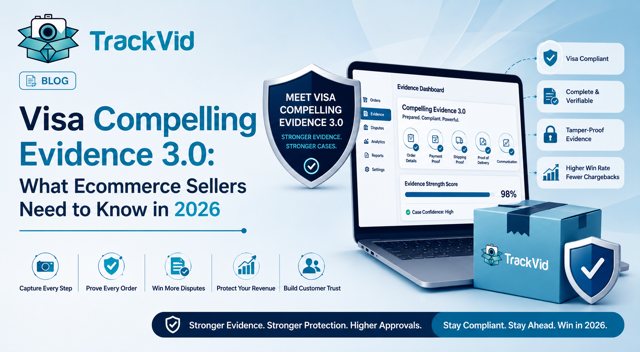
On April 1, 2026, Visa updated its Compelling Evidence 3.0 framework within the Order Insight tool, giving merchants a new and more powerful mechanism for contesting first-party fraud chargebacks. The update allows merchants to share packing-level evidence and prior transaction history directly with issuing banks during dispute review, before the chargeback is decided, not after.
This is the most significant change to chargeback dispute evidence standards since Compelling Evidence was first introduced. And almost no seller-focused content currently explains what it means for your operation, what evidence qualifies, or how to build the system that makes CE3.0 work in practice.
This guide covers exactly that.
What Is Compelling Evidence 3.0?
Compelling Evidence 3.0 (CE3.0) is Visa's evidentiary framework that allows merchants to counter first-party fraud chargebacks by demonstrating that the disputing customer has made prior purchases from the same merchant without disputing them.
The underlying logic is direct: if a customer has purchased from you three times before without dispute, and is now claiming a legitimate transaction was unauthorised fraud, their transaction history is itself evidence against the fraud claim.
CE3.0 specifically applies to Visa reason code 10.4 (card-not-present fraud) chargebacks. It requires merchants to provide at least two prior undisputed transactions from the same card and customer, matching on specific data points, within 120 days of the disputed transaction.
The April 2026 update expanded CE3.0's scope within the Order Insight tool. As of April 1, 2026, merchants can now use Compelling Evidence 3.0 within Order Insight to share evidence with banks regarding suspicious transactions, giving merchants the ability to inject fulfillment-level proof into the dispute process earlier and through a standardised channel that banks' review systems are already configured to evaluate.
Why CE3.0 Matters for Ecommerce Merchants in 2026
First-party fraud, customers disputing legitimate transactions, now accounts for 36 percent of all global ecommerce fraud, according to the Merchant Risk Council's 2026 report. It rose from 15 percent to 36 percent in a single year. CE3.0 is Visa's direct response to this surge.
Before CE3.0, merchants contesting reason code 10.4 chargebacks faced a fundamental problem: the customer is a real cardholder using their own card. Standard fraud signals, device mismatch, velocity, geolocation, all pass because the transaction is genuinely authorised. The fraud happens afterward, in the dispute.
CE3.0 changes the evidence equation by allowing the merchant to demonstrate a pattern of legitimate engagement. A customer who has ordered from you six times and is now claiming the seventh order was unauthorised has a demonstrably implausible claim, if you can produce the evidence of those six prior orders.
The additional significance of the April 2026 update is that it allows fulfillment evidence to be shared through Order Insight, meaning the packing video, product condition documentation, and delivery confirmation can all be submitted to the bank's review system in a standardised format before the chargeback is formally decided.
Related: What is first-party fraud in ecommerce →
What Evidence Qualifies Under CE3.0
CE3.0 has specific technical requirements. Meeting them precisely is what determines whether the submission is evaluated or dismissed.
Required matching data points
Minimum two of the following must match between prior undisputed transactions and the disputed transaction:
- Same device ID or fingerprint
- Same IP address
- Same account holder name
- Same shipping address
Transaction history requirements
At least two prior undisputed transactions from the same cardholder within 120 days of the disputed transaction. Each prior transaction must share at least two matching data points with the disputed transaction.
Additional fulfillment evidence accepted through Order Insight (April 2026 update)
- Proof of delivery to the billing or shipping address
- Product condition documentation at the time of fulfillment
- Order-linked packing video showing what was packed for the specific Order ID
- Communication records demonstrating customer engagement
The April 2026 update specifically enables fulfillment-level evidence submission through the standardised Order Insight channel. This is significant because banks' automated review systems are already integrated with Order Insight, evidence submitted through this channel is evaluated by the bank's review system immediately rather than being processed as a separate document submission.
How Order-Linked Packing Video Fits CE3.0
The April 2026 CE3.0 update opens a specific channel for fulfillment evidence that did not previously exist in a standardised form. Merchants can now submit, through Order Insight, the same evidence type that TrackVid creates automatically for every order.
Order-linked packing video provides:
Independent verification of product fulfillment. The video shows the specific product being packed for the specific Order ID, timestamped at packing. This independently verifies that the correct item was fulfilled, which directly counters "item not as described" components in complex first-party fraud chargebacks.
Timestamped proof predating the dispute. CE3.0 requires evidence created before the dispute, not after. A packing video recorded at fulfillment and linked to the Order ID at that moment is inherently pre-dispute evidence. It cannot be manufactured in response to the chargeback.
Order-level specificity. CE3.0 requires evidence matched to the specific transaction. A packing video linked to the Order ID, SKU, and AWB meets this specificity requirement in a way that general warehouse footage cannot.
TrackVid records this evidence automatically for every order. The video is created at the moment of packing, linked to the Order ID in real time, and stored in indexed cloud. When a CE3.0 submission is needed, the video is retrieved by Order ID in under two minutes and submitted through Order Insight alongside the transaction history evidence.
Related: Chargeback representment for ecommerce sellers →
CE3.0 vs Standard Chargeback Evidence: The Difference
Standard chargeback representment allows merchants to submit any evidence and write a rebuttal letter. The bank evaluates this evidence in whatever format it is submitted.
CE3.0 is a specific framework with defined requirements and a dedicated submission channel (Order Insight). The key differences:
Scope. CE3.0 applies specifically to Visa reason code 10.4 (card-not-present fraud). Standard representment applies to all reason codes. Use CE3.0 for 10.4 disputes; use standard representment for all others.
Evidence format. CE3.0 requires specific data point matching between prior and disputed transactions. Standard representment allows flexible evidence formats.
Submission channel. CE3.0 evidence goes through Order Insight. Standard representment evidence goes through the card network's dispute management system.
Outcome. CE3.0 submissions, when qualifying data points are matched, are significantly more likely to be accepted by issuing banks because the evidence standard is defined and auditable. The bank's system knows exactly what it is evaluating.
Practical CE3.0 Implementation for Ecommerce Sellers
Step 1: Verify your Visa integration includes Order Insight. CE3.0 submissions go through Order Insight. If your payment processor does not have Order Insight integration, speak to them about enabling it. Visa made this available broadly in 2026.
Step 2: Build your prior transaction data retrieval. For CE3.0 to work, you need to quickly identify prior transactions from the same cardholder that share matching data points. Your payment processor's transaction history should contain device ID, IP address, and shipping address data for prior orders. Build a retrieval process for this.
Step 3: Set up packing video documentation. The April 2026 CE3.0 update allows fulfillment evidence through Order Insight. For every order you want this protection on, you need order-linked packing video recorded at the time of packing. TrackVid at trackvid.in creates this automatically for every order.
Step 4: Respond to reason code 10.4 chargebacks with CE3.0 first. When a 10.4 chargeback arrives, immediately check whether CE3.0 applies, prior undisputed transactions, matching data points, within 120 days. If it does, submit through Order Insight. If CE3.0 does not apply, proceed with standard representment.
Step 5: Track CE3.0 outcomes separately from standard representment. CE3.0 submission data tells you how often prior transaction matching is available and how the bank responds. This data helps you identify which customer segments are generating first-party fraud chargebacks and whether CE3.0 coverage is sufficient.
What CE3.0 Cannot Do
CE3.0 is powerful for reason code 10.4 disputes with clear prior transaction history. It has meaningful limitations.
CE3.0 requires prior undisputed transactions. First-time buyers who dispute their first purchase cannot be countered with CE3.0 evidence, there is no transaction history. Standard representment with delivery and packing evidence is the only available defence.
CE3.0 only covers Visa reason code 10.4. Mastercard, Amex, and Discover have their own dispute frameworks. A CE3.0 submission is not applicable to non-Visa disputes or to Visa disputes filed under different reason codes.
CE3.0 addresses the "was this transaction authorised?" question. It does not directly address "was the correct item received?" For disputes that blend unauthorised transaction claims with product condition complaints, CE3.0 must be combined with fulfillment evidence, packing video and delivery documentation, to cover both dimensions of the dispute.
Book a free TrackVid Demo Today
In one session, you will see how TrackVid's packing video system creates the fulfillment evidence that strengthens CE3.0 submissions and covers disputes across all card networks and reason codes simultaneously.
Frequently Asked Questions
What is Compelling Evidence 3.0 for Visa chargebacks?
Compelling Evidence 3.0 is Visa's evidentiary framework for contesting reason code 10.4 (card-not-present fraud) chargebacks. It allows merchants to demonstrate that a customer disputing a transaction as unauthorised has made prior undisputed purchases from the same merchant, using the same payment credentials. CE3.0 requires at least two prior transactions within 120 days that match on two or more data points: device ID, IP address, account name, or shipping address. The April 2026 update expanded CE3.0's scope to allow fulfillment-level evidence submission through Visa's Order Insight tool.
How does CE3.0 help merchants win chargebacks?
CE3.0 allows merchants to counter first-party fraud chargebacks, where a real customer disputes a legitimate transaction, with evidence of prior legitimate transactions from the same customer. If a customer claiming a transaction was unauthorised fraud has purchased from you five times before without dispute, CE3.0 lets you present that transaction history as direct counter-evidence. The April 2026 update also allows merchants to submit packing and fulfillment evidence through Order Insight, giving banks verifiable proof that the correct product was fulfilled for the specific order being disputed.
What counts as compelling evidence in an ecommerce chargeback?
Under CE3.0 specifically, compelling evidence includes prior undisputed transactions with matching device ID, IP address, account name, or shipping address. Beyond CE3.0, compelling evidence in ecommerce chargebacks includes order-linked packing video showing the product packed for the specific Order ID, delivery confirmation with proof of receipt, communication records demonstrating customer engagement with the order, and transaction metadata. Order-linked packing video is the highest-verification evidence type because it is independently verifiable by the bank's automated review system without relying on either party's account.
Does packing video qualify as compelling evidence for Visa disputes?
Yes. The April 2026 CE3.0 update within Visa's Order Insight tool specifically allows merchants to submit packing and fulfillment documentation as part of their dispute evidence. Order-linked packing video that shows the specific product being packed for the specific Order ID, timestamped at the time of packing, qualifies as fulfillment-level evidence under the updated framework. TrackVid at trackvid.in automatically creates this evidence for every order and retrieves it in under two minutes when a dispute requires CE3.0 submission.
How is CE3.0 different from regular chargeback representment?
CE3.0 is a specific framework applying only to Visa reason code 10.4 disputes, requiring specific prior transaction data points to be matched. Standard representment applies to all reason codes and allows flexible evidence. CE3.0 evidence is submitted through Visa's Order Insight channel, giving it a standardised format that bank review systems evaluate directly. Standard representment evidence is submitted through the card network's dispute management system in whatever format the merchant uses. Both are merchant rights in chargeback disputes. CE3.0 is the more powerful tool when it applies.
Sources: Digital Commerce 360 Visa AI Dispute Tools April 1 2026, Visa Compelling Evidence 3.0 documentation, Visa Order Insight program guidelines, Merchant Risk Council 2026 Global eCommerce Payments and Fraud Report, Chargebacks911 CE3.0 guide, Chargeflow 2026 Chargeback Statistics, TrackVid seller data.
TrackVid creates the order-linked packing video evidence that qualifies for Compelling Evidence 3.0 submissions through Visa Order Insight. Automatically. For every order. Learn more at trackvid.in.


Get the Marketplace Claim Recovery Checklist
A 12-point checklist used by 1,100+ sellers to recover 85-90% of marketplace claim losses. Free, instant access.
- Marketplace-specific evidence formats (AJIO, Flipkart, Amazon, Myntra)
- Claim window deadlines for every major platform
- The 6-step process that pushes approval from 85-90%
- Common rejection reasons and how to avoid them
No spam. Unsubscribe anytime. Used by sellers at Rare Rabbit, HRX, Da Milano + 1,100 more.
Stop Losing Money to Fake Returns
Join 1,100+ sellers who recover lakhs every month with TrackVid