
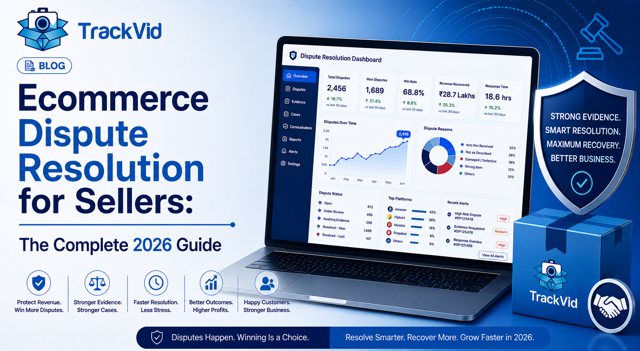
For third-party sellers on Amazon, Shopify, eBay, Etsy, PayPal and all global ecommerce channels. Updated May 2026.
On April 1, 2026, Visa announced six new AI-powered dispute resolution tools designed to fundamentally change how ecommerce disputes are evaluated, processed, and decided. The same week, global chargeback volume surpassed the 337 million transaction mark, a 41 percent increase from 2023. Two weeks earlier, the EU's revised dispute resolution directive had taken effect, changing the landscape for any seller with European customers.
Ecommerce dispute resolution in 2026 is not what it was two years ago. The platforms are different. The tools are different. The evidence standards are higher. And the sellers who understand this shift are winning disputes at rates that make the market average look like the floor, not the ceiling.
Merchants who prepare properly achieve dispute win rates of 30 percent or higher, compared to the 20 to 30 percent overall average, according to Justt.ai 2026 research. With structured, independently verifiable evidence matched to the specific dispute channel, win rates climb further, to 65 to 90 percent. The difference is not luck or Amazon favouritism. It is understanding how ecommerce dispute resolution works across every channel you sell on, and building the evidence infrastructure before disputes arrive.
This guide covers the complete picture: what ecommerce dispute resolution is, the four main channels every seller needs to understand, the new 2026 changes that affect every global seller, the evidence hierarchy that wins across all channels, and what the one proof layer is that makes the difference.
What Ecommerce Dispute Resolution Actually Is
Ecommerce dispute resolution is the formal process by which a seller contests a buyer's claim that something went wrong with a transaction. The claim may arrive through a marketplace mechanism, a payment processor, or directly through a card network. Each pathway has different rules, different timelines, and different evidence requirements.
Understanding which channel a dispute is coming through is the first step to resolving it correctly. A dispute through Amazon's A-to-Z Guarantee is not the same process as a Shopify Payments chargeback, which is not the same as a PayPal dispute, which is not the same as a direct Visa or Mastercard chargeback. Treating all four identically is the most consistent reason sellers lose winnable cases.
The underlying principle is consistent across all channels: when a buyer makes a claim, the seller has the right to contest it with evidence. The burden is on the seller to demonstrate that the transaction was fulfilled correctly. That demonstration requires evidence. The quality and type of evidence determines the outcome.
The Four Channels of Ecommerce Dispute Resolution
Every ecommerce seller needs to understand the mechanics of each channel they are exposed to. Selling on multiple platforms means multiple dispute mechanisms running simultaneously with different deadlines and different rules.
Channel 1: Marketplace Dispute Mechanisms
Marketplaces operate their own dispute resolution systems independent of card networks. These are the first line of dispute resolution for most ecommerce sellers.
Amazon A-to-Z Guarantee. Amazon's dispute mechanism for third-party seller transactions. Covers item not received, item materially different, and return not refunded. Response window: 48 to 72 hours. Appeals window: 30 calendar days. Outcomes affect your Order Defect Rate. Sellers who ship via Amazon Buy Shipping receive automatic protection on item not received claims. Evidence standard: carrier delivery confirmation for non-delivery claims; order-linked product condition evidence including packing video for materially different claims.
eBay Money Back Guarantee. eBay's buyer protection programme with parallel seller protection when evidence requirements are met. Response window: 3 calendar days to accept or decline a return request; 5 calendar days to respond to a payment chargeback. Evidence standard: delivery tracking for non-delivery claims; product listing match and condition evidence for not-as-described claims.
Etsy Purchase Protection. Etsy handles disputes between the platform and the buyer directly for eligible orders. Sellers on Etsy who meet order processing and dispatch requirements are typically held harmless. The risk for Etsy sellers is primarily in chargebacks filed through card networks rather than Etsy's own mechanism.
PayPal Resolution Centre. PayPal's dispute portal handles claims on PayPal-processed transactions. Two-stage process: dispute (buyer-seller negotiation) then claim (PayPal decides). Evidence standard: proof of delivery with signature for digital goods and high-value physical goods; tracking confirmation for standard physical goods.
Channel 2: Payment Processor Chargebacks
When a buyer's claim goes to their card issuer rather than the marketplace, it enters the card network's formal dispute process. This is what most sellers refer to when they say "chargeback."
Shopify Payments, WooCommerce Payments, and other payment processors receive the chargeback from the card network and notify the seller through the processor's dispute portal. The seller submits evidence through the processor portal within the response window, typically 7 to 21 days depending on the card network.
Chargebacks follow reason codes that define what happened and what evidence is required. Reason codes vary by card network but cover the same categories: fraud, item not received, item not as described, and processing errors. The evidence required maps to the reason code, not to the platform.
Channel 3: Direct Card Network Dispute Resolution
Visa, Mastercard, American Express, and Discover operate dispute resolution frameworks that govern all transactions on their networks regardless of the selling platform. Marketplace protections do not override card network rules, a buyer who does not get satisfaction through Amazon's A-to-Z process can still file a chargeback through their card issuer.
This dual-channel risk is significant. A dispute resolved in the seller's favour on Amazon does not prevent a separate chargeback through the buyer's card network. Sellers need evidence that works for both channels simultaneously.
Channel 4: Online Dispute Resolution Platforms (ODR)
For cross-border transactions, particularly in Europe and for certain product categories, Online Dispute Resolution platforms provide a structured alternative to card chargebacks and marketplace mechanisms. The EU's new ADR directive, which took effect on January 19, 2026, has significantly changed the European ODR landscape, moving away from the underutilised central EU ODR platform toward national and sector-specific ADR bodies.
For sellers with European customers, the new framework means disputes may be routed to country-specific ADR bodies with different procedures and timelines than the previous central platform. Under the new rules, local ADR bodies are likely easier for consumers to find and can provide guidance in a language and legal context familiar to the buyer. For sellers, this can mean faster resolutions and clearer expectations on how disputes are handled.
The preparation requirement is the same regardless of the channel: evidence of correct fulfillment, created at the time of dispatch, retrievable when a dispute arrives.
2026's Biggest Change: Visa's New AI Dispute Resolution Tools
The most significant development in ecommerce dispute resolution in 2026 is Visa's April announcement of six new AI-powered tools. Every seller accepting Visa is affected by these changes regardless of which marketplace or payment processor they use.
Visa announced six new dispute resolution tools designed to reduce the billions of dollars lost annually to inefficient, outdated dispute processes, helping merchants and financial institutions cut administrative costs and reduce fraud-related losses.
The tools directly relevant to ecommerce sellers:
Dispute Intelligence. AI-powered case analysis that aids reviewers with network-wide transaction and dispute data. For sellers, this means dispute decisions are increasingly made with AI assistance rather than purely human review. Clean, structured, independently verifiable evidence performs better in automated evaluation than unstructured documentation.
Dispute Doc Analyzer. AI that reads and summarises merchant documents for dispute reviewers. For issuers, this tool provides summaries of merchant documents including key data elements in a structured format to help analysts with time-consuming manual review and dispute decisions. The implication: document quality and structure now directly affect how AI summarises your case for the reviewer. A packing video retrieval link with clear order-level metadata is summarised cleanly. A folder of miscellaneous screenshots is not.
Compelling Evidence 3.0 update. An April 2026 update allows merchants to use Compelling Evidence 3.0 within the Order Insight tool to share evidence with banks regarding suspicious transactions, further reducing friendly fraud instances. This update specifically allows fulfillment-level evidence, including packing video and prior transaction history, to be submitted through a standardised channel that bank review systems are configured to evaluate before the dispute is decided.
The common thread across all three tools is that evidence quality is now evaluated algorithmically before human review. Evidence that is structured, order-specific, and independently verifiable clears automated review. Evidence that is unstructured, generic, or submitted late does not.
Related: Visa Compelling Evidence 3.0, what ecommerce sellers need to know →
The Ecommerce Dispute Resolution Process: From Notification to Resolution
The process varies by channel but follows a consistent logic across all four. Understanding each stage prevents the most common operational failures.
Stage 1: Notification arrives
Dispute notifications arrive through the specific channel, Amazon Seller Central, Shopify Admin, eBay Seller Hub, or your payment processor dashboard. Every channel has a deadline that begins at notification. Missing the deadline means automatic loss in every case.
The most common failure at this stage is a notification that sits unread in an email inbox or an unmonitored portal. Set daily checks for every dispute channel you are exposed to as a non-negotiable routine. Enable notifications in every portal. Designate a team member for dispute monitoring if you process more than 100 orders per day.
Stage 2: Identify the dispute type and required evidence
Read the claim carefully before gathering evidence. The dispute type, non-delivery, not as described, return not refunded, or unauthorised transaction, determines exactly what evidence is needed. A non-delivery dispute requires delivery confirmation. A not-as-described dispute requires product condition evidence at dispatch. Using the same evidence package for all dispute types is one of the most consistent causes of losing winnable cases.
Stage 3: Retrieve evidence matched to the dispute type
For delivery disputes: carrier confirmation with GPS or signature data, tracking history, and dispatch records confirming on-time shipment.
For product condition disputes: order-linked packing video showing the correct product packed for the specific Order ID. This is the evidence type that most sellers do not have and that most dispute guides do not mention. It is also the evidence type with the highest win rate for product condition claims across all channels, Amazon A-to-Z, Shopify chargebacks, eBay disputes, and card network representment.
For return disputes: return delivery tracking, refund records, and any communication showing the return timeline.
Stage 4: Submit through the correct channel portal
Every channel has a specific submission portal. Amazon disputes go through Seller Central's A-to-Z Claims section. Shopify disputes go through the Admin dispute portal. eBay disputes go through Seller Hub. Card network chargebacks go through your payment processor's dispute interface. Submitting through the wrong channel or through direct email does not constitute a formal response.
Stage 5: Appeal if the initial decision was incorrect
Every channel provides an appeal pathway with its own deadline. Amazon: 30 calendar days. Shopify Payments: depends on card network, typically 14 to 30 days. eBay: 30 calendar days. PayPal: 20 calendar days. An appeal must include new evidence not previously submitted. Resubmitting the same documentation rarely reverses a decision.
A Seller Who Discovered Multi-Channel Exposure the Hard Way
James runs a home accessories brand on Amazon UK and his own Shopify store, processing around 180 orders per day across both channels. His dispute monitoring was thorough on Amazon, he checked his A-to-Z portal daily. He assumed Shopify disputes were less common and checked the dashboard weekly.
In a four-week period, three Shopify chargeback notifications arrived that he missed in his weekly check. The response windows had expired by the time he saw them. All three were resolved automatically in the buyers' favour.
Total account debit: £412. None of the three claims were legitimate, one was a confirmed delivery with GPS confirmation, two were product condition claims where he had the correct inventory dispatched. But missed windows have no remedy regardless of the strength of the underlying case.
He set up daily checks across both portals and integrated automated notification alerts. In the following 90 days, one Amazon A-to-Z and two Shopify chargebacks arrived. All three were responded to within 24 hours. All three were resolved in his favour.
"The disputes did not change. The monitoring did. That was the whole difference," James said.
Evidence That Wins Across Every Dispute Channel
The dispute channel determines the portal and the deadline. The evidence determines the outcome. And across every channel, the evidence hierarchy is consistent.
The highest-impact evidence type across all channels: Order-linked packing video showing the specific product being packed for the specific Order ID, timestamped at the time of packing. This is the only evidence type that independently verifies what was in the parcel for a specific transaction, without relying on either party's written account. It is accepted as primary evidence by Amazon A-to-Z, Shopify Payments, eBay's Resolution Centre, PayPal's dispute portal, and through Visa's Compelling Evidence 3.0 framework.
Why it works across all channels simultaneously: Every dispute channel that involves product condition or wrong item claims asks the same question: what was in the parcel when it left the seller? No other evidence type answers this question independently. Tracking confirms arrival. Photos can be disputed. Written accounts are unverifiable. An order-linked, timestamped video of the packing event is the one evidence type that independently verifies the answer.
The second-tier evidence, delivery confirmation, communication records, transaction history, is channel-specific. Delivery confirmation is primary for non-delivery claims. Transaction history through Visa CE3.0 is primary for fraud-code disputes. Communication records are primary for return disputes. These are essential but apply selectively by dispute type.
The evidence that wins ecommerce disputes is not the evidence that is easiest to compile after a dispute arrives. It is the evidence that was created before the dispute existed, at the moment of fulfillment.
TrackVid creates this evidence automatically for every order across every selling channel. When the shipping label is scanned, recording begins. The video is linked to the Order ID in real time. Every recording is stored in searchable cloud and retrievable by Order ID in under two minutes, inside the response window of every dispute channel, including AJIO's 24-hour requirement.
The same evidence that wins an Amazon A-to-Z materially different claim wins a Shopify not-as-described chargeback. The same video that satisfies Visa's Compelling Evidence 3.0 framework satisfies eBay's product condition evidence requirement. One system. Every channel. Every dispute type.
Related: See how TrackVid's multi-channel evidence system works →
The Chargeback vs Marketplace Dispute: Key Differences Sellers Miss
One of the most consequential misunderstandings in ecommerce dispute resolution is the relationship between marketplace disputes and card network chargebacks.
A marketplace dispute, Amazon A-to-Z, eBay MBG, Etsy Purchase Protection, is resolved within the platform's own framework. If you win, the funds are protected at the platform level.
A card network chargeback is filed by the buyer through their bank, outside the marketplace. The card network rules apply regardless of what the marketplace decided. A buyer whose Amazon A-to-Z claim was denied can still file a Visa chargeback. A seller who won the marketplace dispute and believes the issue is resolved may then face a separate chargeback they are unprepared for.
This dual-channel exposure is why evidence quality matters more than platform familiarity. Evidence that wins a marketplace dispute is the same evidence that wins a card network chargeback for the same transaction type. Order-linked packing video works in both channels. The seller who has it is protected in both channels simultaneously.
For sellers on Shopify, WooCommerce, or other direct-to-consumer platforms with no marketplace mechanism, the card network chargeback is the primary dispute channel. There is no marketplace backstop. The evidence requirement is identical, independently verifiable proof of correct fulfillment, but there is no alternative resolution pathway if the evidence is missing.
Platform Dispute Resolution Compared: Key Facts
| Channel | Portal Location | Response Window | Appeal Window | Primary Evidence |
|---|---|---|---|---|
| Amazon A-to-Z | Seller Central, Performance | 48-72 hours | 30 calendar days | Packing video + delivery proof |
| Shopify Payments | Admin, Financials, Disputes | 7-21 days (card network) | 14-30 days | Delivery + packing documentation |
| eBay MBG | Seller Hub, Returns | 3-5 calendar days | 30 calendar days | Tracking + condition evidence |
| PayPal Resolution Centre | Resolution Centre dashboard | 10 calendar days | 20 calendar days | Proof of delivery + order records |
| Visa chargeback | Payment processor portal | 20-30 days | Pre-arbitration then arbitration | CE3.0 evidence + packing video |
| Mastercard chargeback | Payment processor portal | 20-45 days | Pre-arbitration | Delivery + product condition |
Five Questions to Test Your Dispute Resolution Readiness
- How many dispute channels are you currently exposed to across all your selling platforms? If you sell on Amazon, Shopify, and eBay simultaneously, you have at minimum three separate dispute portals with three separate deadlines. Do you check all three daily?
- For a product condition dispute filed on any of your platforms today, what evidence can you retrieve in under two minutes that independently verifies what was in the parcel at dispatch? If the answer is nothing order-specific, that dispute category is effectively uncontestable regardless of channel.
- If a buyer who lost an Amazon A-to-Z claim against you then filed a Visa chargeback for the same transaction, is your evidence strong enough to win in both channels independently? Or were you relying on Amazon's platform-level protection?
- What is your dispute win rate by channel, as a specific number you can name without calculation? Sellers who do not track win rates by channel cannot identify which channel has an evidence gap.
- Are your dispute response processes documented and delegated, so that a claim is responded to on time even when you are unavailable, or do they depend on you personally noticing the notification?
Book a free TrackVid Demo Today
In one session, you will see how TrackVid creates the order-linked packing video evidence that wins disputes across Amazon A-to-Z, Shopify chargebacks, eBay, PayPal, and card network representment simultaneously, from a single system with no platform-specific configuration.
Frequently Asked Questions
What is ecommerce dispute resolution and how does it work for sellers?
Ecommerce dispute resolution is the formal process through which a seller contests a buyer's claim that a transaction was not fulfilled correctly. It operates through four main channels: marketplace mechanisms such as Amazon A-to-Z, eBay Money Back Guarantee, and PayPal's Resolution Centre; payment processor chargeback portals for Shopify, WooCommerce, and similar platforms; direct card network dispute processes under Visa, Mastercard, and Amex rules; and online dispute resolution platforms, including the new national ADR bodies introduced under the EU's revised directive effective January 19, 2026. Each channel has different deadlines, evidence requirements, and appeal pathways. Sellers must understand which channel a dispute is coming through before determining what evidence to submit.
How do I resolve an ecommerce dispute as a seller on Amazon, Shopify or eBay?
The process is consistent across all three platforms: identify the notification immediately, read the claim carefully to determine its type, gather evidence matched to the claim type, submit through the platform's dispute portal before the deadline, and monitor the outcome for appeal opportunities. The deadlines differ: Amazon A-to-Z gives 48 to 72 hours, Shopify Payments gives 7 to 21 days depending on the card network, and eBay gives 3 to 5 calendar days. For product condition disputes on all three platforms, the highest-impact evidence is order-linked packing video showing the correct product packed for the specific Order ID, this is independently verifiable and accepted as primary evidence across all three channels.
What evidence wins an ecommerce dispute claim in 2026?
The evidence hierarchy in 2026 has three tiers. Tier 1, the highest impact: order-linked packing video timestamped at dispatch showing the product and Order ID. This is independently verifiable and wins product condition and wrong item disputes across all platforms. Tier 2: carrier delivery confirmation with GPS or signature for non-delivery claims; prior undisputed transaction history for Visa Compelling Evidence 3.0 fraud disputes. Tier 3: product listing documentation, communication records, order confirmation records. The most important factor is matching evidence to the specific dispute type, delivery evidence does not win product condition disputes, and packing video does not win non-delivery disputes where the product simply was not delivered.
What is the difference between a chargeback and a marketplace dispute for sellers?
A marketplace dispute is resolved within the platform's own system, Amazon A-to-Z, eBay MBG, or PayPal's Resolution Centre. The platform acts as a mediator and applies its own policies. A chargeback is filed directly through the buyer's card issuer, outside the marketplace. The card network's rules apply and the seller responds through the payment processor's dispute portal. The critical difference: these are independent processes. A buyer whose Amazon A-to-Z claim was denied can still file a Visa chargeback for the same transaction. Winning one does not prevent the other. Sellers need evidence strong enough to win both channels independently, which is why order-linked packing video, accepted as primary evidence in both marketplace disputes and card network chargebacks, is the most valuable single investment in dispute readiness.
How does Visa's new dispute resolution system affect ecommerce sellers in 2026?
Visa announced six new AI-powered dispute resolution tools on April 1, 2026. Three are directly relevant to sellers. Dispute Intelligence uses AI to assist reviewers with case analysis, meaning dispute decisions increasingly involve algorithmic evaluation before human review. Structured, independently verifiable evidence performs better in AI evaluation than unstructured documents. Dispute Doc Analyzer uses AI to summarise merchant evidence for reviewers, evidence quality and structure now directly affect how your case is presented. And the April 2026 Compelling Evidence 3.0 update allows sellers to submit fulfillment-level evidence, including packing video, through Visa's Order Insight tool directly to the bank's review system before the dispute is decided. For sellers using order-linked packing video systems like TrackVid at trackvid.in, this update makes that evidence even more powerful and accessible in the dispute process.
Sources: Visa Dispute Resolution Press Release April 1 2026, Digital Commerce 360 Visa AI Dispute Tools April 2026, EU ADR Directive January 2026 via ICECLOG, Justt.ai Merchant Chargeback Rights February 2026, Mastercard Chargeback Volume Statistics 2026, Merchant Risk Council 2026 Global eCommerce Payments and Fraud Report, Chargeflow 2026 Chargeback Statistics, Amazon Seller Central A-to-Z Guarantee documentation, Shopify Payments dispute documentation, eBay Money Back Guarantee seller guidelines, PayPal Resolution Centre documentation, TrackVid seller data.
TrackVid is a video proof and claim management platform used by 1,100+ ecommerce sellers globally. Creates order-linked packing video evidence that wins disputes across Amazon, Shopify, eBay, PayPal, and card networks simultaneously. Officially authorised by Snapdeal. Learn more at trackvid.in.


Get the Marketplace Claim Recovery Checklist
A 12-point checklist used by 1,100+ sellers to recover 85-90% of marketplace claim losses. Free, instant access.
- Marketplace-specific evidence formats (AJIO, Flipkart, Amazon, Myntra)
- Claim window deadlines for every major platform
- The 6-step process that pushes approval from 85-90%
- Common rejection reasons and how to avoid them
No spam. Unsubscribe anytime. Used by sellers at Rare Rabbit, HRX, Da Milano + 1,100 more.
Stop Losing Money to Fake Returns
Join 1,100+ sellers who recover lakhs every month with TrackVid