
For online sellers and D2C brands on Shopify, Amazon, eBay, and global marketplaces. Updated May 2026.
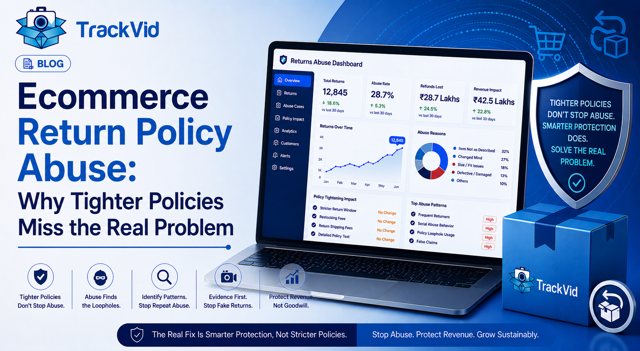
Ecommerce return policy abuse is projected to cost global retailers over $115 billion by 2026, according to NRF data. It is not simply a returns volume problem. It is a documentation problem. The customers responsible for the highest-cost policy abuse are not exploiting vague policies or unusual edge cases. They are exploiting the gap between what a merchant's policy says they should receive back and what the merchant can actually prove was dispatched in the first place.
Tightening a return window from 30 days to 14 days reduces genuine return volume and creates friction for legitimate customers. It does not stop the customer who files a condition claim on day 13 about damage that never existed, because the merchant cannot prove the item left in undamaged condition.
Return policy abuse is not defeated at the policy level. It is defeated at the evidence level. The merchants who have the lowest effective abuse rates are not those with the strictest return terms. They are those who can prove, at the order level, what was dispatched.
How Return Policy Abuse Differs From Return Fraud
The distinction matters practically because it affects how claims are handled and what evidence is needed to contest them.
Return fraud is explicit deception: returning a different product than what was received, filing a non-delivery claim on a delivered order, or submitting a falsified damage claim with fabricated evidence. These are contestable through dispute processes and, in serious cases, are legally actionable.
Return policy abuse operates within the technical terms of the policy while violating its intent. A customer who buys a dress for one occasion, wears it, and returns it in a condition that technically passes the "unworn" check is abusing the policy. A customer who orders four sizes knowing they will return three, generating significant reverse logistics cost, is exploiting the policy's structure. A customer who files a damage claim on the last permitted day of the return window, knowing the merchant cannot disprove it, is exploiting the policy's evidence gap.
These behaviours are difficult to contest legally because the customer has technically complied with the policy's stated terms. The only effective defence is documentation that makes the gap between what was dispatched and what was returned visible and verifiable.
In practice, the most costly category, condition claims on returned items, sits in the overlap between policy abuse and outright fraud. The customer claims the item arrived damaged or was the wrong product. The merchant believes this is false. Without dispatch documentation, neither party can prove their position at the order level. The default resolution, under consumer protection frameworks in the US, UK, EU, and Australia, typically favours the customer.
The Five Return Policy Terms Most Commonly Exploited
Understanding which specific policy terms drive the highest abuse losses helps merchants prioritise both documentation and policy language.
Return Window Exploitation
The return window, typically 14 to 60 days, is the most exploited structural element. Customers with high-use intent, who intend to return from the start, time their purchases and returns to stay within the window while maximising use of the product. Fashion sellers experience this on seasonal items. Electronics sellers experience it on products bought for travel or events.
Tightening the return window reduces accidental returns and reduces the use window for wardrobers. It does not prevent a customer who planned from the start to file a window-compliant claim with false damage language.
Condition Threshold Abuse
Most return policies define acceptable return condition as "unused," "undamaged," or "in original packaging." Each of these terms has enough ambiguity to be exploited at the margin. Customers return items with minimal use that passes visual inspection. They return items in condition that technically meets "no damage" while showing use wear. They repack items in a way that appears original without being so.
Condition threshold abuse is the category most responsive to dispatch documentation. A packing video showing the item in pristine, undamaged condition at the point of dispatch, compared against return condition at receipt, creates the before-and-after record that makes condition exploitation visible. Without the dispatch record, the comparison cannot be made and the benefit of the doubt applies to the customer.
"Arrived Damaged" Claims
Claiming an item arrived damaged is one of the most common and least verifiable return abuse strategies. Most merchants have no documentation of what condition the item was in when it left their warehouse. A customer who files a damage claim is making an assertion that the merchant cannot independently contradict.
This claim type qualifies for full refunds and often avoids restocking fees under most return policies. It is therefore disproportionately used by customers whose primary goal is cost-free product use rather than genuine return. According to NRF survey data, "arrived damaged" accounts for a significant share of the 13.7 percent of all returns estimated to be fraudulent.
Dispatch documentation is the primary defence. An order-linked packing video showing undamaged product at dispatch shifts the burden of the damage narrative. If the item left in demonstrably undamaged condition, the question becomes when and how the damage occurred, and carrier liability enters the dispute as an alternative explanation.
Free Return Policy Abuse
Free returns, which merchants offer to reduce purchase friction, are among the most heavily exploited policy features. The operational cost of a free return is entirely absorbed by the merchant: reverse logistics, inspection, restocking, and repackaging. For customers whose intent is to use-and-return, free returns remove the only financial friction that would otherwise make this strategy costly.
Return policy abuse via free return terms is most effectively addressed by combining free return eligibility with return reason tracking and account-level return rate monitoring. Accounts that consistently use free returns at above-average rates on condition-claim categories are the highest-risk segment and the most appropriate targets for tighter manual review.
Same-Day and Expedited Exchange Abuse
Some merchants offer immediate exchange or replacement dispatch before the original return is received and inspected. This policy, designed to improve customer experience, is exploited by customers who file condition claims to receive a second unit before returning the first in a condition different from what was described. The merchant ends up with two units: one sold and used, one returned in poor condition.
This abuse type requires both dispatch documentation and return receipt documentation to be contestable. The packing video for the original order proves its condition at dispatch. The return receipt photographs prove the condition of what came back.
New York Seller Rachel: $12,400 a Month in Uncontestable Policy Abuse
Rachel runs a D2C home goods brand from New York, selling through her Shopify store and Amazon US at approximately 240 orders a day. Her products are mid-range lifestyle items in the $45 to $120 range. Her return policy was intentionally generous: 30-day free returns, no questions asked on condition claims.
She built the policy this way to compete with the large retailers her customers compared her against. She knew her return rate would be higher than a stricter policy would allow. She had accepted that as a customer acquisition trade-off.
What she had not calculated was the abuse rate within her return volume. When she broke her return data down by claimed reason, the distribution was noticeably skewed. Condition claims, "arrived damaged" and "wrong item," accounted for 38 percent of her returns despite representing a much smaller share of the actual issues her customer service team was seeing in correspondence.
More specifically, her team had noted that a significant portion of the condition-claim returns showed inconsistencies when inspected: packaging wear suggesting extended use, missing items that were present at shipment according to her records, or products that were clearly not from her brand. She could not prove any of this at the order level. She had no documentation of what had left her warehouse for the specific orders in question.
Every condition claim that arrived resolved the same way: refund issued. The policy required it and her evidence did not support a contest. Her monthly uncontestable policy abuse loss was running at approximately $12,400.
The policy I built to win customers was being used by a specific group of customers to extract money I could not get back. And I could not prove it on any single order.
After Rachel added order-linked packing video to her dispatch process, the immediate impact was on the contested claims. When a "wrong item" claim arrived for a specific order, she retrieved the packing video for that order showing the correct product being packed and sealed. She submitted this alongside her return inspection report showing a different product received back. The dispute resolved in her favour.
Over 90 days, her contested condition claim success rate moved from near zero to above 65 percent. Her effective policy abuse loss dropped from $12,400 to under $4,000 monthly. The reduction came from two sources: successful contests on claims that would previously have resolved automatically in the customer's favour, and reduced claim frequency from accounts that had previously been filing consistently.
Why Stricter Policies Solve the Wrong Problem
The instinctive response to return policy abuse is policy restriction: shorten the return window, add restocking fees, require original packaging, and introduce stricter condition thresholds. These measures reduce genuine return volume and reduce the window for some forms of abuse.
They do not address the category that drives the majority of high-cost abuse: condition claims.
A customer who files a false damage claim files it regardless of whether your return window is 14 or 30 days. They file it on day 12 instead of day 25. A restocking fee does not deter a customer claiming the item arrived damaged, because damage claims typically qualify for fee exemption under consumer protection standards. Requiring original packaging does not stop a customer who repackages the item themselves.
Stricter policies create friction for legitimate customers. They create minimal friction for the customers responsible for the highest abuse losses, because those customers have specifically chosen claim types that are exempted from most policy restrictions by consumer protection law.
The effective intervention is documentation, not restriction. When a merchant can produce a packing video for every order showing the item's condition at dispatch, condition claims can be independently evaluated rather than accepted by default. The policy does not need to change. The evidence infrastructure needs to exist.
Related: Refund abuse ecommerce: why detection alone does not stop it →
How Dispatch Documentation Shifts the Evidence Burden
The evidence burden in a return condition dispute currently sits entirely on the merchant. A customer claims the item arrived damaged. The merchant believes this is false. The merchant has no independent evidence of the item's condition at dispatch. The consumer protection default applies: the customer's claim is accepted.
Order-linked packing video shifts this dynamic. When a merchant submits footage of the item being packed in demonstrably undamaged condition, linked to the specific Order ID, the dispute changes from "merchant's word against customer's" to "customer's claim against independent verification."
This does not win every dispute. Customers can still claim the damage occurred in transit, which opens a separate carrier liability question. But it removes the most common path for false condition claims: the assertion of pre-existing damage that cannot be disproved because the dispatch condition was never documented.
For "wrong item" claims specifically, dispatch documentation is decisive. An order-linked packing video showing the correct item being packed for the specific disputed order directly contradicts a "wrong item" claim. The customer must account for the discrepancy between what was dispatched and what they claim to have received. This level of direct contradiction is not available to any merchant who relies on listing screenshots or inventory records alone.
How TrackVid Closes the Return Policy Abuse Evidence Gap
Closing the dispatch documentation gap for return policy abuse requires the same infrastructure that addresses every other post-purchase fraud category: every fulfilled order needs a packing video linked to its Order ID, stored in searchable cloud, and retrievable in under two minutes when a claim arrives.
TrackVid provides this infrastructure for ecommerce sellers globally. Every packing session is recorded automatically and linked to the Order ID, SKU, and dispatch reference at the moment of packing. Videos are stored in indexed cloud, searchable by order number. When a return condition claim arrives, the packing video for the specific order is retrieved and compared against the return receipt documentation.
The comparison is the evidence. Undamaged item at dispatch against damaged return at receipt creates a visible, verifiable record of the condition change and opens the question of when and how the damage occurred.
TrackVid works with existing warehouse cameras. Setup takes under 15 minutes. Evidence is live from the first packing session after activation.
Book a free TrackVid Demo Today
In one session, you will see your current condition claim rate by category, which claims are driving the highest uncontested losses, and what dispatch documentation coverage looks like across your order volume.
Five Questions to Find Where Return Policy Abuse Is Hitting You
- What is your condition claim rate as a share of total returns? Condition claims, "arrived damaged" and "wrong item," as a percentage of total returns above your category baseline signal a policy abuse problem rather than a fulfilment quality problem. Identify this rate before assuming the issue is fulfilment.
- What percentage of condition claims do you successfully contest? If your success rate on contested condition claims is below 30 percent, you have a documentation problem. You are identifying suspicious claims but lacking the evidence to win them individually. Dispatch documentation closes this gap.
- Can you produce the packing video for a specific disputed order in under two minutes? If evidence retrieval requires manual archive searching, you will not produce dispatch evidence within dispute deadlines consistently. Order-linked documentation needs to be indexed and retrievable by order number, not by time and camera.
- Do your "arrived damaged" return inspection results match the claimed damage descriptions? If inspected returns frequently show inconsistencies between the claimed damage and the physical condition received, you are experiencing condition claim abuse. The next question is whether you have dispatch documentation to contest those claims individually.
- Have you compared your condition claim rate before and after implementing dispatch documentation? The before-and-after comparison is the clearest evidence of whether dispatch documentation is reducing abuse volume or simply improving your individual dispute win rate. Both outcomes are valuable. The combination suggests your documentation is functioning as both an evidence tool and a deterrent.
Frequently Asked Questions
What is ecommerce return policy abuse?
Ecommerce return policy abuse occurs when customers exploit return policy terms to extract refunds or replacements beyond what the policy was designed to provide. It ranges from wardrobing, purchasing for single use and returning, to condition claim abuse, filing false damage or wrong-item claims knowing the merchant cannot disprove them. Unlike return fraud, which involves explicit deception, return policy abuse often operates within the technical terms of the policy while violating its intent. According to NRF data, 13.7 percent of all ecommerce returns are estimated to be fraudulent or abusive, with condition claims accounting for a significant share of the highest-loss cases.
How do I stop customers abusing my return policy?
Stopping return policy abuse requires combining account-level detection with order-level documentation. Detection means tracking return rates and claim types by customer account, flagging accounts above your category baseline, and identifying patterns such as disproportionate condition claims or end-of-window filing. Documentation means creating order-linked packing video for every fulfilled order so that when a condition claim arrives, you can produce independent evidence of what was dispatched in what condition. Detection identifies the problem. Documentation gives you the evidence to contest individual claims and deters future abuse from the same accounts.
What is the most abused return policy term in ecommerce?
The "arrived damaged" claim category is the most exploited return policy term in ecommerce, according to NRF return fraud survey data. It qualifies for full refunds under most policies, typically bypasses restocking fees under consumer protection standards, and is difficult to disprove without dispatch documentation. The second most exploited term is the return condition threshold, where items are returned in a technically acceptable condition after use. Both categories are directly addressed by order-linked dispatch documentation, which creates a before-and-after record of item condition that makes condition-based claims verifiable rather than automatically accepted.
How to prevent return policy abuse on Shopify?
On Shopify, return policy abuse prevention combines platform-side rules with post-purchase documentation. Platform-side: use Shopify's customer tagging to flag accounts with above-average return rates, configure return windows by product category rather than blanket terms, and require condition photos from customers initiating returns. Post-purchase documentation: implement order-linked packing video through TrackVid, which records every fulfillment linked to the Order ID and makes dispatch condition independently verifiable when a condition claim arrives. Policy restrictions reduce friction but do not stop condition claim abuse. Dispatch documentation closes the evidence gap that makes condition claims uncontestable by default.
Is return policy abuse illegal?
Return policy abuse exists on a legal spectrum. Explicit false claims, such as filing a "wrong item" claim when the correct item was received, or staging damage that did not exist, constitute fraud under consumer protection law in most jurisdictions. Policy exploitation that stays within the technical terms of the policy, such as wardrobing or bracketing, is typically not illegal, though it may breach the merchant's terms of service. The distinction matters for how merchants respond: fraud claims can be escalated to platforms or legal channels, while policy exploitation is primarily addressed through evidence-based dispute contestation and account-level policy enforcement. In practice, the highest-cost category, condition claims, often sits in the overlap between the two.
What evidence stops return policy abuse claims?
The primary evidence that stops return policy abuse on condition claims is order-linked packing video: footage of the specific item being packed for the specific disputed order, showing its condition before sealing. This evidence directly answers the core question in condition abuse disputes, what was the item's condition at the point of dispatch, which no other documentation can address. Supporting evidence includes return receipt photographs showing the condition of what was received back, and customer communication records if the buyer acknowledged the product before filing a claim. Together, these create a verifiable before-and-after record that makes false condition claims contestable rather than automatically accepted.
How to tighten return policy without losing customers?
Tightening return policy strategically means reducing exploit surfaces without adding friction for legitimate buyers. Practical steps: require condition photographs from customers initiating returns above a value threshold, apply different return terms to high-abuse categories while keeping standard terms for low-risk product lines, make restocking fees conditional on return inspection results rather than automatic, and use account-level return history to apply different verification requirements to high-risk accounts. Avoid blanket window reductions or fee additions that penalise all customers equally. The merchants who have reduced policy abuse most effectively without customer satisfaction impact have combined targeted policy tightening with dispatch documentation, so that genuine returns flow smoothly while abusive claims face evidence-based contestation.
Difference between return fraud and return policy abuse?
Return fraud involves explicitly false claims or actions: returning a different product than what was received, filing a non-delivery claim on a delivered order, or providing falsified damage evidence. These are typically actionable under consumer fraud statutes. Return policy abuse stays within the technical policy terms while violating their intent: purchasing for single use and returning, over-ordering with planned returns, or filing condition claims on the last permitted return day knowing the merchant cannot verify dispatch condition. Both categories generate significant merchant losses. Both are addressed by dispatch documentation, though the legal escalation path differs. For the merchant, the practical response is the same: order-linked packing video that makes any condition or product discrepancy visible and verifiable at the individual order level.
Sources: NRF Retail Return Fraud Survey 2026, Claimlane 2026 Return Research, Chargebacks911 2026 Chargeback Field Report, Signifyd State of Commerce 2026, Merchant Risk Council 2026 Global eCommerce Payments and Fraud Report, TrackVid internal seller data
TrackVid is a video proof and claim management platform used by 1,100+ ecommerce sellers globally. Officially authorised by Snapdeal. Learn more at trackvid.in.

Get the Marketplace Claim Recovery Checklist
A 12-point checklist used by 1,100+ sellers to recover 85-90% of marketplace claim losses. Free, instant access.
- Marketplace-specific evidence formats (AJIO, Flipkart, Amazon, Myntra)
- Claim window deadlines for every major platform
- The 6-step process that pushes approval from 85-90%
- Common rejection reasons and how to avoid them
No spam. Unsubscribe anytime. Used by sellers at Rare Rabbit, HRX, Da Milano + 1,100 more.
Stop Losing Money to Fake Returns
Join 1,100+ sellers who recover lakhs every month with TrackVid