
For ecommerce sellers on Amazon, Shopify, eBay, Etsy and global marketplaces. Updated May 2026.
Friendly fraud affected 79 percent of merchants in 2024, up from 34 percent just one year earlier, according to Visa Acceptance Solutions data. A 40 percent rise in friendly fraud cases is forecast for 2026, according to Chargebacks911. 1 in 5 consumers admit to having committed it.
And yet most friendly fraud prevention advice is aimed at the wrong stage. Clearer merchant descriptors, better 3DS authentication, faster refund processing, these reduce accidental disputes and criminal fraud. They do not stop a customer who deliberately disputes a legitimate purchase. By the time friendly fraud is filed, the checkout is history. The fraud is happening in the dispute system.
This guide covers what friendly fraud is, why standard prevention misses it, and what the evidence-first approach looks like that actually wins disputes when it occurs.
What Friendly Fraud Actually Is
Friendly fraud occurs when a customer files a chargeback dispute against a legitimate transaction. The customer made the purchase intentionally, received the product, and then disputed the charge claiming fraud, non-delivery, or product dissatisfaction.
The "friendly" misnomer suggests accidental behaviour, a forgotten subscription, an unrecognised merchant name on a statement. These genuine cases exist and account for a portion of disputes. But as of 2026, "gaming the system" is cited by 39 percent of merchants as the single biggest driver of first-party misuse, according to MRC 2026 research. The behaviour has become deliberate and increasingly organised.
Friendly fraud succeeds because it exploits the information gap between what the merchant knows, the product was correct, packed, and delivered, and what the bank can independently verify. Without independent proof of fulfillment, the bank evaluates a dispute between a customer's claim and a merchant's counter-claim. The customer's claim often wins by default.
Related: What is first-party fraud in ecommerce →
Why Checkout-Stage Prevention Does Not Stop Friendly Fraud
The standard friendly fraud prevention checklist includes: 3D Secure 2.0 implementation, clear merchant descriptors on bank statements, proactive order confirmations, accessible refund processes, and chargeback alert services.
These measures reduce the volume of accidental disputes and deter some opportunistic fraud. None of them affect the customer who has already received the product and decides to dispute the charge.
3DS authentication verified the customer was who they claimed to be at checkout. It does not prevent them from disputing the charge afterward. A clear merchant descriptor prevents confusion on the bank statement. It does not prevent a deliberate dispute. Chargeback alerts give advance notice of impending disputes. They do not create evidence that wins those disputes.
The limitation of checkout-stage prevention is structural: it operates at the wrong point in the transaction timeline. Friendly fraud operates post-purchase, in the dispute system, where checkout security has no reach.
The Evidence-First Approach: What Actually Works
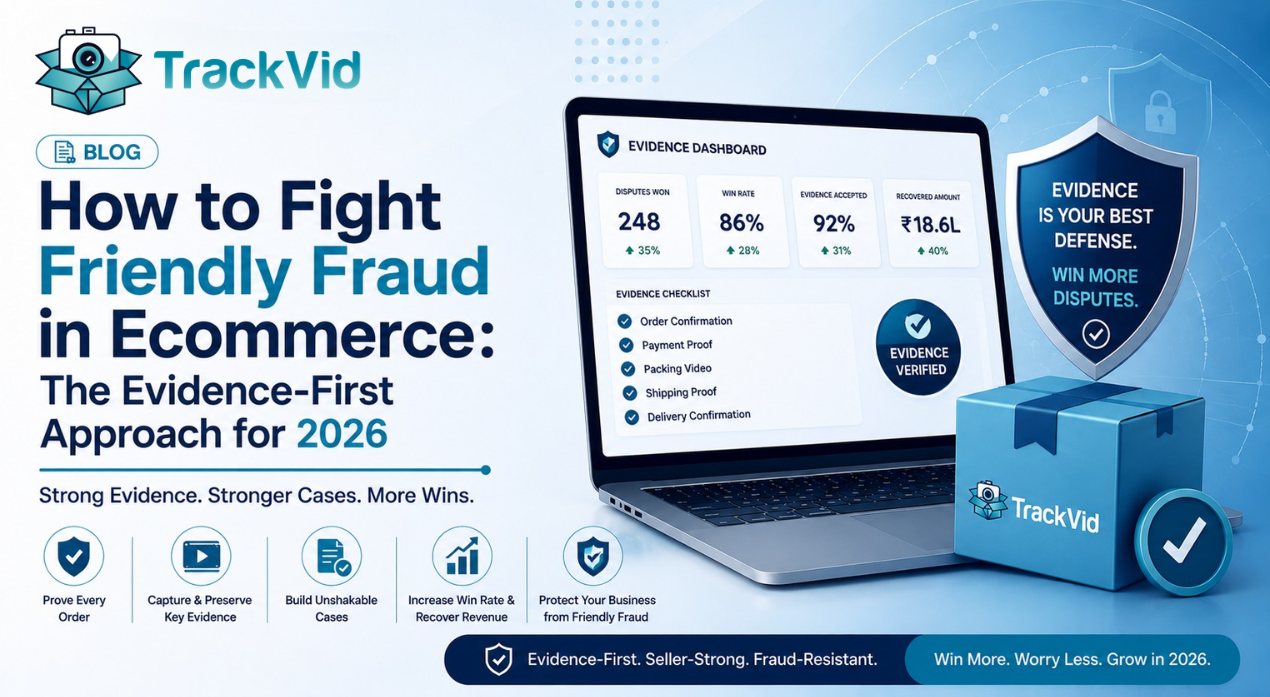
The evidence-first approach to fighting friendly fraud builds independently verifiable proof of every fulfillment before disputes exist, so that when a friendly fraud dispute arrives, the evidence is retrieved rather than created.
Evidence layer 1: Fulfillment proof. Order-linked packing video created at the moment of packing, linked to the Order ID, stored in indexed cloud. When a customer claims "item not as described" or "wrong item received" as part of a friendly fraud dispute, this video shows exactly what was in the parcel for that specific order. It is independently verifiable. It cannot be credibly disputed.
Evidence layer 2: Delivery proof. Carrier confirmation of delivery to the correct address, with GPS photo or signature confirmation for high-value orders. When a customer claims "never received" as a friendly fraud pretext, delivery confirmation is the primary counter-evidence.
Evidence layer 3: Transaction history. For Visa CE3.0 eligible disputes, prior undisputed transactions from the same customer demonstrating a pattern of legitimate purchases. When a customer claims "unauthorised transaction" against a pattern of prior purchases, transaction history is compelling counter-evidence.
Evidence layer 4: Communication records. Email, chat, or support ticket records showing the customer acknowledged the order, confirmed receipt, or contacted you about the delivered item before filing the dispute. These records directly contradict claims of non-receipt or non-authorisation.
Together, these four layers create an evidence chain that covers every dimension of a friendly fraud dispute. The customer claimed the product was wrong. The packing video shows it was correct. The customer claimed non-delivery. The carrier tracking shows delivery. The customer claimed the transaction was unauthorised. The prior transaction history shows it was not. Nothing in the dispute is left unaddressed.
A UK Fashion Brand That Reduced Friendly Fraud Losses by 71 Percent
Clara manages operations for a UK-based womenswear brand selling on Shopify and Etsy. Average order value is £85. Friendly fraud was her biggest margin problem, customers claiming "not as described" on items that had been worn and returned, or "not received" on items the carrier had confirmed delivered.
Her previous approach was reactive: submit whatever evidence was available after the dispute arrived. Win rate: 21 percent.
She built an evidence-first system in early 2025: packing video for every order, standardised delivery confirmation with carrier photo, and communication records logged through her customer service platform.
In the following 90 days, her friendly fraud win rate moved to 74 percent. Her total monthly loss from friendly fraud declined by 71 percent, not because fewer disputes were filed, but because fewer of them could succeed against the evidence.
"The fraud did not stop. The fraud just stopped working."
Making Friendly Fraud Difficult: The Deterrence Effect
Evidence-first systems do not just win disputes, they reduce the volume of friendly fraud attempts against merchants who are known to have them.
Organised friendly fraud operations, fraud-as-a-service platforms that coach consumers through dispute processes, actively identify merchants with weak evidence before targeting them. A merchant known to submit only tracking numbers and written accounts is a more attractive target than a merchant known to submit packing video and delivery proof for every dispute.
This deterrence effect is not theoretical. Fraud networks operate on return on effort. Disputing a merchant who will submit video evidence of the correct product being packed is significantly higher effort for the fraudster than disputing a merchant who will submit only a tracking number.
TrackVid creates the visible evidence infrastructure that deters organised friendly fraud. Its automated packing video for every order means that any friendly fraud attempt faces a complete evidence chain from the first dispute notification.
Related: How to win a chargeback dispute as an ecommerce seller →
Friendly Fraud vs First-Party Fraud: The Terminology Shift
The industry is formally moving from "friendly fraud" to "first-party fraud" or "first-party misuse" as the standard terminology. The Merchant Risk Council's 2026 report uses "first-party misuse" as its official category.
The reason for the change matters: the term "friendly fraud" implies accidental behaviour. Most of what merchants face in 2026 is deliberate. The MRC change reflects the reality that 39 percent of merchants cite "gaming the system" as the primary driver.
For sellers building their prevention and response strategy, the implication is direct: if the fraud is deliberate, prevention must be structural, not just procedural. Clearer policies and better descriptions help with accidental disputes. Independent evidence at fulfillment is required to win deliberate fraud disputes.
Book a free TrackVid Demo Today
In one session, you will see how TrackVid creates the order-linked fulfillment evidence that wins friendly fraud chargebacks across Amazon, Shopify, eBay, and Etsy from one system.
Frequently Asked Questions
How to fight friendly fraud in ecommerce?
The evidence-first approach: build order-linked packing video documentation for every fulfillment, establish delivery confirmation with carrier photo, log all communication records, and for Visa disputes, enable CE3.0 submission through Order Insight using prior transaction history. When friendly fraud is filed, the evidence already exists and is retrieved rather than created under deadline pressure. Sellers using this approach with TrackVid's automated packing video system report win rates of 65 to 90 percent on product-type friendly fraud disputes, compared to industry averages below 25 percent.
What is friendly fraud in ecommerce?
Friendly fraud in ecommerce occurs when a customer disputes a legitimate transaction with their card issuer, claiming fraud, non-delivery, or product dissatisfaction, despite having made the purchase intentionally and typically having received the item. It is now formally called "first-party misuse" by the Merchant Risk Council. It affects 79 percent of merchants according to Visa Acceptance Solutions research, and 1 in 5 consumers admit to having committed it. The fraud exploits the information gap between what the merchant knows and what the bank can independently verify about the fulfillment.
Does friendly fraud affect small ecommerce sellers?
Yes, and disproportionately. Larger merchants have dedicated fraud teams, automated dispute workflows, and existing evidence infrastructure. Smaller merchants typically rely on manual processes that cannot scale with dispute volume. A single successful friendly fraud dispute can represent a significant proportion of a small seller's margin. The evidence-first approach is as applicable at 50 orders per day as at 5,000, the tools to implement it are available at all scales.
How to prove friendly fraud happened?
Proving friendly fraud happened requires demonstrating that the dispute claim is inconsistent with the evidence of what was actually delivered. For product claims: order-linked packing video showing the correct item was packed. For non-delivery claims: delivery confirmation and GPS photo showing the parcel arrived. For unauthorised transaction claims: prior transaction history and device matching through Visa CE3.0. You cannot "prove" a customer's fraudulent intent, you can only provide evidence that directly contradicts their claim.
How do I win a friendly fraud chargeback with evidence?
The evidence package for a friendly fraud chargeback should include: order-linked packing video showing the specific product packed for the specific Order ID, delivery confirmation matching the buyer's address, communication records showing customer engagement, and for Visa 10.4 disputes, prior transaction history through CE3.0. The package should be submitted before the deadline with a concise rebuttal letter referencing each piece of evidence by name. The packing video is the most decisive element for product-based friendly fraud claims because it independently verifies the fulfillment.
Sources: Visa Acceptance Solutions 2024 Merchant Survey, MRC 2026 Global eCommerce Payments and Fraud Report, Chargebacks911 2026 Field Report, Chargeflow 2026 Chargeback Statistics, Justt.ai Merchant Chargeback Rights February 2026, TrackVid seller data.
TrackVid creates the order-linked fulfillment evidence that wins friendly fraud chargebacks. Automated. For every order. Learn more at trackvid.in.


Get the Marketplace Claim Recovery Checklist
A 12-point checklist used by 1,100+ sellers to recover 85-90% of marketplace claim losses. Free, instant access.
- Marketplace-specific evidence formats (AJIO, Flipkart, Amazon, Myntra)
- Claim window deadlines for every major platform
- The 6-step process that pushes approval from 85-90%
- Common rejection reasons and how to avoid them
No spam. Unsubscribe anytime. Used by sellers at Rare Rabbit, HRX, Da Milano + 1,100 more.
Stop Losing Money to Fake Returns
Join 1,100+ sellers who recover lakhs every month with TrackVid