
For online sellers and D2C brands on Shopify, Amazon, eBay, and global marketplaces. Updated May 2026.
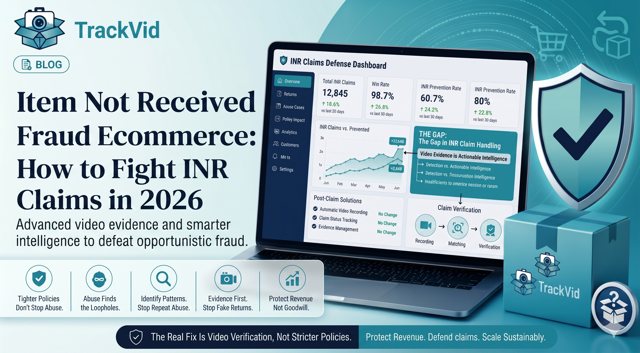
Item not received fraud is the most automated fraud type in ecommerce in 2026. Professional "Refund-as-a-Service" operations now file fake INR claims at scale using one-click dispute tools that bypass the merchant entirely and go directly to the customer's bank, according to CyberSource 2026 fraud research. These are not confused customers who misread a tracking update. They are organised groups filing hundreds of coordinated INR claims across multiple merchants simultaneously.
The cost is significant. Non-delivery fraud costs consumers and merchants a combined average of $264 per incident, according to FTC data. For merchants, the loss is the product, the reversal, and the $20 to $100 dispute fee on top. For high-volume sellers, INR claims arriving from organised fraud operations can generate thousands of dollars in monthly losses that never trigger a fraud score at checkout because every transaction was legitimate.
The standard defence advice, get carrier GPS confirmation and signature on delivery, protects against the simple version of INR fraud. It does not protect against the version that is actually growing.
Why Carrier Tracking Alone Is Not Enough
The conventional INR defence strategy is built around one question: can you prove the item was delivered? For straightforward non-delivery disputes, this is the right question. Carrier tracking with GPS confirmation, timestamp, and delivery receipt directly answers it.
The problem is that modern INR fraud has evolved beyond the straightforward version.
The simple version: a customer files a dispute claiming their order never arrived. The merchant provides carrier tracking showing delivery to the correct postcode on the correct date. The bank closes the dispute in the merchant's favour.
This version still exists. It is no longer the majority of INR losses for merchants at volume.
The evolved version operates differently. A customer, or a Refund-as-a-Service operation acting on a customer's behalf, files a claim that combines non-delivery language with product condition language. The dispute reads: the package arrived, but it was empty. Or: the package arrived, but it contained the wrong item. Or: the package arrived damaged, and nothing was inside when opened.
These claims occupy a grey zone between INR and product condition disputes. Carrier tracking proves the parcel arrived. It proves nothing about what was inside. The bank's question shifts from "was it delivered" to "was the correct item inside when it was delivered?" Carrier tracking cannot answer this. Signature confirmation cannot answer this. GPS delivery coordinates cannot answer this.
The only evidence that answers this specific question is order-linked packing video: footage of the item being placed into the parcel, tagging to the specific Order ID, recorded at the moment of dispatch.
Without this evidence, the dispute is unresolvable in the merchant's favour because the claimant has made a claim the merchant cannot disprove. Carrier tracking proves arrival. The merchant says the item was inside. The customer says it was not. The bank has no independent evidence to evaluate. In the absence of specific evidence, most banks default to the cardholder.
This is why INR fraud losses are rising for merchants who have excellent carrier tracking. The fraud has moved to the part of the order lifecycle that tracking data cannot reach.
The Three Types of Item Not Received Fraud
Understanding which version of INR fraud is hitting your store determines what defence infrastructure you need.
Type 1: Pure Non-Delivery Claims
The customer or claimant disputes a transaction claiming the item was never delivered. No package arrived. Nothing was received at any point.
This is the most straightforward INR claim and the most straightforward to defend. Carrier tracking with GPS delivery confirmation, delivery timestamp, and matching address is primary evidence. For orders above $100, signature confirmation significantly strengthens the case.
Where merchants lose this type: carriers that mark "delivered" without GPS coordinates, delivery scans that show the correct postcode but not the specific address, and delivery to a shared building or post room where individual recipient confirmation is unavailable.
Type 2: Empty Package Claims
The package arrived, but was empty or contained only packaging material. The customer claims the item was not inside.
This is the fastest-growing INR variant according to CyberSource 2026 fraud reports, and it is the one that carrier tracking cannot defend. Delivery is confirmed. The dispute is about contents. The only evidence that answers the bank's question about what was inside the parcel at dispatch is packing video that shows the item being placed inside and the parcel being sealed.
Merchants without order-linked packing video lose empty package claims at very high rates because they cannot independently verify what was packed. The customer's assertion that the box was empty cannot be disproved with delivery records.
Type 3: Wrong Item Substitution Claims
The package arrived and contained an item, but not the item ordered. The customer claims a different or lesser product was inside.
This variant is filed both as a standalone dispute and in combination with INR language. In either case, the evidence requirement is the same: order-linked packing video showing the correct item being packed for the specific disputed Order ID. Without it, the merchant is relying on inventory records and listing screenshots to prove what was dispatched, neither of which answer the specific question of what was in order number 10057 specifically.
Sydney Seller Tom: AUD $9,200 a Month in INR Losses Nobody Was Organising Manually
Tom runs a D2C apparel brand from Sydney, selling through his own Shopify store and eBay Australia at approximately 190 orders a day. His products sit in the AUD $80 to $180 range, premium enough to make individual INR claims worthwhile targets.
For about five months, his INR dispute volume had been increasing. He was filing representment on every one. His win rate was 11 percent.
What caught his attention was the pattern. His INR claims were not distributed evenly across his order volume. They clustered on specific higher-value SKUs, came in waves across short time windows, and several appeared to share customer account ages under 60 days. The behaviour did not look like individual customers with genuine non-delivery complaints. It looked coordinated.
Tom had carrier tracking with delivery confirmation for every disputed order. It showed delivery to the correct postcode, correct suburb, correct date. He was submitting this in every representment. He was losing almost every dispute.
The reason became clear when he looked at the dispute language more carefully. Most of his INR claims were not simple "I never received it" disputes. They were "the package arrived empty" or "the package arrived but contained a different item." Delivery confirmation proved arrival. It answered a different question than the one being disputed.
My tracking showed delivered. Their claim said empty. The tracking could not prove anything about what was inside. The bank had no way to rule for me.
After Tom added order-linked packing video to his dispatch process, the change was structural. Every order above AUD $60 was recorded at packing with the video tagged to the Order ID. When an INR dispute arrived for a specific order, the packing video for that order showed the item being packed, the correct product visible, and the parcel being sealed. He submitted this alongside carrier confirmation.
His INR dispute win rate moved from 11 percent to 79 percent within 45 days. The claims that still succeeded were genuine delivery failures where his carrier had not completed delivery and his tracking was ambiguous. The wave-pattern coordinated claims stopped arriving at the same rate after several consecutive losses, consistent with organised fraud operations identifying merchants with documentation and moving to easier targets.
His monthly INR loss dropped from AUD $9,200 to under AUD $1,900.
What Actually Wins Item Not Received Fraud Disputes
The evidence that wins INR fraud disputes depends on the specific claim type.
For pure non-delivery claims, carrier GPS confirmation with delivery timestamp, address match, and ideally signature confirmation is the primary evidence. For orders above $150, signature confirmation is the single most effective step a merchant can take because it shifts the dispute from "merchant's word against customer's" to "signed receipt."
For empty package and wrong item INR variants, order-linked packing video is the primary and often only effective evidence. The bank's question, "what was inside the parcel at dispatch," cannot be answered by anything else. This is not a gap in carrier tracking. It is a gap in what any delivery-side documentation can cover. Delivery records only exist after dispatch. The only documentation that covers what happened at dispatch is documentation created at dispatch.
This is why the majority of INR fraud defence guides leave merchants exposed to the fastest-growing claim types. They cover the delivery side comprehensively and the dispatch side not at all.
Related: Chargeback representment: matching evidence to reason codes for product disputes →
How Refund-as-a-Service Operations Work and Why Standard Fraud Screens Miss Them
Refund-as-a-Service is an organised fraud model where groups or individuals offer to secure refunds or chargebacks on behalf of customers in exchange for a percentage of the recovered amount, according to CyberSource and CNP fraud research from 2025 and 2026.
These operations are effective specifically because they use real customer accounts, real transaction credentials, and real delivery addresses. Every transaction they target passed checkout fraud screening cleanly because the buyer was legitimate at the point of purchase.
The fraud occurs entirely post-purchase. The RaaS operator files INR claims on behalf of real customers after delivery, using the combined non-delivery and empty package framing that carrier tracking cannot disprove. They target merchants at volume. A single RaaS operation can file dozens of coordinated claims against one merchant in a short window, which is why coordinated INR fraud shows the clustering pattern Tom noticed: multiple claims within days, similar account ages, concentrated on high-value SKUs.
Standard fraud scores at checkout are not designed to detect this because the fraud signal does not exist at checkout. The only effective defence is post-purchase documentation that makes individual claims unwinnable, which causes these operations to move to merchants without that documentation.
Dispatch documentation is not just a dispute response. It is a deterrent. Organised INR fraud operations evaluate merchants the same way any risk-aware operation evaluates its targets. Merchants who consistently produce order-level packing video for disputed claims are not cost-effective targets. The evidence gap these operations rely on does not exist for those merchants.
How TrackVid Closes the INR Fraud Gap
The dispatch documentation layer that defends against modern INR fraud requires one specific capability: every fulfilled order needs a packing video linked to its Order ID, stored in a searchable system, retrievable in under two minutes when a dispute arrives.
TrackVid provides this infrastructure for ecommerce sellers globally. Every packing session is recorded and linked to the Order ID, SKU, and dispatch reference at the moment of packing. Videos are stored in indexed cloud, searchable by order number. When an INR dispute arrives, the merchant retrieves the exact packing video for the disputed order and submits it as primary evidence alongside carrier documentation.
This covers both the delivery proof gap and the dispatch proof gap simultaneously. Carrier tracking proves arrival. Order-linked packing video proves contents. Together, they answer every version of INR fraud that a claimant can raise.
TrackVid works with existing warehouse cameras. Setup takes under 15 minutes. Evidence is available from the first packing session after activation.
Book a free TrackVid Demo Today
In one session, you will see your current INR claim breakdown, whether any show the clustering patterns associated with coordinated fraud, and what dispatch documentation coverage looks like across your order volume.
Five Questions to Know If Your INR Defence Has Gaps
- What percentage of your INR claims use "empty package" or "wrong item" language rather than pure non-delivery? If more than 30 percent combine non-delivery with product condition language, carrier tracking alone is insufficient for those cases. You are losing disputes you could win with dispatch documentation.
- Do your INR claims cluster on specific SKU ranges or order value bands? Organised fraud operations target high-value items. Clustering by value band, rather than random distribution, is a strong signal of coordinated activity rather than genuine delivery failures.
- Can you retrieve the packing video for any specific order in under two minutes? If the answer requires accessing warehouse CCTV archives manually, you cannot produce this evidence before your representment deadline under high-volume dispute conditions. Dispatch documentation needs to be indexed and searchable, not archived.
- Do your INR dispute wins correlate with orders that have GPS delivery confirmation? If you win significantly more INR disputes on orders with GPS confirmation than those without, your losses are concentrated in the delivery evidence gap. Adding dispatch documentation covers the separate gap that GPS confirmation cannot reach.
- Have you received multiple INR claims within short windows from accounts with similar registration ages? Account age clustering combined with timing clustering is the signature of Refund-as-a-Service operations. Individual genuine non-delivery complaints do not show this pattern. Recognising it helps merchants prioritise which claims to contest and which to escalate to platform fraud reporting.
Frequently Asked Questions
What is item not received fraud in ecommerce?
Item not received fraud in ecommerce occurs when a customer or organised fraud operation files a false claim that an order was never received, in order to obtain a refund or chargeback while keeping the product. It ranges from simple non-delivery claims on orders that were delivered, to more sophisticated "empty package" and "wrong item" claims that combine INR language with product condition disputes. According to CyberSource 2026 research, professional Refund-as-a-Service operations now automate INR claims at scale using one-click dispute tools that bypass the merchant and go directly to the issuing bank. INR fraud is the fastest-growing automated fraud type in ecommerce as of 2026.
How to fight a fake item not received claim?
Fighting a fake INR claim requires matching evidence to the specific version of the claim. For pure non-delivery claims, GPS carrier delivery confirmation with timestamp and address match is primary evidence. For empty package or wrong item INR claims, order-linked packing video showing the correct item being packed for the disputed Order ID is the only evidence that directly answers the bank's question about parcel contents. Carrier tracking proves arrival but not contents. Merchants who add order-linked packing video to their dispatch process report INR dispute win rates moving from under 15 percent to above 70 percent on cases where video is submitted, according to TrackVid data.
Customer says item not received but tracking shows delivered: what should I do?
When a customer claims non-delivery but carrier tracking shows delivery, the first step is to confirm the specific delivery record: GPS coordinates, timestamp, and address match. If your carrier shows "delivered" without GPS confirmation, that tracking record is weak evidence in a dispute. If the customer's claim uses "arrived empty" or "wrong item inside" language alongside the non-delivery claim, delivery confirmation alone will not win the dispute because the bank's question has shifted from delivery to contents. In that case, order-linked packing video for the disputed order is the evidence needed. Without it, the dispute is difficult to win regardless of how clear your delivery record is.
What is Refund-as-a-Service fraud?
Refund-as-a-Service, or RaaS, is an organised fraud model where operators file chargebacks or platform disputes on behalf of customers in exchange for a share of the recovered amount. These operations target ecommerce merchants systematically, typically focusing on high-value SKUs and merchants with weak post-purchase documentation. RaaS claims use legitimate customer accounts and real transaction data, which means they pass checkout fraud screening cleanly. The fraud signal only appears in the pattern of claims: clustering on high-value items, timing coincidence across multiple accounts, and account ages below 90 days. According to CyberSource 2026 research, RaaS operations are now a primary driver of INR claim volumes for mid-to-large ecommerce merchants.
Does carrier tracking protect against INR claims?
Carrier tracking with GPS delivery confirmation protects against straightforward non-delivery INR claims. It does not protect against empty package claims, wrong item claims, or any INR variant where the customer acknowledges delivery but disputes contents. For these claim types, the bank's question shifts from "was it delivered" to "what was inside at dispatch" and carrier tracking cannot answer the second question. Only order-linked packing video created at the moment of dispatch can independently verify parcel contents. Merchants relying solely on carrier tracking for INR defence are protected against the simple version of the fraud but exposed to the version that is growing fastest in 2026.
Customer claims package arrived empty: what to do?
An "arrived empty" claim is one of the most difficult INR variants to defend without dispatch documentation, because the carrier confirms delivery and the customer acknowledges receipt but disputes contents. To win this dispute, you need packing video for the specific disputed order showing the item being placed inside the parcel before sealing. If you do not have order-linked packing video, submit all available carrier documentation alongside a clear rebuttal explaining your dispatch process, but be aware that the dispute is unresolvable in your favour on evidence grounds without the packing video. Going forward, TrackVid records every packing session linked to the Order ID, specifically to close this evidence gap for future disputes.
How to win an item not received chargeback?
Winning an INR chargeback requires producing evidence that matches the specific claim type. For standard non-delivery disputes, submit GPS delivery confirmation with date-timestamp, prior customer communication acknowledging the order, and for high-value orders, signature confirmation. For empty package or wrong item INR chargebacks, submit order-linked packing video as primary evidence alongside delivery documentation. Organise the submission as a structured package with a brief rebuttal letter mapping each document to the specific claim. According to Justt.ai 2026 research, merchants who prepare properly achieve win rates of 30 percent or higher, and with the right evidence for the reason code, win rates reach 65 to 90 percent.
How to stop INR fraud on my online store?
Stopping INR fraud requires closing both the delivery evidence gap and the dispatch evidence gap. For delivery: use GPS-confirmed carriers, require signatures on high-value orders, and enroll in Ethoca or Verifi pre-dispute resolution alerts to resolve claims before they become chargebacks. For dispatch: implement order-linked packing video documentation through TrackVid, which records every fulfillment and links each video to the Order ID. This covers the empty package and wrong item INR variants that delivery confirmation cannot address. Merchants with systematic dispatch documentation report that organised INR fraud volume decreases after consistent dispute wins, as coordinated operations avoid merchants with order-level evidence and redirect to easier targets.
Sources: CyberSource 2026 Global Fraud Report, FTC Consumer Sentinel Network Data 2026, Justt.ai Merchant Chargeback Rights February 2026, Chargebacks911 2026 Chargeback Field Report, Merchant Risk Council 2026 Global eCommerce Payments and Fraud Report, Riskified January 2026 INR Fraud Analysis, TrackVid internal seller data
TrackVid is a video proof and claim management platform used by 1,100+ ecommerce sellers globally. Officially authorised by Snapdeal. Learn more at trackvid.in.

Get the Marketplace Claim Recovery Checklist
A 12-point checklist used by 1,100+ sellers to recover 85-90% of marketplace claim losses. Free, instant access.
- Marketplace-specific evidence formats (AJIO, Flipkart, Amazon, Myntra)
- Claim window deadlines for every major platform
- The 6-step process that pushes approval from 85-90%
- Common rejection reasons and how to avoid them
No spam. Unsubscribe anytime. Used by sellers at Rare Rabbit, HRX, Da Milano + 1,100 more.
Stop Losing Money to Fake Returns
Join 1,100+ sellers who recover lakhs every month with TrackVid