
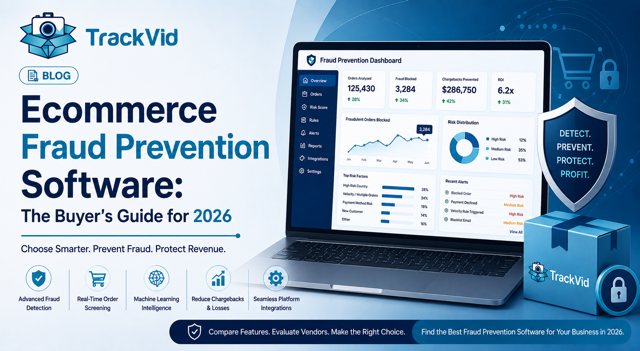
For online sellers and D2C brands on Shopify, Amazon, and global marketplaces. Updated May 2026.
If you search "ecommerce fraud prevention software" right now, every result gives you the same list: Signifyd, Riskified, Sift, Forter, Kount. These are strong tools. But every guide covering them treats ecommerce fraud prevention software as a single category, when it is actually two.
Pre-purchase fraud prevention software protects your checkout. It catches stolen card data, blocks card testing attacks, scores transaction risk in real time, and applies 3DS2 authentication before an order is approved. This is what Signifyd, Riskified, Sift, and Forter all do.
Post-purchase fraud prevention software protects your recovery window. It documents what was packed and dispatched at the order level, gives you retrievable evidence when a return dispute or chargeback arrives, and closes the gap between "fraud happened" and "I can prove what actually occurred." This is what most sellers have never installed.
According to the Merchant Risk Council's 2026 Global Payments and Fraud Report, 57 percent of merchants experienced rising refund and policy abuse, and 47 percent identified refund abuse as their top attack type. Payment fraud tools do not touch refund abuse. That is not a criticism of those tools. It is a category boundary. And most sellers do not know the boundary exists until they are losing money on the wrong side of it.
This guide explains both categories, what the leading tools in each cover, and how to evaluate which combination your operation actually needs.
What Ecommerce Fraud Prevention Software Does
Ecommerce fraud prevention software is any tool that reduces financial loss from fraudulent or abusive activity across the order lifecycle. It detects, prevents, or documents fraud so sellers can block bad transactions, contest false claims, and recover revenue they would otherwise write off.
The category spans two distinct phases of the order journey, and the software built for each phase works differently.
Phase 1: Pre-purchase. From the moment a buyer lands on your store to the moment an order is approved. Fraud signals here include stolen card credentials, device fingerprinting anomalies, IP risk scores, velocity patterns, account takeover attempts, and card testing. Tools in this phase operate at checkout, in milliseconds.
Phase 2: Post-purchase. From the moment an order is fulfilled to the moment a dispute window expires. Fraud signals here include false "item not received" claims, product swap returns, refund policy abuse, and friendly fraud chargebacks. Tools in this phase operate at the warehouse and documentation layer, before the dispute arrives.
Most sellers buy Phase 1 software. Most merchant fraud losses come from Phase 2.
According to Chargebacks911, 60 to 80 percent of all chargebacks are friendly fraud, meaning legitimate transactions disputed by real customers. Chargebacks from legitimate-looking orders pass every pre-purchase fraud filter cleanly. They only become fraud after fulfillment.
Category 1: Pre-Purchase Ecommerce Fraud Prevention Software
These tools sit at or before checkout. They evaluate transaction signals in real time and decide whether to approve, flag, or block an order. The leading platforms share similar architecture: machine learning trained on large transaction datasets, device fingerprinting, behavioral signals, identity resolution, and risk scoring.
Signifyd
Signifyd is the most widely cited name in ecommerce fraud prevention software. Its core model uses machine learning trained on a global merchant network to recognize buying patterns and flag anomalies. The key commercial differentiator is its chargeback guarantee: for orders Signifyd approves, it reimburses the merchant for any fraud-related chargebacks. This removes financial risk from the approval decision. Signifyd integrates natively with Shopify, Magento, and BigCommerce. It has been ranked the top ecommerce fraud protection platform by Digital Commerce 360 for five consecutive years. Pricing is a percentage of approved order value.
Best for: High-volume merchants who want to shift chargeback liability and improve approval rates. Signifyd's strength is payment fraud at checkout.
Coverage boundary: Signifyd does not cover post-purchase fraud. Return fraud, product swaps, and refund abuse that occur after fulfillment fall outside its guarantee and detection scope.
Riskified
Riskified operates on the same chargeback guarantee model. It uses machine learning and a global merchant data network to make real-time order decisions, with a stated goal of reducing false declines as much as reducing fraud. Riskified integrates with major ecommerce platforms and payment processors. Pricing is customised and typically based on processed transaction volume.
Best for: Global merchants who experience high false-decline rates from overly conservative fraud filters. Riskified's published case studies show strong results in approval rate recovery alongside fraud reduction.
Coverage boundary: Like Signifyd, Riskified's scope is pre-purchase and payment fraud. Post-purchase disputes, fake returns, and refund abuse are not covered under its guarantee or detection model.
Sift
Sift describes itself as a Digital Trust and Safety platform. It goes beyond pure payment fraud to cover account takeover, content abuse, and promotion abuse alongside transaction fraud. This broader scope makes it relevant for marketplaces and platforms with account-level abuse patterns. Pricing is custom and based on transaction volume and product modules.
Best for: Merchants and platforms managing account-level fraud (ATO) alongside payment fraud. Sift's behavioral analytics are stronger on account security than some competitors.
Coverage boundary: Sift covers account and payment fraud but not post-fulfillment documentation and return dispute evidence. Its post-purchase module (if deployed) flags risky customers but does not provide order-level packing proof.
Forter
Forter positions itself around identity intelligence. Its Identity Graph covers over 1.8 billion known identities, which means it can make instant fraud decisions based on whether a buyer has been seen across its network before. It processes $350 billion in GMV annually. Decisions are returned in under 400 milliseconds. Pricing is enterprise, custom, and not publicly listed.
Best for: Large merchants handling high transaction volumes who need sub-second decisioning without manual review. Forter's identity resolution strength makes it effective against synthetic identity fraud.
Coverage boundary: Forter's scope is identity and payment fraud at checkout. Post-purchase fraud on legitimate identities, which is the definition of friendly fraud, does not register as a risk signal within its identity model.
The Gap Every Checkout Tool Leaves Open
The tools above are purpose-built, well-funded, and genuinely effective within their category. But they share a structural limitation that no checkout tool can overcome: they stop at fulfillment.
Once an order is approved and dispatched, no checkout-layer fraud prevention software has visibility. The post-purchase window opens. This is where return fraud, product swap schemes, fake INR claims, and friendly fraud chargebacks originate. And this is where most merchants have no software coverage at all.
According to NRF data, return fraud losses for global retailers are projected to exceed $115 billion by 2026. According to Signifyd's State of Commerce 2026, return abuse surged 64 percent between January 2024 and May 2025. According to the Merchant Risk Council, refund abuse now ranks as the top fraud attack type for 47 percent of merchants globally.
These losses land outside the coverage scope of every checkout fraud tool. They require a different software category to address them.
The goal is not zero returns. The goal is to stop writing off losses that a structured system could recover.
Category 2: Post-Purchase Ecommerce Fraud Prevention Software
Post-purchase fraud prevention software operates at the warehouse and documentation layer. Instead of screening transactions before they happen, it creates the evidence infrastructure that makes fraudulent return and dispute claims impossible to sustain.
The mechanism is order-level video documentation: every packing event is recorded and automatically linked to its Order ID, SKU, and dispatch reference. When a return dispute, fake INR claim, or friendly fraud chargeback arrives, the seller can retrieve the exact packing video for that order in under two minutes and submit it as primary evidence.
This is the category that checkout tools are not built to replace. And it is the category most sellers have never evaluated.
How Post-Purchase Fraud Prevention Software Works
The operational flow has four components.
Recording. Every order is recorded during packing. The recording is not a time-stamped CCTV archive. It is an order-linked video, tied to the specific Order ID being packed.
Indexing. Each video is automatically tagged with Order ID, SKU, and AWB number and stored in searchable cloud. No manual logging. No physical DVR. Retrieval time: under two minutes by Order ID search.
Detection. For marketplaces with automated CCTV-required notification systems, post-purchase software monitors for dispute triggers and responds automatically before claim windows expire.
Submission. When a dispute arrives, the evidence package is ready: the order-linked packing video, submission-ready for the relevant platform's representment process.
This documentation infrastructure changes the economics of post-purchase fraud. Without it, sellers contest disputes without evidence and lose most of them. With it, the dispute win rate shifts significantly because the specific proof fraudsters rely on sellers not having suddenly exists.
TrackVid
TrackVid is purpose-built post-purchase fraud prevention software for ecommerce sellers. It records every packing session and links each video to the Order ID, SKU, and AWB number at the moment of packing. Videos are stored in indexed, searchable cloud. Evidence retrieval takes under two minutes. The system integrates with existing warehouse cameras and takes under 15 minutes to set up.
TrackVid is used by 1,100+ ecommerce sellers globally and is officially authorised by Snapdeal. Sellers using TrackVid report dispute success rates above 80 percent compared to under 20 percent before the system was deployed, according to TrackVid's internal seller data.
TrackVid does not replace Signifyd or Riskified. It covers the post-purchase layer those tools leave open. For sellers running a checkout fraud stack who are still losing money on return fraud and friendly fraud chargebacks, TrackVid is the missing second layer.
Related: What a VMS for ecommerce looks like →
An Amsterdam Seller Who Had Signifyd but Still Lost €7,800 a Month
Daniel runs a D2C apparel brand based in Amsterdam, dispatching approximately 240 orders a day across his own Shopify store and two marketplace channels. Within his first year he deployed Signifyd for checkout fraud. Payment fraud was not his problem.
Every month, a consistent volume of his fulfilled orders generated disputes. Customers claiming empty boxes. Return packages arriving with the wrong product. Friendly fraud chargebacks on orders where tracking confirmed delivery. Daniel was filing representment for every dispute. He was winning 12 percent of them.
Not because his claims were wrong. Because his evidence was not order-specific. His warehouse CCTV showed packing activity. It could not show what was packed for order 10042 specifically. When a dispute arrived for that order, he had no usable proof. The disputes went against him, and Signifyd's guarantee did not extend to post-fulfillment claims.
His monthly post-purchase fraud loss averaged €7,800. Every month. On top of a checkout fraud stack he was already paying for.
After adding TrackVid as a second layer, every packing session was tagged to its Order ID. When a dispute arrived, the evidence was a searchable, specific, order-linked video. Dispute wins moved from 12 percent to 82 percent within two billing cycles. His monthly post-purchase fraud loss dropped to under €1,500.
His checkout stack handled what it was built for. TrackVid handled what it was not.
How to Evaluate Ecommerce Fraud Prevention Software for Your Store
Ask these five questions before committing to any tool.
- Where is your fraud actually coming from? Run a 90-day audit. Separate payment fraud (chargebacks on declined or stolen card orders) from post-purchase fraud (disputes on fulfilled orders, return abuse, INR claims). If the majority is post-purchase, adding more checkout software will not fix it.
- Does the tool cover the fraud type you are experiencing most? Signifyd and Riskified are excellent for payment fraud. They do not cover return fraud or post-purchase disputes by design. TrackVid covers post-purchase. It does not replace checkout screening. Match the tool to the fraud category, not to the tool's brand recognition.
- What evidence does the tool produce when a dispute arrives? Checkout tools produce transaction records, device data, and delivery confirmation. Post-purchase tools produce order-linked packing video. Platform dispute processes often require specific evidence formats. Know what each tool produces and whether that matches what the platforms you sell on actually accept.
- What is your current dispute win rate? If your dispute win rate is below 40 percent on fulfilled orders, you are missing post-purchase documentation infrastructure, not checkout fraud screening. Adding a second checkout tool will not move that number.
- How does the tool scale with your order volume? Manual evidence gathering breaks above 100 orders a day. Any post-purchase fraud prevention software you evaluate should operate automatically without requiring staff time per dispute. TrackVid's automation requires zero manual effort per claim once set up.
Related: How product swap fraud works and why sellers keep losing on it →
TrackVid works with your existing warehouse cameras. Setup takes under 15 minutes.
Book a free TrackVid Demo Today
In one session, you will see exactly which category of fraud is costing you the most and what a complete two-layer fraud prevention setup looks like in your specific operation.
Frequently Asked Questions
What does ecommerce fraud prevention software do?
Ecommerce fraud prevention software reduces financial losses from fraudulent transactions, fake returns, chargebacks, and refund abuse across the order lifecycle. It operates in two categories. Pre-purchase software (Signifyd, Riskified, Sift, Forter) screens orders at checkout using machine learning and device signals to block stolen card fraud and account takeovers. Post-purchase software (TrackVid) creates order-level documentation during fulfillment, providing the evidence needed to win return disputes and friendly fraud chargebacks after delivery. A complete fraud prevention setup requires both layers, not just one.
Best fraud prevention software for Shopify?
For checkout fraud on Shopify, Signifyd and NoFraud both offer strong native Shopify integrations and chargeback guarantee models. Signifyd has been ranked the top ecommerce fraud protection platform by Digital Commerce 360 for five consecutive years. For post-purchase fraud on Shopify, TrackVid covers the layer those tools do not reach: return fraud, fake INR claims, and friendly fraud chargebacks on fulfilled orders. Most Shopify sellers who have recurring post-purchase fraud losses need a post-purchase layer specifically, not an additional checkout tool.
Signifyd vs Riskified: which is better?
Both Signifyd and Riskified operate on a chargeback guarantee model and use machine learning to score transaction risk at checkout. Signifyd is generally preferred for Shopify and North American sellers; Riskified is often favoured for high-volume global merchants with significant false-decline concerns. For most sellers the practical difference is marginal. The more important question is whether either tool covers your actual fraud problem. Both Signifyd and Riskified cover checkout fraud. Neither covers post-purchase fraud, return abuse, or friendly fraud on fulfilled orders. If your dispute losses are concentrated post-fulfillment, the Signifyd vs Riskified question is less relevant than adding a post-purchase layer.
Do I need fraud prevention software for my online store?
If you are processing more than 50 orders a day, yes. According to Juniper Research, global ecommerce fraud losses reached $48 billion annually. According to LexisNexis, every $1 of direct fraud loss costs merchants approximately $4.61 in total once chargebacks, fees, and operational costs are included. For small sellers, the question is not whether to use fraud prevention software but which category to prioritize first. If you are experiencing checkout fraud, start with a pre-purchase tool. If your dispute win rate on fulfilled orders is below 40 percent, start with a post-purchase documentation system.
How much does ecommerce fraud prevention software cost?
Pre-purchase fraud prevention software typically costs either a percentage of approved order value (Signifyd, Riskified) or a monthly subscription based on transaction volume (SEON starts at approximately $599 per month for usage-based plans). Enterprise tools like Forter, Sift, and Kount require custom pricing and are generally in the thousands per month. Post-purchase fraud prevention software like TrackVid is priced based on order volume and operates alongside existing warehouse cameras with no additional hardware cost. For most sellers, the ROI calculation is simple: if a post-purchase fraud tool improves dispute win rates from 15 percent to 80 percent, the cost recovers itself within the first month.
What is post-purchase fraud prevention software?
Post-purchase fraud prevention software creates the evidence infrastructure that protects sellers after an order is fulfilled. It records every packing session and links each video to its Order ID so that when a dispute, fake return, or chargeback arrives, the seller can submit specific, order-linked proof rather than generic CCTV or shipping confirmation. TrackVid is the leading post-purchase fraud prevention software for ecommerce sellers. It automates recording, indexing, and evidence retrieval so sellers can contest disputes with the same efficiency at 500 orders a day as at 50. Learn more at trackvid.in.
Does Signifyd cover return fraud?
No. Signifyd's chargeback guarantee covers fraud-related chargebacks on orders that Signifyd approves at checkout. It does not cover post-purchase fraud including return fraud, product swap fraud, fake INR claims, or friendly fraud chargebacks that originate after fulfillment of a legitimate-looking order. This is not a limitation specific to Signifyd. It applies to all checkout-focused ecommerce fraud prevention software. The coverage boundary is at fulfillment. Post-purchase fraud requires a separate documentation layer, which is the category TrackVid fills. Sellers running Signifyd who still experience high post-purchase dispute losses need a second layer, not a different checkout tool.
What is the best ecommerce fraud prevention software for a growing D2C brand?
For a growing D2C brand, the optimal setup is a two-layer stack. Layer 1 is a checkout fraud tool matched to your transaction volume and platform: Signifyd or NoFraud for Shopify, Riskified for high-volume global operations, SEON for smaller sellers who want transparent pricing. Layer 2 is a post-purchase fraud prevention tool that covers return fraud, INR disputes, and friendly fraud chargebacks: TrackVid, which works with existing warehouse cameras and requires no additional hardware. Most growing D2C brands over-invest in Layer 1 and have nothing for Layer 2. For many, adding Layer 2 recovers more revenue in the first quarter than any additional Layer 1 investment would prevent. Schedule a demo at trackvid.in/book-demo.html to see how post-purchase fraud protection integrates with your current setup.
Sources: Merchant Risk Council 2026 Global eCommerce Payments and Fraud Report, Juniper Research Merchant Fraud Prevention Report, LexisNexis Risk Solutions True Cost of Fraud Study 2024, Chargebacks911 Chargeback Field Report, NRF Return Fraud Survey, Signifyd State of Commerce 2026, Digital Commerce 360
TrackVid is a video proof and claim management platform used by 1,100+ ecommerce sellers globally on Amazon, Flipkart, AJIO, Myntra and Meesho. Officially authorised by Snapdeal. Learn more at trackvid.in.

Get the Marketplace Claim Recovery Checklist
A 12-point checklist used by 1,100+ sellers to recover 85-90% of marketplace claim losses. Free, instant access.
- Marketplace-specific evidence formats (AJIO, Flipkart, Amazon, Myntra)
- Claim window deadlines for every major platform
- The 6-step process that pushes approval from 85-90%
- Common rejection reasons and how to avoid them
No spam. Unsubscribe anytime. Used by sellers at Rare Rabbit, HRX, Da Milano + 1,100 more.
Stop Losing Money to Fake Returns
Join 1,100+ sellers who recover lakhs every month with TrackVid