
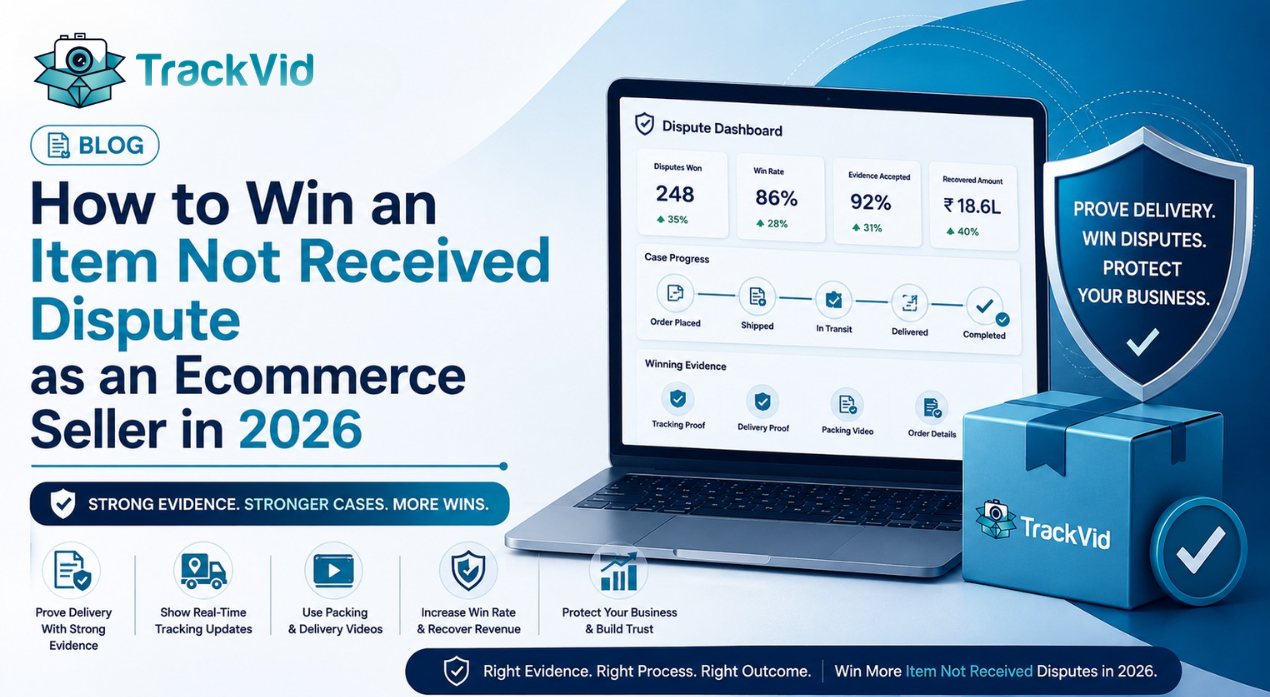
For ecommerce sellers on Amazon, Shopify, eBay, Etsy and global marketplaces. Updated May 2026.
"Item not received" is the most commonly filed chargeback reason code in global ecommerce, accounting for 32 percent of all disputes according to post-purchase fraud research. It is also one of the most frequently mishandled by merchants, not because the case is weak, but because the evidence submitted answers the wrong question.
When a customer claims they did not receive their order, the dispute is not about whether the parcel was delivered. It is about whether they received it. Carrier tracking that shows "delivered" proves the logistics event. It does not prove the customer received the contents. The distinction is where most "item not received" dispute losses happen.
This guide covers exactly what evidence wins INR disputes in 2026, what does not, and how the strongest sellers close both the delivery proof gap and the contents proof gap.
What Actually Happens in an INR Dispute
An "item not received" dispute is filed by a customer claiming they paid for an order that never arrived. The filing triggers an automatic chargeback from the issuing bank, reversing the funds and debiting the merchant's account.
The customer's claim falls into one of two categories:
Genuine non-delivery. The parcel was lost in transit, stolen from a doorstep, delivered to the wrong address, or was never collected by the carrier. These are legitimate disputes that merchants should resolve through carrier insurance and tracking investigation.
Friendly fraud INR. The customer received the order, or deliberately arranged not to receive it, and disputes the charge. According to research, friendly fraud now accounts for 32 percent of INR disputes specifically, and 1 in 5 consumers admit to having committed it at some point.
The evidence strategy differs slightly between these two scenarios, but the baseline evidence requirement is the same for both: proof that the order was correctly fulfilled and delivered to the address on record.
The Two-Layer Evidence Structure for INR Disputes
Winning an INR dispute requires covering two layers of evidence that most merchants only address one of.
Layer 1: Delivery proof (standard, most merchants have this)
Delivery confirmation showing the parcel was delivered to the buyer's address. For orders above $750 on Visa and Mastercard networks, signature confirmation is required for seller protection eligibility. GPS delivery photos where available. Carrier tracking with timestamps at each stage.
This layer answers: "Was the parcel delivered?"
Layer 2: Contents proof (most merchants do not have this)
For the significant share of INR disputes that are actually friendly fraud, where the customer claims the parcel arrived empty or contained the wrong item to support a non-delivery claim. Layer 1 evidence alone is insufficient.
A customer can acknowledge the parcel arrived while claiming it was empty or contained a different item. In this case, carrier tracking is irrelevant. The dispute has shifted from delivery to contents, and contents require packing-level evidence.
Order-linked packing video showing the specific product being packed for the specific Order ID answers: "What was in the parcel?" This is the evidence layer that most merchants cannot produce and where INR disputes escalate into losses.
Related: Ecommerce fulfillment proof, the evidence layer every seller needs →
Evidence That Wins vs Evidence That Loses
Wins INR disputes:
Delivery confirmation with tracking showing delivery to the billing or shipping address on record. Signature confirmation for orders above the card network threshold. GPS delivery photo from the carrier. Communication records showing the customer confirmed receipt or contacted you about the delivered item. Order-linked packing video as supporting evidence against upgraded claims about contents.
Does not win INR disputes alone:
Proof that the order was placed and processed. Proof the parcel was collected by the carrier. Order management records. Written account of what was packed. Photos of the product not tied to the specific order.
The critical nuance: carrier tracking that shows "delivered" is strong for straightforward INR disputes. But for disputes that shift to "delivered but empty" or "delivered but wrong item," delivery tracking stops being relevant and packing video becomes the primary evidence.
Platform-Specific INR Evidence Requirements
Amazon SAFE-T: Delivery confirmation to the correct address is required. For orders above $750, signature confirmation is required. Amazon additionally accepts unboxing video as supporting evidence when the customer disputes the contents of a delivered parcel. Window: 7 days from return delivery confirmation.
Shopify Payments: Delivery tracking showing delivery to billing or shipping address. Signature confirmation where available. Shopify Payments' automatic dispute resolution system accepts fulfillment documentation submitted through the dispute portal. Window: 7 to 21 days depending on card network.
eBay Money Back Guarantee: Delivery tracking showing delivery to the buyer's checkout address. Signature confirmation for orders above $750. eBay provides seller protection for INR claims when delivery can be confirmed. Window: 5 calendar days.
PayPal Seller Protection: Delivery tracking showing delivery to the address on the PayPal transaction. Signature confirmation for transactions above $750. PayPal's Seller Protection for "item not received" covers full reimbursement when delivery is confirmed. Window: response required within the dispute notification period.
The Fulfilment Proof Layer That Changes INR Outcomes
Most guides stop at delivery proof for INR disputes. The sellers who win the highest percentage of INR disputes, including the ones that escalate to content disputes, add one more layer.
When every order is packed with a recording linked to the Order ID, the evidence chain is complete: the product was in the box at packing, the box was sealed and collected, and the carrier confirmed delivery to the correct address.
This complete evidence chain is decisive in the escalated INR dispute, where a customer moves from "I did not receive it" to "I received it but it was empty." Delivery proof establishes the parcel arrived. Packing video establishes the product was in it. The dispute has no evidentiary basis.
TrackVid creates the packing video layer automatically for every order. When an INR dispute arrives, the packing video is retrieved by Order ID in under two minutes and submitted alongside delivery confirmation as a complete evidence package.
Delivery tracking proves the parcel arrived at the door. Packing video proves what was inside when it left the warehouse. Together, they answer every question an INR dispute can raise.
Related: How to win a chargeback dispute as an ecommerce seller →
Book a free TrackVid Demo Today
In one session, you will see how TrackVid creates the packing video layer that wins escalated INR disputes and how it integrates with your existing delivery and dispute workflows.
Frequently Asked Questions
How to win an item not received dispute as an ecommerce seller?
Submit delivery confirmation showing the parcel was delivered to the address on the order, with signature confirmation if the order exceeds $750. If the dispute escalates to claims about the parcel's contents, add order-linked packing video showing what was packed for the specific Order ID. Write a concise rebuttal letter referencing both evidence types and submit within the platform's deadline, 7 days for Amazon SAFE-T, 5 days for eBay, 7 to 21 days for Shopify Payments. The combination of delivery proof and packing video covers all dimensions of INR disputes including escalated friendly fraud claims.
What evidence wins an INR chargeback?
For standard INR disputes: delivery tracking to the correct address plus signature confirmation for high-value orders. For escalated INR disputes where the customer claims the parcel arrived empty: delivery confirmation plus order-linked packing video showing the product packed for the specific Order ID. The packing video is independently verifiable, banks and card network reviewers can confirm what was in the parcel at the moment of packing without relying on either party's account.
Customer claims item not received, what do I do?
Check your carrier tracking immediately. If delivery is confirmed to the correct address, pull the delivery confirmation documentation and any available delivery photo. Check your packing records for the Order ID and retrieve any packing video if you have a structured system. Then submit through the platform's dispute mechanism within the deadline. If delivery is not confirmed, investigate with the carrier and consider whether this is a genuine non-delivery or a friendly fraud claim based on the customer's history.
Can I win an INR claim if tracking shows delivered?
Yes. Delivery tracking showing a confirmed delivery to the correct address is the primary evidence for INR disputes and typically wins straightforward cases. The complication arises when customers escalate to claiming the parcel arrived empty or contained the wrong item. At this point, delivery tracking is no longer the decisive evidence, contents evidence is. Order-linked packing video covers this escalation scenario and gives you the complete evidence chain for any INR dispute regardless of how it is framed.
Sources: Chargebacks911 INR Chargeback Guide 2026, Chargeflow 2026 Chargeback Statistics, Amazon SAFE-T documentation, Shopify Payments dispute guidelines, eBay Money Back Guarantee seller protection, PayPal Seller Protection documentation, Justt.ai Merchant Chargeback Rights 2026, TrackVid seller data.
TrackVid provides the packing evidence layer that wins escalated INR disputes. Order-linked video. Auto-retrieved. Globally accepted. Learn more at trackvid.in.


Get the Marketplace Claim Recovery Checklist
A 12-point checklist used by 1,100+ sellers to recover 85-90% of marketplace claim losses. Free, instant access.
- Marketplace-specific evidence formats (AJIO, Flipkart, Amazon, Myntra)
- Claim window deadlines for every major platform
- The 6-step process that pushes approval from 85-90%
- Common rejection reasons and how to avoid them
No spam. Unsubscribe anytime. Used by sellers at Rare Rabbit, HRX, Da Milano + 1,100 more.
Stop Losing Money to Fake Returns
Join 1,100+ sellers who recover lakhs every month with TrackVid