
For sellers on Amazon, Flipkart, AJIO, Myntra and Meesho. Updated July 2026.
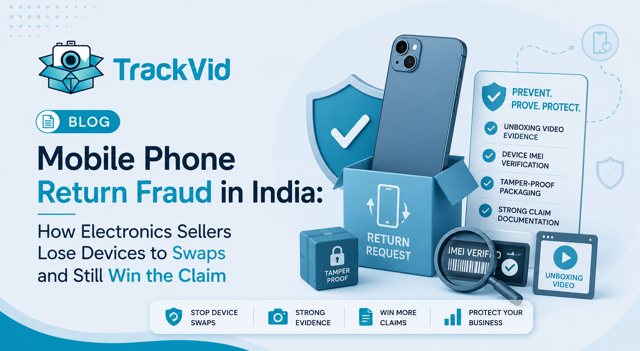
Mobile phone return fraud in India happens when a buyer keeps the working phone you shipped, sends back a fake unit, a dead handset, or an empty box, and still wins the refund because you cannot prove which exact device left your warehouse. Electronics is one of the two categories where swap attempts concentrate, alongside fashion, and claim success without structured proof sits below 25 percent, according to TrackVid data.
For a phone seller, one lost claim is not a small write-off. It is Rs 12,000 to Rs 60,000 gone in a single order. Run 300 orders a day at a two percent fraud attempt rate and the math turns ugly fast.
The frustrating part is that you usually know exactly what happened. You just cannot prove it in a format the marketplace accepts.
Why Phone Orders Attract Fraud More Than Almost Anything Else
A returned phone is not like a returned kurta. The resale value of the device is high, the parts market is active, and the fraud is easy to disguise. That combination is why this has become a category problem rather than a rare event.
Three things make phones a target. The unit price is high, so a single successful fraud pays well. The device is small and swappable, so a fake or dead unit looks identical in a photo. And the buyer knows the seller often cannot tell one IMEI from another after the fact.
Return fraud costs retailers more than 103 billion dollars a year globally, and roughly 9 to 14 percent of all ecommerce returns are fraudulent, according to NRF data. In high-value electronics, the incentive to attempt fraud is simply larger than in any low-ticket category.
A phone claim is not decided by what you know happened. It is decided by what you can prove happened to that specific IMEI.
The gap between those two things is where sellers lose money every month.
Delhi Seller Deepak: 350 Orders a Day and Rs 1.2 Lakh Disappearing
Deepak runs a mobile and electronics accessories business out of Delhi, shipping around 350 orders a day across Amazon and Flipkart. Mid-range smartphones and premium earbuds are his highest-margin lines, and also his most attacked.
The pattern he kept seeing was the same. A customer would order a phone, receive it, then raise a return citing a defect. The unit that came back would be a different handset, sometimes an older model with a cracked screen, sometimes a dead board in the right box.
He tried the obvious fixes first. His team took photos of every phone before sealing the box. They kept the retail CCTV running over the packing table. Neither worked. The photos had no link to the order, and the CCTV footage could not be tied to a specific IMEI or AWB when Amazon asked for proof.
By his own tracking, Deepak was writing off close to Rs 1.2 lakh a month in unrecovered phone and device claims. Not because the fraud was clever, but because his evidence never matched the order.
The change came when he started recording the IMEI and the box seal on video at the moment of packing, with each clip linked to the Order ID. The next disputed claim, he pulled the packing video, showed the exact IMEI leaving his facility, and won.
The problem was never the fraud. It was that I could describe what happened but never point to the exact device on record.
Within two months his claim win rate on device disputes moved from under a quarter to the high eighties. The fraud attempts did not stop. His recovery on them did.
The Four Ways Mobile Phone Return Fraud Actually Happens
This fraud is not one trick. It is four, and each one defeats a different weak point in a seller's process.
The device swap
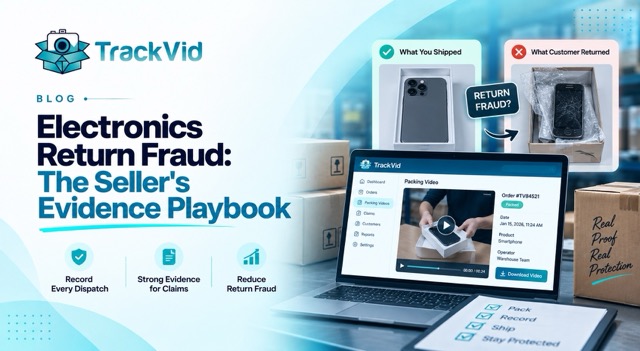
The buyer keeps your new phone and returns a different unit, usually a broken or older model of the same brand. Without a record of the exact device you shipped, the returned handset looks like a legitimate defective return.
The IMEI swap
Every phone carries a unique IMEI, the identity number a network uses to recognise the device. In an IMEI swap, the fraudster shows or returns a device whose IMEI does not match the one you dispatched. Buyers can verify a phone's IMEI on the Government of India CEIR portal at ceir.gov.in, but that only helps if you recorded the IMEI you actually sent.
The empty box and weight trick
The buyer returns the retail box with the accessories, or with a weight substitute like a power bank, but no phone. The parcel weight passes a rough check, and the refund is approved before anyone opens it.
The false dead-on-arrival claim
The buyer claims the phone arrived dead or damaged, when it left your facility working and sealed. This is the hardest to fight, because "it was fine when we shipped it" is an assertion, not evidence.
Each of these wins against a seller who has photos, CCTV, or a written explanation. None of them wins against an order-linked video of the IMEI and seal at packing.
Why CCTV and Photos Never Win a Phone Claim
Most electronics sellers already have cameras. That is exactly why they assume they are covered, and exactly why they keep losing.
Standard CCTV records by time and location, not by Order ID. When Amazon asks for proof on a claim filed eleven days after dispatch, you are scrubbing hours of footage to find one packing event, and even when you find it, the clip is not linked to the order or the IMEI. It proves a phone was packed. It does not prove that phone was packed for that order.
Photos have the opposite problem. They are order-agnostic and trivially reusable. A still image of an IMEI sticker could be from any unit, taken at any time, which is exactly why marketplace reviewers discount it.
CCTV records everything, which is also why it proves nothing specific.
The evidence a phone claim needs is narrow and precise: this IMEI, in this order, sealed on this date, retrievable in seconds. Anything wider than that gets rejected.
How to Stop Mobile Phone Return Fraud With Video Proof
The sellers who consistently recover phone losses built one thing before the dispute, not after it: order-linked packing proof.
TrackVid (trackvid.in) records every packing automatically and links each video to the Order ID, the SKU, and the AWB number at the moment of packing. For an electronics seller, that means the on-screen IMEI, the serial number, and the box seal are captured against the exact order, then stored in searchable cloud storage.
When a device swap or empty-box claim comes in, you search the Order ID and pull the packing video in under two minutes. The clip shows the specific IMEI that left your facility, sealed. That is primary evidence a marketplace accepts, not an argument it dismisses.
TrackVid works with your existing warehouse cameras and takes under 30 minutes to set up, so you are not buying new hardware to close the gap. Learn more at trackvid.in.
This is the difference between the fraud being a monthly write-off and being a claim you file and win. The attempt is the same. The outcome is not.
Related: How packing video proof beats fake return claims
What Amazon and Flipkart Actually Ask For
Winning a device claim depends on giving each platform the exact evidence its process expects, inside its window.
Amazon India
Amazon handles seller-side reimbursement through SAFE-T in Seller Central, with a window that typically runs seven days from the return delivery. For an electronics claim, order-linked packing and opening video that shows the correct IMEI is the evidence that moves a SAFE-T case in your favour. Related: The Amazon SAFE-T claim guide for Indian sellers
Flipkart
Flipkart runs seller protection through its portal with a tighter window, often 48 to 72 hours, and expects video with clear timestamps under its SPF process. A phone claim filed with a timestamped, order-linked packing clip showing the IMEI carries far more weight than photos or a written note.
The pattern across both platforms is identical. Specific beats general, order-linked beats time-based, and video of the IMEI beats a description of it every time.
Five Questions to Check If Your Phone Business Is Exposed
1. Can you retrieve the packing video for any phone order in under two minutes by searching the Order ID?
If not, you cannot answer a SAFE-T request inside the window.
2. Does your record show the exact IMEI that left your facility for each order?
If not, a device swap is unprovable.
3. When a phone comes back, can you compare the returned IMEI against the shipped one?
If not, you are accepting the buyer's word.
4. Do you know your claim win rate on device disputes this month as a specific number?
If you do not track it, it is almost certainly under 25 percent.
5. If your order volume doubled during the next sale, would this process still hold?
Manual photos and CCTV do not scale. Order-linked video does.
If any answer is no, the exposure is not theoretical. It is the write-off already showing up in your monthly numbers.
Schedule a free demo at trackvid.in/book-demo.html
In one session, you will see exactly where your recoverable revenue is going and what a structured proof system looks like in your specific operation.
Frequently Asked Questions
Customer returned a fake phone, what to do?
Pull the packing video for that Order ID and show the exact IMEI you shipped. File the claim with that clip as primary evidence through Amazon SAFE-T or the Flipkart seller portal. Without an order-linked video of the IMEI, most such claims fail, since claim success without structured proof is under 25 percent according to TrackVid data.
How to prove a phone swap on Amazon?
You prove it by matching the IMEI you dispatched against the IMEI that came back. TrackVid records the IMEI and box seal on video at packing, linked to the Order ID, so you can show the specific device that left your facility inside the SAFE-T window.
Flipkart mobile return fraud kya kare?
Sabse pehle us order ka packing video nikalo jisme IMEI aur seal dikh raha ho. Flipkart ke SPF process me timestamped video sabse strong proof hoti hai. Agar aapke paas order-linked video nahi hai to sirf photo se claim jeetna mushkil hai.
Someone returned an empty box instead of a phone. Can I still get my money back?
Yes, if you can prove the phone was in the box when it left you. A packing video that shows the device and the seal against the Order ID is what wins an empty-box claim. Related: The empty box return scam and how to beat it
Is CCTV enough to fight mobile phone return fraud?
No. CCTV records by time and location, not by Order ID or IMEI, so it cannot tie a specific device to a specific order. That is why marketplaces regularly reject it. Order-linked packing video is the format that gets accepted.
How do I check if a returned phone is the one I sent?
Compare the IMEI. Record the shipped IMEI on video at packing, then check it against the returned unit and the CEIR portal at ceir.gov.in if needed. If the numbers do not match, you have a documented swap.
What is the best system to stop mobile phone return fraud in India?
The most effective setup is automated packing video that captures the IMEI and seal, links each clip to the Order ID, SKU and AWB, and stores it for instant retrieval. TrackVid does this and is used by 1,000+ Indian sellers, which is why device-claim win rates commonly move past 90 percent.
Sources: NRF (return fraud cost and fraudulent return rate), TrackVid seller data (claim success rates), Government of India CEIR portal ceir.gov.in (IMEI verification), Amazon SAFE-T and Flipkart SPF seller documentation.
TrackVid is a video proof and claim management platform used by 1,000+ Indian ecommerce sellers on Amazon, Flipkart, AJIO, Myntra and Meesho. Officially authorised by Snapdeal. Learn more at trackvid.in.






Get the Marketplace Claim Recovery Checklist
A 12-point checklist used by 1,100+ sellers to recover 85-90% of marketplace claim losses. Free, instant access.
- Marketplace-specific evidence formats (AJIO, Flipkart, Amazon, Myntra)
- Claim window deadlines for every major platform
- The 6-step process that pushes approval from 85-90%
- Common rejection reasons and how to avoid them
No spam. Unsubscribe anytime. Used by sellers at Rare Rabbit, HRX, Da Milano + 1,100 more.
Stop Losing Money to Fake Returns
Join 1,100+ sellers who recover lakhs every month with TrackVid