
For dropshipping sellers on Shopify, WooCommerce, Amazon, eBay, and Etsy globally. Updated May 2026.
Dropshipping return fraud is not a minor operational nuisance. It is a structured attack on the most vulnerable point in the dropshipping business model, and it is growing faster than checkout fraud in 2026 because dropshippers are uniquely easy to target. A buyer who commits return fraud against a traditional retailer faces a seller who physically inspects returns, maintains warehouse documentation, and can often identify a substituted item immediately. A buyer who commits return fraud against a dropshipper faces a seller who typically never sees the product, has limited dispatch documentation, and absorbs most losses rather than contest them.
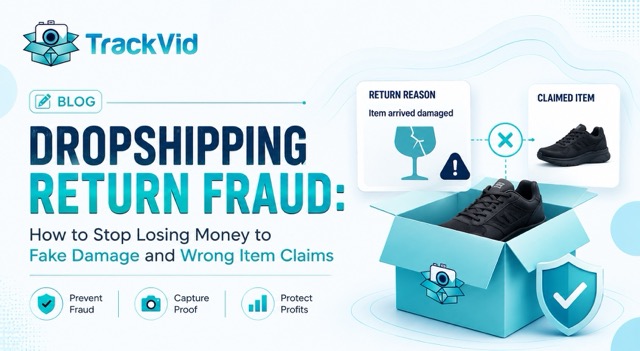
The three most common forms of dropshipping return fraud are fake damage claims, wrong item returns, and empty package claims. All three exploit the same fundamental gap: the dropshipper cannot prove what was dispatched at the order level. All three are directly solvable with order-linked packing video. And all three are costing dropshippers far more than the face value of the individual return suggests.
The Triple Loss Structure That Makes Dropshipping Return Fraud Different
Before covering how dropshipping return fraud works, it is worth calculating what a single fraudulent return actually costs in full, because the face value dramatically understates the real impact.
Consider a typical dropshipping scenario: a customer orders a product that cost you $6.50 from your AliExpress or supplier, sells for $19.99 on your Shopify store, and arrives at the buyer's address in the correct condition.
The buyer files a "damaged item" claim. You process the refund: $19.99 reversed. You now have three separate losses from one incident.
Loss 1: The revenue reversal. The $19.99 you received is gone.
Loss 2: The supplier cost. You already paid $6.50 for the product. In most dropshipping arrangements, the supplier does not issue a refund for a buyer-reported damage claim unless the seller can demonstrate the damage occurred before dispatch. Without dispatch documentation, this cost is unrecoverable.
Loss 3: Payment processing fees. The approximately $1.00 in processing fees from the original transaction is not returned with the refund.
Total loss from a $19.99 transaction: approximately $27.50. That is 138 percent of the selling price, according to fulfillment data from DailyFulfill 2026. Across 40 such incidents per month, which is not unusual for a Shopify store processing 200 to 400 daily orders, the monthly loss from dropshipping return fraud alone runs to $1,100. Across a quarter: $3,300. Against the margin of a typical dropshipping operation, this is the difference between profitability and operating at a loss.
The return fraud rate among ecommerce transactions is approximately 13.7 percent of all returns, according to NRF data. For dropshipping specifically, where buyers know the product came from a distant supplier and the seller has limited evidence infrastructure, organised fraud operations specifically target dropshipping stores because the expected success rate is higher.
The Three Types of Dropshipping Return Fraud
Type 1: Fake Damage Claims
A buyer receives the correct product in perfect condition. They photograph a damaged version of a similar product, or in 2026 increasingly generate AI-altered damage photos, and file a "damaged item" claim with this manufactured evidence.
The dropshipper receives a photo of a damaged product, an assertion that it arrived this way, and a refund request. Without any record of the product's condition at the time it was dispatched, the dropshipper has no countervailing evidence. The claim resolves in the buyer's favour because there is nothing to evaluate against it.
AI-generated fake damage photos are a specific 2026 escalation in this fraud type. AI image tools can now realistically alter product photographs to show cracks, scratches, broken components, and missing parts. The resulting image looks legitimate to customer service teams and platform reviewers. The only evidence that can specifically contradict a fake damage photo is footage of the product in undamaged condition at the moment of dispatch.
Type 2: Wrong Item Returns (Swap Fraud)
A buyer receives the correct product, keeps it, and returns a different item: a cheaper product of similar appearance, a used version of the same item, broken stock they owned, or in some cases an entirely unrelated product. The return arrives in the original packaging or a similar package, passes initial inspection, and triggers an automatic refund.
Wrong item returns are particularly damaging in dropshipping because the dropshipper's evidence position is poor before the fraud even starts. They did not pack the original order. They cannot compare the dispatch event to the return because they have no record of the dispatch event. The supplier may confirm what was ordered, but cannot confirm what was placed in the specific parcel for order number 10421.
Without order-level dispatch documentation, wrong item return fraud is structurally uncontestable for dropshippers. The buyer asserts one thing. The seller asserts another. No independent verification exists. Platforms and banks default to the buyer.
Type 3: Empty Box Claims
The buyer reports that the parcel arrived empty. The packaging was intact but no product was inside. This is a variant of the "item not received" fraud type but operates differently because the buyer is not claiming non-delivery. They are claiming the parcel contained nothing.
Empty box claims are the fastest-growing dropshipping return fraud type in 2026, according to CyberSource fraud research, specifically because they combine elements of both INR and product condition disputes in a way that makes them extremely difficult to contest without dispatch documentation.
Delivery tracking proves the parcel arrived. It cannot prove what was inside the parcel when it arrived. A buyer who claims an empty box arrived has made an assertion that delivery confirmation cannot contradict. The only evidence that addresses this specific claim is footage of the product being placed inside the packaging before dispatch.
Melbourne Seller Dan: AUD $9,200 a Month Gone Before He Knew There Was a Pattern
Dan runs a general merchandise dropshipping store from Melbourne on Shopify, using a 3PL warehouse in Sydney for packing and dispatch. He processes approximately 190 orders per day across electronics accessories, kitchen gadgets, and fitness items. Average order value AUD $48.
For eight months, Dan had been absorbing what he described as "an unusually high return problem." Individual incidents seemed random. A kitchen gadget returned as damaged with a photo that did not match his product's colour. A set of earbuds returned with a different model inside the box. Two orders in the same week where the buyer claimed the parcel arrived empty despite tracking showing delivery to the correct suburb.
He had not connected the incidents into a pattern because he was processing returns in batches at the end of each week and the specific fraud indicators, mismatched products, inconsistent damage photos, tracking-confirmed but claimed-empty deliveries, were not being reviewed in aggregate.
When Dan calculated his return fraud loss for the previous quarter, the number was $27,600 AUD over three months. Monthly average: AUD $9,200. He had absorbed it all without contesting a single dispute because he had no evidence to contest them with.
The specific problem was that his 3PL warehouse was recording CCTV for security purposes but not Order ID-linked packing video. When a dispute arrived for a specific order, he could theoretically review the CCTV archive from the relevant date and time window, but he could not independently match the footage to the specific disputed order. The footage showed packing activity. It could not show that order 10421 specifically was packed correctly.
Every dispute I received, I knew something was wrong. I had no way to prove what I was saying against what they were saying. I was always the one without evidence.
After Dan implemented TrackVid at his Sydney 3PL, every packing session was recorded with the video automatically linked to the Order ID. When a dispute arrived for order 10421, he retrieved the exact packing video for that order in under two minutes, showing the correct product in undamaged condition being placed inside the sealed parcel.
His first contested return fraud dispute was a wrong item claim. The packing video showed the correct product being dispatched. The returned item was clearly different. The dispute resolved in his favour within six days.
Over the following 90 days, his monthly return fraud loss dropped from AUD $9,200 to under AUD $1,800. The incidents that remained were genuine issues, not fraud, and those were handled through his normal returns process.
Why Dropshippers Are the Ideal Target for Return Fraud
Understanding why return fraud operations specifically target dropshipping stores helps explain why standard retail anti-fraud advice does not fully apply.
Organised return fraud operations evaluate merchants based on one variable: what is the probability of successfully filing a claim and receiving a refund? A merchant who consistently wins disputes with order-level evidence is not a cost-effective target. A merchant who absorbs losses silently or contests disputes with weak general evidence is an attractive one.
Dropshippers have three specific characteristics that make them high-probability targets.
First, limited dispute evidence. Most dropshippers using direct supplier shipping have no dispatch documentation at all. No packing video, no order-level photographs, no independently verifiable record of what was placed in the parcel for a specific order. The merchant's word against the buyer's word favours the buyer in most platform and bank reviews.
Second, high return policy generosity. Competition in dropshipping drives return policies toward 30-day no-questions-asked terms that buyers know will apply to fraud claims as effectively as genuine returns. Strict return policies create friction for legitimate buyers and fraudulent ones equally. Permissive policies signal low dispute resistance.
Third, the economics of small claims. Dropshippers with lower average order values ($20 to $60) often choose not to contest individual disputes because the time cost of contestation exceeds the claim value. Organised fraud operations know this and concentrate on stores where the per-incident value sits below the typical contestation threshold. Automating the documentation and dispute process removes this threshold entirely.
How Packing Video Specifically Stops Each Return Fraud Type
The same order-linked packing video addresses all three forms of dropshipping return fraud through different evidence mechanisms.
Against fake damage claims: The packing video shows the product in undamaged condition at the moment of dispatch. When submitted alongside the buyer's damage photo, it creates a direct comparison: the video shows no damage at dispatch, the photo claims damage at receipt. The question becomes whether the damage occurred in transit (carrier liability) or was fabricated. This immediately shifts the narrative from "the seller sent a damaged product" to "a damage claim was filed on an undamaged product."
Against wrong item returns: The packing video shows the specific correct item being packed for the specific Order ID. When the returned item is different from what the video shows, the comparison is the evidence. The buyer's assertion that the wrong item was sent does not survive comparison with footage of the correct item being dispatched.
Against empty box claims: The packing video shows the product being placed inside the packaging before sealing. This directly contradicts the claim that the parcel arrived empty. Delivery confirmation proves arrival. Packing video proves contents. Together, they address both elements of an empty box claim.
The evidence is order-specific because it is linked to the Order ID at the moment of recording. When a dispute arrives for order 10421, the video retrieved is specifically for order 10421, not a general clip of packing activity from the relevant time period. This specificity is what makes it acceptable as primary evidence in bank and platform dispute reviews.
Related: Dropshipping chargebacks: the two-layer protection guide →
How to Identify Dropshipping Return Fraud Before It Becomes a Pattern
Return fraud in dropshipping is most costly when it goes unrecognised. Sellers who identify the pattern early can implement the evidence infrastructure and dispute process that stops the accumulation. Three signals indicate systematic return fraud rather than isolated genuine returns.
Signal 1: Mismatch between damage photo and product. If the damage photo submitted by the buyer shows a different colour, model, or condition than what was ordered, the claim is almost certainly fraudulent. This requires comparing buyer-submitted photos against product records at the time of dispute review.
Signal 2: Account patterns in return claims. Buyers who file return fraud claims often show identifiable account patterns: newly created accounts, multiple orders from the same household across a short window, or accounts that have filed prior disputes on other platforms. Some dropshipping platforms surface this data. For others, manual tracking is needed.
Signal 3: Tracking confirmation combined with empty box or wrong item claims. Genuine non-delivery disputes typically come with no delivery confirmation. Claims that acknowledge delivery but assert wrong contents on orders with confirmed delivery are disproportionately fraudulent. This pattern, particularly for orders in the $40 to $100 range, is a consistent indicator of organised return fraud rather than genuine buyer error.
How TrackVid Provides Return Fraud Protection for Dropshippers
Dropshipping return fraud protection requires the same infrastructure as general ecommerce fraud protection with one additional consideration: for dropshippers using 3PL or self-managed warehouses, the solution needs to work at the warehouse level without requiring manual evidence preparation for each disputed claim.
TrackVid provides order-linked packing video documentation for dropshipping businesses using 3PL, warehouse fulfillment, or semi-dropshipping models where orders are physically handled before dispatch. Every packing session is recorded and linked to the Order ID, SKU, and dispatch reference at the moment of packing. Videos are stored in indexed cloud, retrievable by order number in under two minutes.
When a return fraud dispute arrives for any reason code (fake damage, wrong item, or empty box), the packing video for the specific order is retrieved and submitted as primary evidence. The comparison between what was dispatched and what was claimed changes every dispute from "seller's word against buyer's word" to "seller has independent documentation, buyer does not."
Dropshippers using supplier-direct shipping with no physical contact with the product need to work with suppliers to implement equivalent documentation. For high-value orders, requiring suppliers to produce Order ID-linked packing video before dispatch is the supply chain version of the same protection.
TrackVid works with existing warehouse cameras. Setup takes under 15 minutes.
Schedule a free demo at trackvid.in/book-demo.html
Five Questions to Know If Return Fraud Is Hitting Your Dropshipping Store
- Have you received any return in the last 90 days where the photo submitted by the buyer did not precisely match your product? A colour discrepancy, model difference, or damage inconsistent with the product type is a direct indicator of a fake damage claim, not a genuine return.
- When a return arrives at your warehouse or 3PL, does your team compare the returned item against the original dispatch record? Without an order-level dispatch record to compare against, wrong item swap fraud passes through your returns process undetected. The substituted item becomes your loss with no evidence trail.
- Do you know your return fraud rate as a separate number from your genuine return rate? Most dropshippers track total return volume but not fraud-attributed returns specifically. The distinction matters because genuine returns and fraudulent returns require different responses.
- For your last three "damaged item" disputes, could you independently verify the product's condition at dispatch? If the answer is no, those disputes were decided by one party's assertion against another's. Packing video changes this dynamic for every future dispute.
- Has your total return processing cost, including refunds, supplier costs, and processing fees, been calculated per order rather than just as a return rate percentage? The triple-loss structure means return fraud costs 138 percent of the product's selling price per incident. Most dropshippers who calculate this number for the first time significantly revise their assessment of whether individual disputes are worth contesting.
Frequently Asked Questions
What is return fraud in dropshipping?
Return fraud in dropshipping occurs when a buyer exploits the return process to obtain a refund while keeping the genuine product. The three most common types are fake damage claims, where the buyer fabricates or stages damage evidence; wrong item returns, where the buyer keeps the genuine product and returns a substitute; and empty box claims, where the buyer claims the parcel arrived with no contents. Dropshippers are disproportionately targeted because they typically lack order-level dispatch documentation, making claims structurally difficult to contest. According to NRF data, 13.7 percent of all ecommerce returns involve fraud or abuse. The triple-loss structure of dropshipping, combining revenue reversal, unrecoverable supplier cost, and processing fees, means a single fraudulent return costs approximately 138 percent of the selling price.
How to stop return fraud in dropshipping?
Stopping return fraud in dropshipping requires order-linked packing video at the dispatch stage. This is the evidence that directly contests fake damage claims, wrong item returns, and empty box claims, because it independently verifies what was in the specific parcel for the specific disputed Order ID. Detection of return fraud patterns, including photo mismatches, account clustering, and tracking-confirmed empty box claims, helps identify fraud before it accumulates. For dropshippers using 3PL or self-managed warehouses, TrackVid records every packing session linked to the Order ID and makes evidence retrievable in under two minutes when a dispute arrives. For supplier-direct operations, requiring suppliers to provide Order ID-linked packing video for high-value orders is the supply chain equivalent.
Customer returned wrong item in dropshipping: what to do?
When a customer returns a different item than what you dispatched in a dropshipping dispute, immediately document the discrepancy with photographs of the returned item showing how it differs from your product. File a dispute response with your platform or payment processor using the comparison: your dispatch documentation against what was received back. If you have order-linked packing video showing the correct item being packed for the disputed order, submit it as primary evidence. Without dispatch documentation, a wrong item return is very difficult to win because you cannot independently prove what was sent. Going forward, implement order-linked packing video through TrackVid so every future wrong item claim is contestable with specific dispatch evidence.
How to win a fake damage claim in dropshipping?
Winning a fake damage claim in dropshipping requires order-linked packing video showing the product in undamaged condition at the moment of dispatch. Submit this alongside the buyer's damage photo in your dispute response. The comparison between undamaged product at dispatch and claimed damage at receipt directly contradicts the fake claim. For 2026, AI-generated fake damage photos are increasingly sophisticated, which makes packing video even more important because it is independently verifiable footage that AI image manipulation cannot retroactively affect. Without dispatch documentation, fake damage claims resolve in the buyer's favour by default because there is no independent evidence to evaluate against the buyer's photograph.
Does packing video protect dropshippers from return fraud?
Yes, significantly. Order-linked packing video addresses all three major dropshipping return fraud types: fake damage claims, wrong item returns, and empty box claims. It directly answers the question that all three disputes turn on, "what was in the specific parcel for the specific order?" which no other evidence type can answer at the order level. Dropshippers using TrackVid for order-linked packing video report return fraud dispute win rates above 70 percent on cases where video is submitted, compared to the industry average below 20 percent using standard documentation. Packing video also deters organised fraud operations: stores that consistently win disputes with dispatch documentation are deprioritised as targets by fraud operations that calculate expected success rates.
What is the most common return fraud in dropshipping?
The three most common return fraud types in dropshipping are fake damage claims, wrong item swap returns, and empty box claims. According to 2026 fraud research, fake damage claims are the most common overall, with AI-generated damage photos emerging as a 2026 escalation that makes the fraud harder to detect at the photograph review stage. Wrong item swap fraud is the most financially damaging because the buyer retains the genuine product, which is typically unrecoverable. Empty box claims are the fastest-growing category because they are structurally difficult to contest with delivery tracking alone and require dispatch documentation to address. All three are preventable with order-linked packing video recorded at dispatch.
How to prove what I shipped in a dropshipping dispute?
Proving what you shipped in a dropshipping dispute requires order-linked packing video, footage of the specific product being packed for the specific Order ID, recorded at the moment of dispatch and stored in indexed cloud retrievable by order number. This is the only evidence type that independently answers the bank's or platform's question about what was in the specific parcel. Listing screenshots prove your catalogue. Supplier order confirmations prove what you ordered from the supplier. Neither proves what was placed in the parcel for the specific disputed transaction. For dropshippers using 3PL or warehouse fulfillment, TrackVid automates this documentation from the first packing session after setup.
Customer sent back a different item in dropshipping: what evidence do I need?
When a customer sends back a different item in a dropshipping dispute, you need two pieces of evidence: what was dispatched for the specific order (order-linked packing video showing the correct item being packed for the disputed Order ID), and what was received back (photographs of the returned item clearly showing it is different from what was dispatched). Together, these create the before-and-after comparison that proves a swap occurred. Without the dispatch documentation, a wrong item return dispute reduces to seller assertion versus buyer assertion, and banks typically default to the buyer in the absence of independent evidence. TrackVid creates the dispatch documentation automatically for every order.
Sources: DailyFulfill Dropshipping Returns and Refunds Guide 2026, NRF Return Fraud Survey 2026, CyberSource 2026 Global Fraud Report, Signifyd State of Commerce 2026, Chargebacks911 2026 Chargeback Field Report, TrackVid internal seller data
TrackVid is a video proof and claim management platform used by 1,100+ ecommerce sellers globally. Officially authorised by Snapdeal. Learn more at trackvid.in.

Get the Marketplace Claim Recovery Checklist
A 12-point checklist used by 1,100+ sellers to recover 85-90% of marketplace claim losses. Free, instant access.
- Marketplace-specific evidence formats (AJIO, Flipkart, Amazon, Myntra)
- Claim window deadlines for every major platform
- The 6-step process that pushes approval from 85-90%
- Common rejection reasons and how to avoid them
No spam. Unsubscribe anytime. Used by sellers at Rare Rabbit, HRX, Da Milano + 1,100 more.
Stop Losing Money to Fake Returns
Join 1,100+ sellers who recover lakhs every month with TrackVid