
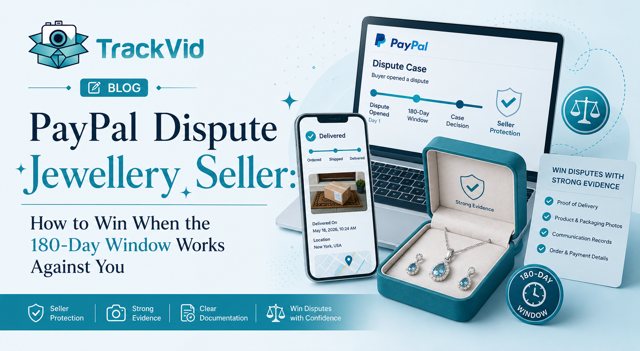
For handmade and independent jewellery sellers accepting PayPal Goods and Services globally. Updated May 2026.
PayPal disputes for jewellery sellers carry a risk that no other platform's dispute system creates to the same degree: the 180-day filing window. A buyer who purchases a piece of jewellery through PayPal Goods and Services has six months from the transaction date to open a dispute. A jewellery seller who dispatched an order in January can receive a PayPal "item not as described" dispute in June with no documentation of what they actually sent.
For sellers on Etsy, this is the chargeback filed through the buyer's bank rather than through Etsy's case system. For sellers on their own Shopify store accepting PayPal, it is the standard buyer protection mechanism. For sellers on eBay using PayPal-integrated payments, it is the same 180-day exposure. The platform does not matter. The window is six months, and six months after a dispatch, most jewellery sellers have no order-level evidence of what they sent.
This is the specific vulnerability that makes PayPal disputes disproportionately costly for jewellery sellers compared to other product categories, and it is the vulnerability that order-linked packing video closes permanently.
How PayPal Disputes Work for Sellers
Understanding the mechanism helps explain why the evidence you submit, not the platform's good intentions, determines the outcome.
When a buyer opens a PayPal dispute, the case moves through two stages. The first is negotiation: PayPal gives the buyer and seller a window to resolve the dispute directly. If unresolved, it escalates to a PayPal claim, at which point PayPal reviews the case and makes a binding decision.
For "Item Not Received" (INR) disputes, PayPal's investigation centres on delivery evidence: tracking confirmation, carrier GPS, delivery to the buyer's registered PayPal address. Sellers with tracked delivery to the correct address win the majority of straightforward INR disputes.
For "Significantly Not as Described" (SNAD) disputes, the investigation is different. PayPal asks: did the item match what was described in the listing? The seller must provide evidence that it did. This is where the evidence gap opens for jewellery sellers and where most losses occur.
PayPal's Seller Protection covers unauthorized transactions and INR claims where tracked delivery to the registered address can be confirmed. For SNAD claims, PayPal's Seller Protection does not apply in the same way. The seller must demonstrate through evidence that the item matched the description. If the buyer is required to return the item, the condition of what arrives back becomes the evidence that PayPal evaluates alongside what the seller originally sent.
Without order-level documentation of the original dispatch, the seller's evidence for a SNAD claim is their listing, their product description, and their account of what was packed. The buyer's evidence is their assertion that the item did not match. PayPal evaluates both. In the absence of independently verifiable dispatch evidence, SNAD disputes are significantly harder for sellers to win.
The 180-day window makes this worse for jewellery sellers than for any other category because the evidence degradation over time is more severe. Six months after a dispatch, a seller may have no memory of the specific piece, may have sold similar pieces since, and will almost certainly have no footage of the specific item that left their hands on that date.
Stockholm Seller Maja: A June Dispute for a January Order
Maja makes and sells Scandinavian-inspired silver jewellery from her studio in Stockholm, listing primarily on her own Shopify store and accepting PayPal Goods and Services at checkout. Her pieces range from SEK 800 to SEK 2,800. She dispatches between 20 and 35 orders per week.
In June 2025, she received a PayPal dispute notification for a SNAD claim on a piece she had dispatched in late January. The buyer claimed the oxidised finish on the ring was uneven in a way that did not match the listing photos, and that the silver felt lighter than expected for the price.
Maja had no specific recollection of this individual order from five months earlier. She had made dozens of similar rings in that period. Her listing photos were beautiful and accurate representations of her work. They showed the oxidised finish exactly as described. But they showed a sample piece from a photoshoot, not the specific ring from order number 7842.
She submitted her listing, her product description, and a written account explaining her oxidisation process. PayPal reviewed the case and found in the buyer's favour. Maja issued the refund and received back a ring that she believed, based on inspection, was not the one she had sent.
She could not prove the difference. She had no footage of what she had packed five months earlier.
A six-month window to dispute means I would need six months of video archives to defend any sale. I had none of that. I had listings from a photoshoot.
When Maja implemented order-linked packing video after this incident, the change was not just to her dispute outcomes. It was to her psychological relationship with the 180-day window. Every order she dispatches now has a permanent record. A dispute filed six months later for any of those orders retrieves the packing video in under two minutes. The 180-day window stopped being a threat and became a defined evidence coverage period.
In the 11 months since, she has received two PayPal SNAD disputes. She has won both by submitting the packing video for the specific order as primary evidence.
The Evidence PayPal Actually Needs by Dispute Type
Winning PayPal disputes as a jewellery seller requires matching evidence to the specific dispute type. Submitting the same package regardless of claim type is the most common preventable loss.
Item Not Received (INR)
PayPal's question: was the item shipped and delivered to the buyer's registered PayPal address?
Primary evidence: tracked delivery confirmation showing the carrier's delivery record to the PayPal address on the transaction. For orders above the relevant threshold in your region, PayPal requires online tracking with a status of "Delivered." For orders below that threshold, proof of shipment is typically sufficient.
Where jewellery sellers lose INR disputes: carriers that mark "delivered" without GPS confirmation, deliveries to shared buildings or post rooms without individual confirmation, and orders where the buyer claims the package arrived empty. For the empty-package variant, delivery confirmation proves arrival but not contents. Only packing video addresses this specific claim.
What PayPal's Seller Protection covers: INR claims where tracked delivery to the registered address is confirmed. This is the dispute type where platform protection is most reliable.
Significantly Not as Described (SNAD)
PayPal's question: did the specific item match what was described in the listing at the time of purchase?
Primary evidence: order-linked packing video showing the specific dispatched piece in the condition and configuration matching the listing description. This is the evidence that directly answers PayPal's question about whether the item matched the description at the order level.
Supporting evidence: listing screenshots from the time of purchase, any pre-purchase buyer communication confirming the specification, return receipt documentation showing the condition of what arrived back.
Where jewellery sellers lose SNAD disputes: submitting listing photos and written accounts as primary evidence. These prove the listing's accuracy. They do not prove that the specific dispatched piece matched the listing. PayPal evaluates what the buyer received, not what the listing showed, and without order-level evidence of the dispatch, the seller's account of what was sent cannot be independently verified.
What PayPal's Seller Protection covers: SNAD disputes are more complex. Seller Protection does not apply to SNAD claims in the same way it applies to INR claims. The seller's submitted evidence is the primary determinant of outcome.
Unauthorised Transaction
PayPal's question: did the account holder authorise this purchase?
Primary evidence: delivery to the billing address, prior transaction history from the same PayPal account, and any communication from the buyer acknowledging the transaction after purchase.
For jewellery sellers: unauthorised transaction claims on high-value pieces are sometimes filed after a SNAD claim has been unsuccessful. If you have prior successful transactions with the same PayPal account, submit that history. PayPal treats established buyer-seller relationships differently from first-transaction disputes.
Why the 180-Day Window Is a Jewellery-Specific Problem
The 180-day PayPal dispute window is a significant exposure for jewellery sellers in a way that does not apply equally to other product categories.
For consumables, perishables, or experience-based products, a 180-day window is largely moot because the product's condition changes over time in ways that make the original dispatch comparison irrelevant.
For jewellery, the 180-day window is highly exploitable because:
A piece of jewellery purchased in January and returned in June can look almost identical to the original if the buyer has kept it carefully. A substituted piece can appear plausible. A damage claim filed six months later is difficult to verify as transit damage versus use damage without documentation of the original dispatch condition.
The seller almost certainly has no footage of the specific piece dispatched six months ago unless they have systematically recorded and indexed every packing session. Most jewellery sellers do not.
The practical result: the 180-day window effectively means that for any PayPal SNAD dispute, the seller needs documented evidence reaching back 180 days for every order that could be disputed. Without indexed, searchable, Order ID-linked archives, that evidence does not exist for the majority of orders.
The sellers who have neutralised the 180-day window are those who have indexed packing video for every order across the full 180-day lookback period. When a dispute arrives on day 173, the packing video for that order is retrieved in under two minutes and submitted. The six-month gap between dispatch and dispute becomes irrelevant because the evidence is indexed and permanent.
The Specific Evidence Gap for Handmade Jewellery SNAD Claims
Handmade jewellery presents a specific evidence challenge that mass-produced items do not: each piece is slightly different from the listing photograph.
A listing photograph shows a sample or a studio piece. The piece the buyer received is a different individual item from the same design. For mass-produced goods, these are functionally identical. For handmade jewellery, the oxidisation shade, the metal texture, the stone shade, and the finish can vary between individual pieces even when the maker's intention and skill are consistent.
This natural variation is what SNAD claims exploit for handmade jewellery. A buyer who expected a specific shade of oxidisation that the listing communicated generally can claim "not as described" on a piece that is accurate to the listing's description but slightly different from the specific listing photo. Without evidence of what the specific dispatched piece looked like, the seller cannot demonstrate that the variation was within the normal range of handmade production rather than a genuine description mismatch.
Order-linked packing video of the specific piece addresses this directly. It shows what was dispatched for this order, not what a studio photo shows. The comparison between the video and the buyer's claim can be evaluated by PayPal's review team on the actual evidence rather than on assertion versus assertion.
Related: How to sell jewellery online safely: the two-category protection framework →
How to Submit a Winning PayPal Dispute Response as a Jewellery Seller
The submission process matters alongside the evidence content. PayPal's Resolution Centre reviews high volumes of disputes. A structured, clearly labelled submission is processed more favourably than the same documents submitted without context.
Step 1: Identify the dispute type immediately. Check the PayPal Resolution Centre notification for the dispute category: INR, SNAD, or unauthorised transaction. Do not gather evidence before knowing which category you are responding to. Each requires different primary evidence.
Step 2: Retrieve the Order ID-linked packing video first. This is your primary evidence for SNAD and empty-package INR disputes. Retrieve it before anything else. If you have TrackVid or a similar indexed system, the video is available in under two minutes by searching the Order ID. If you have manual archives, locate the clip now, before you spend time preparing other documentation.
Step 3: Write a brief, factual response statement. Two to three sentences. Lead with the dispute type and your position: "This is a Significantly Not as Described claim for Order [ID] dated [date]. The attached packing video for this order shows the piece in the condition it was dispatched, matching the listing description." Map each document you are attaching to what it demonstrates.
Step 4: Assemble the evidence package in reference order. Packing video as the primary document. Listing screenshots from the purchase date. Any pre-purchase buyer communication. Return receipt documentation if the piece has already been returned. Label each document.
Step 5: Submit before the escalation deadline. If the dispute is in negotiation, you have a limited window before escalation. Submit your full evidence package before PayPal escalates the case, not after, because the escalation review is based on the complete evidence at that point.
How TrackVid Closes the 180-Day Evidence Gap for PayPal Jewellery Sellers
The practical problem the 180-day window creates is an evidence archive problem: every order dispatched in the last 180 days is a potential PayPal dispute candidate, and the evidence for each one needs to be indexed and retrievable at any point in that window.
Manual approaches fail this requirement at volume. A camera roll of packing clips sorted by date requires manual matching to Order IDs under time pressure when a dispute arrives. For a seller dispatching 20 to 35 orders per week, 180 days of manual archives represent 520 to 910 individual order clips with no searchable index.
TrackVid solves this specifically. Every packing session is recorded and linked to the Order ID at the moment of packing. Videos are stored in indexed cloud, searchable by order number. When a PayPal dispute arrives for order 7842, the packing video for order 7842 is retrieved in under two minutes regardless of when it was packed, whether that was last week or five months ago.
For jewellery sellers accepting PayPal Goods and Services, TrackVid converts the 180-day window from a structural vulnerability into a defined coverage period where every order in the window has permanent, indexed, order-level evidence. The dispute filed on day 173 has the same evidence quality as the dispute filed on day three.
TrackVid works with existing cameras including phone cameras for solo workshop setups. Setup takes under 15 minutes. Evidence is indexed and searchable from the first packing session after activation.
Schedule a free demo at trackvid.in/book-demo.html
Five Questions to Know If Your PayPal Setup Leaves You Exposed
- For every order you dispatched in the last six months, could you produce the packing video in under two minutes by searching the Order ID? If the answer requires searching a camera roll manually or relies on whether you remembered to record that specific day, your 180-day window is undefended for most of those orders.
- Do you know the difference between INR and SNAD dispute types in PayPal, and does your evidence preparation differ for each? Submitting tracking confirmation for a SNAD claim answers the wrong question. Knowing the distinction before a dispute arrives determines the quality of your response under deadline pressure.
- Have you received a SNAD claim on a handmade piece where the buyer disputed natural variation between the listing photo and the dispatched piece? If yes, that dispute was almost certainly unwinnable without packing video of the specific piece. Every similar dispute in the future will have the same outcome without indexed dispatch documentation.
- Do you accept PayPal Goods and Services on your own Shopify or standalone store? Sellers on their own stores have no platform dispute framework as a fallback. PayPal's review of your submitted evidence is the entire process. The quality of your evidence is the entirety of your protection.
- Do you track which of your PayPal dispute losses were SNAD claims versus INR claims? If you have lost more than one SNAD claim in the last 12 months, the pattern is a documentation gap, not bad luck. Each loss represents a dispatch for which order-level evidence did not exist at the time the dispute arrived.
Frequently Asked Questions
How to win a PayPal dispute as a jewellery seller?
Winning a PayPal dispute as a jewellery seller requires matching evidence to the specific dispute type. For Item Not Received disputes, tracked delivery confirmation to the buyer's registered PayPal address is primary evidence. For Significantly Not as Described disputes, order-linked packing video showing the specific dispatched piece is the primary evidence, because listing photos prove the listing's accuracy but not what was in the specific order. For SNAD claims on handmade jewellery, the packing video of the specific piece is the only evidence that answers PayPal's question about whether the dispatched item matched the description. Sellers using TrackVid for indexed, order-linked packing video report winning the majority of SNAD disputes where video is submitted.
Does PayPal seller protection cover jewellery?
PayPal's Seller Protection covers jewellery sellers for eligible Item Not Received claims where tracked delivery to the buyer's registered PayPal address is confirmed. For Significantly Not as Described claims, PayPal's Seller Protection does not apply in the same way. The seller must demonstrate through submitted evidence that the item matched the listing description. For handmade jewellery, where each piece naturally varies slightly from listing photographs, this evidence requirement specifically means order-linked packing video of the dispatched piece rather than the listing photo. The protection gap for SNAD claims is where most PayPal dispute losses for jewellery sellers occur.
PayPal buyer opened dispute on my jewellery: what do I do?
When a PayPal buyer opens a dispute on a jewellery order, first check the dispute type in the PayPal Resolution Centre: INR or SNAD. For INR, retrieve your tracked delivery confirmation immediately. For SNAD, retrieve the packing video for the specific Order ID immediately. Do not wait to see whether the dispute escalates. Prepare your full evidence package now. Submit a brief, factual response in the Resolution Centre stating your position and mapping each document to the specific claim. If you do not have order-linked packing video for the disputed order, submit your listing, any pre-purchase buyer communication, and return receipt documentation if the piece has been returned. Go forward by implementing order-linked packing documentation before the next order ships.
Why did I lose a PayPal dispute for jewellery?
The most common reason jewellery sellers lose PayPal disputes despite a valid case is submitting evidence that answers the wrong question. For SNAD claims, listing photos and product descriptions prove that your listing was accurate. They do not prove that the specific dispatched piece matched the listing. PayPal reviews what the buyer received, not what the listing showed, and without independent evidence of the specific dispatch, the seller's account of what was sent cannot be verified. The second most common reason is the 180-day filing window: a dispute filed months after dispatch finds the seller without any documentation of that specific order's dispatch condition.
How to fight a PayPal not as described claim on jewellery?
To fight a PayPal SNAD claim on jewellery, submit order-linked packing video of the specific dispatched piece as primary evidence. This video shows the piece in its condition at the moment of packing, linked to the specific Order ID, and directly answers PayPal's question about whether the item matched the description. Support this with your listing screenshots from the purchase date and any pre-purchase buyer communication. If the piece has been returned, include return receipt documentation showing the condition of what arrived back. A comparison between dispatch condition and return condition, where the two differ, strengthens the case further. Without order-level dispatch evidence, SNAD claims on handmade jewellery are structurally difficult to win regardless of how legitimate the seller's position is.
Does PayPal protect sellers from false claims?
PayPal's Seller Protection provides specific coverage for eligible INR claims with tracking and eligible unauthorised transaction claims with delivery confirmation. It does not provide the same automatic protection for SNAD claims, where the burden of evidence falls on the seller to demonstrate the item matched the description. False SNAD claims, where a buyer disputes the description of a piece that was correctly dispatched, are not automatically covered by Seller Protection. The seller's evidence determines the outcome. Order-linked packing video is the evidence that makes false SNAD claims unwinnable for buyers, because it independently demonstrates what was dispatched for the specific order and contradicts the false claim directly.
How long does PayPal give buyers to dispute?
PayPal gives buyers 180 days from the transaction date to open a dispute. This is substantially longer than Etsy's dispute window, Amazon's 90-day A-to-Z Guarantee, or most other platform protection periods. For jewellery sellers, this means every order dispatched in the past six months is a potential active dispute candidate at any given time. Without indexed, Order ID-linked packing video archives covering the full 180-day lookback period, sellers cannot produce dispatch evidence for orders where the 180-day window was used. TrackVid stores packing video in indexed cloud with no archive limit, making 180-day-old order footage as retrievable as yesterday's.
What evidence wins a PayPal jewellery dispute?
The evidence that wins a PayPal jewellery dispute depends on the dispute type. For INR claims, tracked delivery confirmation to the buyer's registered PayPal address with a "Delivered" status is primary. For SNAD claims, order-linked packing video showing the specific piece in its dispatch condition is the highest-impact evidence because it directly answers whether the item matched the description at the order level. For unauthorised transaction claims, delivery to the billing address and prior purchase history from the same account are primary. Listing photos alone lose SNAD disputes because they prove the listing's accuracy, not the specific dispatch. According to TrackVid data, sellers who submit order-linked packing video for SNAD disputes win the majority of those cases, compared to significantly lower win rates using standard listing-based documentation.
Sources: PayPal Seller Protection Policy 2026, PayPal Resolution Centre documentation, PayPal Buyer and Seller Protection guidelines, Chargeback.io PayPal Chargeback Guide February 2026, Justt.ai Merchant Chargeback Rights February 2026, TrackVid internal seller data
TrackVid is a video proof and claim management platform used by 1,100+ ecommerce sellers globally. Officially authorised by Snapdeal. Learn more at trackvid.in.


Get the Marketplace Claim Recovery Checklist
A 12-point checklist used by 1,100+ sellers to recover 85-90% of marketplace claim losses. Free, instant access.
- Marketplace-specific evidence formats (AJIO, Flipkart, Amazon, Myntra)
- Claim window deadlines for every major platform
- The 6-step process that pushes approval from 85-90%
- Common rejection reasons and how to avoid them
No spam. Unsubscribe anytime. Used by sellers at Rare Rabbit, HRX, Da Milano + 1,100 more.
Stop Losing Money to Fake Returns
Join 1,100+ sellers who recover lakhs every month with TrackVid