
For online sellers on Shopify, Amazon, marketplaces, and D2C stores. Updated July 2026.
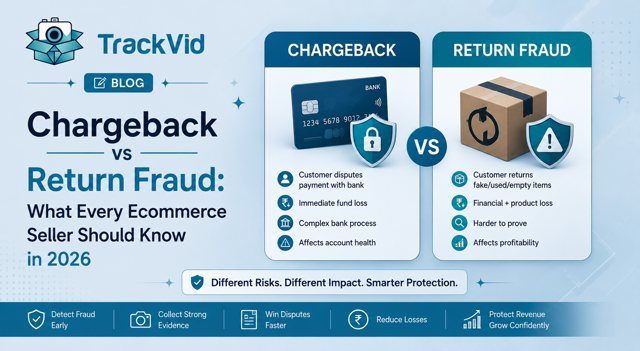
Chargeback vs return fraud is one of the most confused distinctions in ecommerce, and getting it wrong costs sellers money on both sides. A chargeback is a payment dispute: the buyer asks their bank to reverse a card charge. Return fraud is a returns-process abuse: the buyer exploits your return policy to keep the product and still get their money or a replacement. Different mechanism, different battlefield, but the two now bleed into each other, and the defense for both is the same thing most sellers do not have: documentation.
The scale is not small. Return fraud is part of a problem the National Retail Federation puts at roughly 103 billion dollars a year, and friendly fraud now drives the majority of card disputes, around 75 percent of cases, according to Chargebacks911.
Chargeback vs Return Fraud: The Core Difference
The two terms describe two different money-recovery paths a buyer can take against you, and the difference decides who you argue with and what proof wins.
A chargeback runs through the payment system. The customer contacts their issuing bank, disputes the transaction, and the card network forces a provisional reversal of funds from you back to the cardholder. You do not argue with the customer. You argue with the bank, through a process called representment, by submitting evidence that the charge was valid.
Return fraud runs through your returns process. The customer receives the product, then abuses the return path to keep value they are not entitled to. They swap the item for a different one, wear it and send it back, ship an empty box, or use a fake tracking ID so a refund is auto-approved before anyone inspects the parcel. Here you argue with the marketplace or manage the loss directly, and the proof is about what was shipped versus what came back.
A chargeback is a dispute about the payment. Return fraud is a dispute about the product. The overlap between them is where sellers lose the most.
| Chargeback | Return Fraud | |
|---|---|---|
| Who the buyer contacts | Their bank or card issuer | The seller or marketplace |
| What is disputed | The card payment | The returned product |
| Who the seller argues with | The issuing bank, via the card network | The marketplace, or absorbs it directly |
| Winning evidence | Proof of a valid, delivered order | Proof of what was packed and shipped |
| Typical form | Friendly fraud, item-not-received claims | Swap, wardrobing, empty box, FTID |
When Return Fraud Becomes a Chargeback
The two problems are not sealed off from each other. A common pattern is the double dip. A buyer requests a refund through the return process, keeps the product, and if the seller or marketplace pushes back, files a chargeback with their bank to recover the money a second way.
This is why fighting one channel in isolation fails. Tighten your returns without a payment-side defense and the loss simply migrates to a chargeback. First-party fraud, where a real customer disputes a charge they actually authorized, is now the leading fraud type globally at 36 percent of reported fraud, up from 15 percent a year earlier, according to industry data.
The buyer who abuses a return and the buyer who files a friendly-fraud chargeback are increasingly the same person. That is the strongest argument for a single evidence layer that answers both.
Why Both Are Getting Worse in 2026
On chargeback vs return fraud, the numbers on both sides are moving the wrong way for sellers.
On the chargeback side, disputes are rising and each one costs far more than the transaction. Every dollar lost to chargebacks costs merchants between 3.75 and 4.61 dollars once fees, lost goods, and labor are counted, a 37 percent increase since 2021, according to industry chargeback data. Chargebacks911 projects that 61 percent of disputes will be friendly fraud by 2026, and first-party fraud has become the leading fraud type globally, representing a 132 billion dollar risk to ecommerce.
On the return side, abuse is climbing just as fast. Return abuse surged 64 percent between January 2024 and May 2025, according to Signifyd, and 45 percent of consumers admit to some form of return policy abuse, according to Riskified. A small group does most of the damage: serial returners, around 5 to 10 percent of buyers, drive 30 to 40 percent of returns, according to Claimlane.
Put together, a seller in 2026 is exposed from two directions at once. The same dishonest customer can request a refund fraudulently through returns, and if that fails, dispute the charge through their bank. Fighting one without the other just moves the loss.
The problem is not the fraud. It is the proof.
A Global Operator Story: From 4,200 Dollars a Month Written Off to Documented
A D2C apparel brand shipping about 500 orders a day from a single fulfillment center had a loss it could not close. Buyers were disputing charges and abusing returns in roughly equal measure, and the operations lead could not win either fight.
The pattern was consistent. A customer would receive an order, claim the item never arrived or was wrong, and file a chargeback. When the brand tried to fight it, the bank asked for compelling evidence, and all the brand had was a shipping label and a tracking number that proved a parcel moved, not what was inside it. On the returns side, buyers sent back worn items and empty boxes, and without proof of what shipped, the brand ate the loss. It was writing off close to 4,200 dollars a month across the two.
The team tried the usual defenses. Stricter return windows annoyed honest customers without stopping the abusers. Tracking numbers won a few item-not-received chargebacks but did nothing for swaps and wardrobing.
The change was building an evidence layer at packing. Every order was recorded and the video linked to the order number and tracking ID at the moment it was packed. When a chargeback came in claiming a wrong or missing item, the brand submitted the packing video as compelling evidence. When a return came back swapped, the same video proved what had actually shipped.
Recovered disputes roughly tripled over a quarter, and the monthly write-off fell from 4,200 dollars to under 1,100.
"We were losing both fights for the same reason," the operations lead said. "We could prove a box left the building. We could never prove what was in it. The day we could, the disputes stopped going the customer's way."
How to Fight a Chargeback as a Seller
Winning a chargeback is about giving the issuing bank a clean, verifiable story. The process is called representment, and it rewards specific evidence over argument.
- Read the reason code. The chargeback arrives with a code that tells you what the buyer claimed: item not received, not as described, or unauthorized. Your evidence has to answer that specific claim.
- Gather proof the order was valid and delivered. Order confirmation, delivery confirmation, matching billing and shipping details, and any customer communication.
- Prove what was actually shipped. For not-as-described and wrong-item claims, order-linked packing video is the strongest evidence, because it shows the correct product going into the specific order.
- Submit inside the network window. Card networks give tight response windows. A strong case filed late is an automatic loss.
- Track outcomes and patterns. Repeat disputers and recurring reason codes tell you where to tighten checkout and fulfillment.
The same evidence discipline that wins a chargeback also deters return fraud, because a buyer who knows their order was recorded is far less likely to try a swap or an empty-box return in the first place.
Where Proof Closes Both Gaps
The reason sellers lose chargeback vs return fraud disputes is rarely that their loss was not real. It is that they cannot prove the specifics fast enough. This is where TrackVid (trackvid.in) fits.
TrackVid records every order at packing and links each video to the order number, SKU, and tracking ID automatically, then stores it in searchable cloud. When a chargeback lands claiming a wrong or missing item, the seller pulls the exact packing clip and submits it as compelling evidence in the representment. When a return comes back swapped or short, the same video proves what shipped. One evidence layer answers both the payment dispute and the product dispute.
That is the practical answer to chargeback vs return fraud: stop treating them as two problems with two defenses. Build proof once, at packing, and use it on whichever front the loss arrives. TrackVid is used by 1,100+ ecommerce sellers, works with existing cameras, and installs in under 15 minutes.
For the wider fraud picture, see Related: the complete ecommerce fraud prevention guide, and for one of the fastest-growing return scams, see Related: how sellers stop FTID fraud.
Five Questions to Test Your Dispute Defense
These questions show where you are exposed on chargeback vs return fraud.
1. When a chargeback claims a wrong or missing item, can you prove what was actually inside the parcel?
A tracking number proves movement, not contents.
2. Can you retrieve the evidence for any order in minutes, inside the card network response window?
If retrieval is slow, valid cases lose on timing.
3. Do you know what share of your losses are chargebacks versus return fraud?
If you cannot split them, you cannot defend either properly.
4. Is your packing evidence linked to the order and tracking ID, or is it loose footage?
Unlinked evidence is hard for a bank or marketplace to verify.
5. Would a dishonest customer assume you can prove what you shipped?
If not, you are an easy target for both a chargeback and a return scam.
Schedule a free demo at trackvid.in/book-demo.html
In one session, you will see exactly where your recoverable revenue is going and what a structured proof system looks like in your specific operation.
TrackVid works with your existing warehouse cameras. Setup takes under 15 minutes.
Frequently Asked Questions
Chargeback vs return fraud difference
A chargeback is a payment dispute where the buyer asks their bank to reverse a card charge. Return fraud is a returns-process abuse where the buyer keeps the product and still recovers value, through swaps, worn returns, empty boxes, or fake tracking. One is fought with the bank, the other with the marketplace, but both are won with proof of what was shipped.
What is friendly fraud ecommerce
Friendly fraud, also called first-party fraud, is when a legitimate customer disputes a valid charge they actually made, often claiming the item never arrived or was not as described. It now drives around 75 percent of card disputes, according to Chargebacks911, and represents a 132 billion dollar risk to ecommerce. Order-linked proof of a valid, delivered order is the main defense.
How to fight a chargeback as a seller
Read the reason code, gather proof the order was valid and delivered, and submit order-linked evidence of what was actually shipped inside the card network's response window. For wrong-item and not-as-described claims, packing video is the strongest evidence. Every dollar lost to chargebacks costs merchants 3.75 to 4.61 dollars all-in, according to industry data, so winning representments protects real margin.
Chargeback meaning ecommerce
A chargeback is a forced reversal of a card payment initiated by the buyer's bank after the buyer disputes a transaction. The funds are pulled from the merchant and returned to the cardholder unless the merchant wins the dispute with compelling evidence. It is a payment-system mechanism, separate from your store's refund and return process.
Customer got refund and kept product what is that
That is a form of return fraud or refund abuse. The buyer recovers money while keeping the item, often by returning an empty box, a swapped product, or by disputing after receiving the goods. If it runs through the bank as a card dispute, it also becomes friendly fraud. The defense is order-linked proof of what was shipped and received.
How to win a chargeback dispute
You win by matching your evidence to the reason code and submitting it on time: delivery confirmation for item-not-received, and packing video for wrong-item or not-as-described. Clear, verifiable, order-linked evidence beats written argument. Tools like TrackVid store this proof by order number so it is retrievable within the response window.
Is return fraud a chargeback
Not always. Return fraud happens inside your returns process, while a chargeback happens inside the payment system. They overlap when a buyer abuses a return and then also disputes the charge with their bank, which is common. Sellers who defend only one of the two keep losing on the other.
What is the best way to prevent chargeback and return fraud for ecommerce sellers
The best approach is a single evidence layer built at packing: order-linked video that proves what shipped, retrievable in minutes for both bank representments and marketplace return disputes. This deters abuse and wins the disputes that still happen. TrackVid provides this layer and is used by 1,100+ ecommerce sellers across major marketplaces.
Sources: National Retail Federation (NRF), Chargebacks911, Chargeflow, Signifyd 2026, Riskified 2026, Claimlane 2026, TrackVid data.
TrackVid is a video proof and claim management platform used by 1,100+ Indian ecommerce sellers on Amazon, Flipkart, AJIO, Myntra and Meesho. Officially authorised by Snapdeal. Learn more at trackvid.in.


Get the Marketplace Claim Recovery Checklist
A 12-point checklist used by 1,100+ sellers to recover 85-90% of marketplace claim losses. Free, instant access.
- Marketplace-specific evidence formats (AJIO, Flipkart, Amazon, Myntra)
- Claim window deadlines for every major platform
- The 6-step process that pushes approval from 85-90%
- Common rejection reasons and how to avoid them
No spam. Unsubscribe anytime. Used by sellers at Rare Rabbit, HRX, Da Milano + 1,100 more.
Stop Losing Money to Fake Returns
Join 1,100+ sellers who recover lakhs every month with TrackVid