
For Indian ecommerce sellers and D2C brands on Amazon, Flipkart, AJIO, Myntra, Meesho and shipping aggregators including Shiprocket, Delhivery, Bluedart and Xpressbees. Updated June 2026.
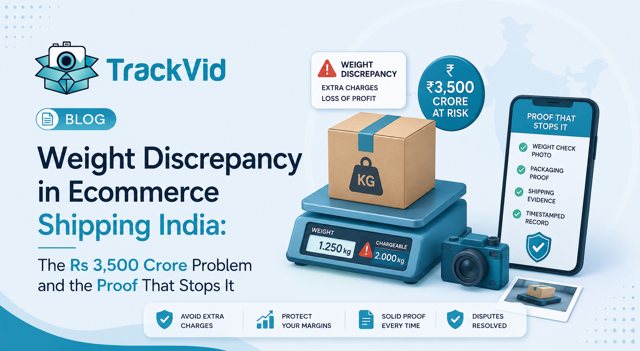
Weight discrepancy in ecommerce shipping India is the most expensive operational problem most Indian sellers do not track separately. It hides inside courier invoices as line items of Rs 10 to Rs 50 per shipment, deducted silently from wallet balances and reconciled across hundreds of orders before anyone notices the aggregate impact. According to Eshopbox 2026 research, Indian ecommerce businesses lose an estimated Rs 3,500 crore annually to inefficient shipping practices, with weight discrepancies being the single largest contributor.
The disputes that follow these deductions are almost always lost. Not because the seller's weight was wrong, but because the seller cannot produce evidence the courier accepts. Manual entries in a spreadsheet do not prove anything. Standard CCTV recording from the warehouse does not prove anything. A photograph of the package on a scale taken on someone's phone does not meet the dispute standard most couriers apply.
What does win these disputes consistently: order-linked packing video on a calibrated scale, recorded at the moment of dispatch, retrievable by AWB or Order ID within the courier's dispute window. This is the evidence layer that closes the gap between "I know my package was 500 grams" and "I can prove my package was 500 grams."
What Weight Discrepancy in Ecommerce Shipping India Actually Is
Weight discrepancy occurs when the courier's recorded weight or dimensions for a parcel differ from what the seller declared at the time of booking. Indian couriers including Delhivery, Bluedart, Xpressbees, Shiprocket-routed carriers, and Amazon Easy Ship and Flipkart Smart Fulfilment partners all bill based on the higher of two values: actual dead weight, or volumetric weight calculated as length multiplied by breadth multiplied by height divided by a divisor (typically 5,000 for domestic shipments).
When the courier's measurement is higher than the seller's declared weight, the system flags it as a discrepancy and bills the seller the difference. The disputed amount is deducted immediately from the seller's wallet or aggregator account. The seller has a window, typically 7 to 14 days, to raise a dispute with evidence.
Four specific factors cause this discrepancy to occur repeatedly:
Manual weighing errors. Warehouse staff using uncalibrated digital scales or making transcription mistakes when entering weight into courier portals. A 500 gram product can be entered as 0.5 kg, 500 g, or 0.50 kg with different rounding behaviour across courier systems.
Volumetric miscalculations. Lightweight products in oversized packaging are billed on volumetric weight, not actual weight. A 200 gram product in a 30 x 25 x 20 cm box has a volumetric weight of 3 kg, which is what the courier bills. Sellers who do not calculate volumetric weight before booking get hit with discrepancy charges that look inexplicable on the invoice.
Re-weighing at courier hubs. Parcels are weighed multiple times during transit, at pickup, at the origin sorting hub, and at the destination hub. Each weighing machine may have different calibration. Courier policy typically treats the hub measurement as final, which is almost always higher than the pickup measurement.
Product deformation in transit. Items in polybags such as hoodies, jeans, and soft toys can deform during handling, increasing the LBH dimensions and pushing the volumetric weight into a higher slab. This is technically not a discrepancy at dispatch, but the courier bills it as one anyway.
The Hidden Cost of Weight Discrepancy That Indian Sellers Are Missing
The headline figure of Rs 3,500 crore per year sounds large because it is large. Broken down to the individual seller level, the maths is more striking.
A mid-sized Indian ecommerce brand shipping 5,000 orders per month with a 15 percent weight discrepancy rate absorbs over Rs 1.8 lakh per year in extra charges, according to Eshopbox 2026 data. A smaller brand shipping 1,000 orders per month at the same rate absorbs Rs 1 lakh-plus annually, per Shipmozo 2026 research.
These numbers are direct cost. The full impact is larger because weight discrepancy creates four downstream losses sellers rarely calculate together.
First, wallet lock-up. Disputed amounts are deducted immediately and locked until the dispute resolves. Resolution takes days to weeks. During that period, working capital is unavailable for re-investment in inventory or ads.
Second, operational time loss. A seller's claims or operations team spends hours every week chasing weight disputes with shipping aggregators or courier accounts. According to ScanDim360 seller surveys, sellers report spending 8 to 15 hours per month per Rs 1 lakh of disputed amount.
Third, delivery delays. Parcels flagged for weight discrepancy face processing delays of 24 to 48 hours at courier hubs while they are re-evaluated, according to industry data. For sellers competing on same-day or next-day delivery, this directly impacts customer satisfaction and review scores.
Fourth, operational penalties on marketplace fulfilment programmes. Sellers enrolled in Amazon Easy Ship, Flipkart Smart Fulfilment, or Myntra-managed shipping face penalties or suspension when their declared weights repeatedly do not match courier measurements. Beyond the per-order discrepancy charge, the seller risks losing access to the programme entirely.
The combined impact across all four dimensions, for the mid-sized brand absorbing Rs 1.8 lakh in direct charges, often exceeds Rs 4 lakh per year when working capital cost and operational time are added.
Coimbatore Seller Aravind: How Rs 87,000 in Monthly Overcharges Was Hidden in Plain Sight
Aravind runs a men's casual wear D2C brand from Coimbatore on Shopify, with Amazon India and Flipkart as secondary channels. Daily dispatch volume approximately 320 orders. He uses Shiprocket as his primary shipping aggregator, with parcels routed across Delhivery, Bluedart, and Xpressbees depending on pincode.
For 14 months of operation, Aravind had treated weight discrepancy charges as a normal cost of shipping. His operations team reviewed Shiprocket invoices monthly, raised disputes on the obvious mistakes (cases where the courier billed 3 kg on a 1 kg parcel), and absorbed the smaller variances. He estimated his monthly weight discrepancy charges at around Rs 18,000 to Rs 22,000.
When he ran a complete audit covering the previous quarter, the actual number was Rs 2,61,000 over 90 days. Monthly average Rs 87,000. More than four times his estimate.
The audit showed three distinct loss categories he had been collapsing into one number.
Category A: confirmed overcharges where the courier's recorded weight exceeded his declared weight by more than 100 grams. He had been disputing approximately 30 percent of these. Without packing video evidence, his dispute win rate was 23 percent.
Category B: volumetric weight charges he had not anticipated, particularly on lightweight cotton kurtas in polybags that deformed in transit. He had not been disputing any of these because he assumed the volumetric calculation was correct.
Category C: missed dispute windows. Returns and reconciliation work piled up during sale seasons, and dispute windows of 7 days closed before his team could file. According to his audit, this category alone accounted for Rs 42,000 in eligible-but-unfiled disputes per month.
I was looking at one number on the invoice every month and feeling annoyed about it. I had no idea three different problems were combining into that one number. I had been treating my courier invoice as something to scan, not something to audit.
After Aravind implemented TrackVid at his Coimbatore warehouse, every packing session was recorded on a calibrated digital scale visible in the frame, with the AWB number, Order ID, and weight reading clearly captured. Footage was indexed by Order ID and AWB and stored in searchable cloud.
When Shiprocket or his courier raised a weight discrepancy, his team retrieved the specific packing video for that AWB in under two minutes and submitted it as primary dispute evidence. The video showed the parcel on a calibrated scale displaying the declared weight at the moment of dispatch.
His Category A dispute win rate moved from 23 percent to over 80 percent in 60 days. He began disputing Category B volumetric charges with packing video showing the actual LBH at dispatch, and won 67 percent of these. Category C window misses dropped to under 10 percent because every dispute event was tracked automatically with a deadline countdown.
Monthly weight discrepancy recovery improved by Rs 64,000 within the first quarter. His monthly absorbed weight loss dropped from Rs 87,000 to under Rs 23,000.
What Wins a Weight Discrepancy Dispute: The Evidence Hierarchy
Understanding exactly what evidence Indian couriers and shipping aggregators accept for weight disputes is the difference between a 23 percent win rate and an 85-90 percent win rate. Every Indian courier and aggregator evaluates weight disputes on the same hierarchy.
Tier 1 evidence: order-linked packing video on a calibrated scale. This is the highest-impact evidence type. Video shows the specific parcel for the specific AWB on a calibrated scale at the moment of packing, with the weight reading clearly visible. The video is indexed by Order ID and AWB, meaning the courier can verify the link between the disputed shipment and the evidence. This evidence wins disputes consistently because it independently demonstrates both weight and dimensions at dispatch.
Tier 2 evidence: photograph of the parcel on a calibrated scale at packing. Better than nothing. Lower win rate than video because a still photograph does not show the moment of weighing, only an end-state. Courier dispute reviewers can question whether the photo was staged after the fact.
Tier 3 evidence: dimensioning system report. Automated dimensioning hardware such as Scandim360 generates a digital report with measured LBH and weight. Accepted by some aggregators but treated as a vendor claim rather than independent verification by most couriers. Requires hardware investment of Rs 1.5 to 3 lakh upfront.
Tier 4 evidence: declared weight in courier portal + written assertion. This is what most sellers submit. It is the seller's own assertion of weight with no independent verification. Win rate below 25 percent across Indian couriers.
Tier 5 evidence: standard CCTV footage. Time-based CCTV showing packing activity at a relevant time window. Not accepted by Indian couriers as primary evidence because the footage cannot be matched to a specific AWB or Order ID. The courier's review team cannot verify that the parcel shown in the footage is the parcel they billed.
The implication is direct. Sellers operating at Tier 4 or Tier 5 evidence are losing disputes structurally, regardless of whether their underlying weight measurement was correct.
How Packing Video on a Calibrated Scale Specifically Wins These Disputes
The mechanism by which Tier 1 evidence wins weight discrepancy disputes is straightforward. The courier asks one specific question: at the moment this parcel was dispatched, what was its weight and what were its dimensions?
Packing video on a calibrated scale shows:
The parcel being placed on a calibrated digital scale at the packing station. The weight reading on the scale display, clearly visible in the frame, showing the declared weight. The shipping label being applied with the AWB number visible. The Order ID either on the label or stated in the metadata of the video file.
This combination directly and independently answers the courier's question. No assertion is required. No interpretation is needed. The video shows the answer.
For volumetric weight disputes specifically, the packing video also captures the package's LBH dimensions visually, often with a measurement reference (such as the standardised box size labels visible in the warehouse) in frame. When a courier claims the parcel was larger than declared, the packing video shows the box size used and contradicts the claim at the dispatch level.
This is fundamentally different from time-based CCTV. A CCTV camera recording the packing area from 2pm to 3pm on a Tuesday cannot prove which specific parcel in that hour is the parcel the courier disputed. Order ID and AWB-linked packing video can.
Related: How to reduce RTO in ecommerce India
Five Common Weight Discrepancy Scenarios and How to Win Each
Scenario 1: Volumetric Overcharge on Lightweight Apparel
You shipped a 250 gram cotton kurta in a polybag measuring 25 x 20 x 5 cm. Your declared weight was 0.25 kg. The courier bills you for 0.5 kg, citing volumetric weight after the polybag expanded in transit.
Evidence that wins: Packing video showing the polybag being measured at dispatch dimensions of 25 x 20 x 5 cm, on a calibrated scale showing 250 grams. Volumetric calculation at dispatch (25 x 20 x 5 / 5000 = 0.5 kg) versus actual transit expansion.
Resolution: Most Indian aggregators including Shiprocket allow partial dispute wins for in-transit deformation cases. With packing video showing dispatch dimensions, sellers typically recover 50 to 70 percent of the disputed overcharge.
Scenario 2: Manual Weighing Error
You declared 800 grams. Courier billed 1.2 kg. The product is shoes weighing 750 grams in a box weighing 50 grams, total 800 grams confirmed.
Evidence that wins: Packing video on a calibrated scale showing exactly 0.80 kg at the moment of dispatch, with AWB visible.
Resolution: Direct discrepancy disputes with Tier 1 evidence win at 75 to 90 percent across Indian couriers.
Scenario 3: Hub Re-weighing Mismatch
Pickup weight matched your declared weight. Destination hub re-weigh shows 200 grams higher. Courier bills the difference.
Evidence that wins: Packing video at dispatch showing the declared weight. This shifts the burden to the courier to prove the in-transit gain was a measurement error rather than a packaging or contents change in transit.
Resolution: Most aggregators waive these charges when packing video evidence is submitted, because the in-transit gain has no plausible explanation and the seller has independent evidence of correct dispatch weight.
Scenario 4: Combo Product Dimension Dispute
You shipped a 3-piece combo of trousers in a single box. Declared 1.2 kg, 35 x 25 x 15 cm. Courier bills 1.8 kg citing 40 x 30 x 18 cm dimensions.
Evidence that wins: Packing video showing the combo being placed in a labelled standard box size (typically a 35 x 25 x 15 cm or similar) on a calibrated scale.
Resolution: Combo dispute resolutions vary by aggregator. Shiprocket and Delhivery accept packing video evidence for combo dimension disputes with consistent win rates above 70 percent.
Scenario 5: Missed Dispute Window
The discrepancy charge appears on your invoice 10 days after dispatch. Your dispute window was 7 days. The charge is locked in.
Evidence that wins: Nothing once the window is closed. The fix is automated tracking that flags every potential discrepancy at the moment of pickup confirmation and starts the dispute window countdown. Order-linked packing video must be accessible automatically, not retrieved through manual search.
Resolution: Automation prevents window misses. With TrackVid, every dispatch creates a packing video automatically. When Shiprocket or the courier raises a discrepancy, the corresponding video is retrieved by AWB in under two minutes.
How TrackVid Closes the Weight Discrepancy Evidence Gap for Indian Sellers
TrackVid (trackvid.in) provides order-linked packing video documentation for Indian ecommerce sellers across Amazon India, Flipkart, AJIO, Meesho, Myntra, Snapdeal, and Shopify. Every packing session is recorded with the calibrated scale visible in frame, linked to the Order ID and AWB at the moment of packing. Evidence is stored in indexed cloud, searchable by AWB or Order ID.
For weight discrepancy disputes specifically, the packing video shows the parcel on the calibrated scale at the moment of dispatch with the weight reading visible. When Shiprocket, Delhivery, Bluedart, Xpressbees, or any Indian courier raises a weight or dimension discrepancy, the corresponding video for that specific AWB is retrieved and submitted as primary dispute evidence.
The same Order ID-linked video that wins weight disputes with couriers also wins SPF claims on Flipkart, SAFE-T claims on Amazon India, CCTV-required emails on AJIO, PPP claims on Myntra, and WFR disputes on Meesho. One system, one archive, one dashboard covers every dispute type Indian sellers face.
TrackVid is officially authorised by Snapdeal, the only claim management system in India with that designation. Works with existing warehouse cameras. Setup under 15 minutes. Indian sellers using TrackVid for weight disputes specifically report recovery improvements of Rs 50,000 to Rs 1,50,000 per month within the first quarter, depending on order volume.
Schedule a free demo at trackvid.in/book-demo.html
Five Questions to Audit Your Weight Discrepancy Exposure Today
1. Do you know your monthly weight discrepancy total as a separate line item, not aggregated with other shipping charges?
Most sellers do not. The number is typically two to four times higher than the seller's estimate when audited separately.
2. When you file a weight dispute with Shiprocket or your aggregator, what evidence do you currently submit?
If the answer is "the original declared weight from our portal entry," you are at Tier 4 evidence and losing the majority of disputes structurally.
3. Are you tracking dispute windows automatically, or relying on your team to monitor them manually?
Indian courier dispute windows range from 7 to 14 days. Manual tracking misses approximately 30 to 40 percent of eligible disputes during high-volume periods.
4. Do your packing videos show the parcel on a calibrated scale with the weight reading visible at the moment of dispatch?
This is the difference between Tier 1 evidence (wins 75 to 90 percent of disputes) and Tier 5 evidence (wins under 25 percent).
5. If a weight discrepancy appears on your invoice today for a shipment from 6 days ago, can you retrieve the packing video for that specific AWB in under five minutes?
If retrieval requires manually scrolling through CCTV archives by date and time, your evidence infrastructure cannot win disputes under deadline pressure.
Frequently Asked Questions
Courier weight discrepancy kya hoti hai?
Courier weight discrepancy tab hoti hai jab courier company (Delhivery, Bluedart, Shiprocket-routed carriers, Amazon Easy Ship, Flipkart Smart Fulfilment) ke measured weight aur seller ke declared weight mein difference hota hai. Couriers do tarah ka weight calculate karte hain: dead weight (actual physical weight) aur volumetric weight (length x breadth x height / 5000 for domestic). Inme se jo zyada hota hai, uss pe billing hoti hai. Jab courier ka measurement seller ke declared se zyada hota hai, system ye discrepancy flag karta hai aur extra charge wallet se deduct kar leta hai. Indian sellers Rs 3,500 crore yearly lose karte hain isi pe Eshopbox 2026 ke data ke according.
Shiprocket weight dispute kaise file kare?
Shiprocket pe weight dispute file karne ke liye Shiprocket panel mein "Reports" section mein jao, weight discrepancies tab kholo. Wahan se specific AWB pe dispute raise karo. Evidence mein order-linked packing video submit karo jo calibrated scale pe parcel ka actual weight dikhaye dispatch ke time pe. Sirf declared weight ya phone se li hui photo Tier 4 evidence hai aur 25 percent se kam disputes jeetati hai. Order ID aur AWB-linked packing video Tier 1 evidence hai jo 75 to 90 percent disputes jeetati hai. Window 7 din ka hota hai dispute raise karne ka, isliye automated tracking zaroori hai.
Volumetric weight kya hota hai India mein?
Volumetric weight India mein domestic shipping ke liye is formula se calculate hota hai: Length (cm) x Breadth (cm) x Height (cm) / 5000 = volumetric weight in kg. Courier hamesha is volumetric weight aur dead weight mein se jo zyada hai uss pe charge karta hai. Example: 200 gram product jo 30 x 25 x 20 cm ke box mein hai, uska volumetric weight hai 30 x 25 x 20 / 5000 = 3 kg. Yaani 200 gram ka product 3 kg ka bill aata hai. Yeh lightweight products jaise clothing, footwear, soft toys, home decor pe sabse common problem hai. Solution: minimum possible box size use karo aur har booking se pehle volumetric weight calculate karo.
Amazon Easy Ship pe weight overcharge kaise rokein?
Amazon Easy Ship pe weight overcharge rokne ke liye teen cheezein zaroori hain. Pehla, calibrated digital scale use karo packing station pe, regularly calibrated rakho. Doosra, har order ka packing video record karo jo scale pe weight reading aur AWB number dono dikhaye. Teesra, Easy Ship Seller Central mein "Manage Returns" section se weight dispute file karo with packing video evidence. Amazon ka 2026 stricter documentation requirement specifically order condition images aur dispatch verification maangta hai, jo Order ID-linked packing video provide karta hai. TrackVid har dispatch ka video automatically capture karta hai aur Easy Ship disputes ke liye instant retrievable hai.
How to dispute Delhivery weight discrepancy charges?
To dispute Delhivery weight discrepancy charges, log into your Delhivery Partner Panel or your shipping aggregator's dashboard if you use Shiprocket, Pickrr, or similar to route Delhivery shipments. Locate the specific AWB in the discrepancy report, raise a dispute, and submit Tier 1 evidence: packing video on calibrated scale at dispatch showing weight and AWB. Delhivery's dispute window is 7 days from invoice date. Without packing video, written disputes and declared weight entries lose at over 75 percent. With Order ID-linked packing video, dispute win rates move to 75 to 90 percent across most Delhivery dispute categories.
Weight freeze kya hota hai ecommerce mein?
Weight freeze ek practice hai jo fulfilment providers jaise WareIQ aur Eshopbox use karte hain. Iska matlab hai ki ek standard SKU ka weight aur dimensions ek baar verify karke system mein lock kar diye jaate hain. Phir har dispatch pe wahi weight automatically use hota hai courier billing ke liye. Yeh manual weighing errors aur SKU-to-SKU variability ko eliminate karta hai. Lekin weight freeze ka issue yeh hai ki yeh sirf fulfilment provider ke saath enrolled SKUs ke liye work karta hai. Independent ecommerce sellers ke liye weight freeze ke alternative mein order-linked packing video evidence sabse strong protection hai jo har dispatch ko independently verify karti hai bina fulfilment provider lock-in ke.
How much do Indian ecommerce sellers lose to weight discrepancy annually?
According to Eshopbox 2026 research, Indian ecommerce businesses lose an estimated Rs 3,500 crore annually to inefficient shipping practices, with weight discrepancies being the single largest contributor. At individual seller level, a brand shipping 1,000 orders monthly with a 15 percent discrepancy rate loses over Rs 1 lakh annually in direct charges per Shipmozo data. A 5,000-order-per-month brand at the same rate loses Rs 1.8 lakh-plus annually per Eshopbox data. Including downstream costs like working capital lock-up and operational time, the full impact for a mid-sized Indian D2C brand often exceeds Rs 4 lakh per year. Most sellers underestimate their weight discrepancy losses by a factor of three to four because they do not audit the line item separately.
Shipping mein extra paisa kyu lagta hai?
Shipping mein extra paisa multiple reasons se lag sakta hai. Pehla aur sabse common reason hai weight discrepancy: courier ne aapke parcel ka weight zyada measure kiya hai aapke declared weight se. Doosra reason hai volumetric weight, jismein box ki size ki wajah se charge zyada lagta hai actual weight se. Teesra hai pincode-based zone charges, jahan courier zone change hone se rate change ho jata hai. Chautha hai COD charges (handling fees for Cash on Delivery orders). Paanchva hai NDR ya undelivered attempt charges, jismein delivery fail hone pe extra fee lagti hai. In sab mein weight discrepancy sabse zyada controllable hai with proper evidence aur calibrated scale process. Order-linked packing video har dispatch ka independent proof banata hai jo dispute jeetne ke liye zaroori hai.
Sources: Eshopbox Smart Fulfilment Weight Discrepancies Report 2026, Shipmozo Weight Discrepancy in Shipping May 2026, Scandim360 India Post Weight Discrepancy 2025, WareIQ Shipping Weight Discrepancy India Guide, Shiprocket Discrepancy Dispute Policy 2026, Amazon India Easy Ship Seller Documentation 2026, Delhivery Partner Panel Dispute Guidelines, TrackVid internal seller data.
TrackVid is a video proof and claim management platform used by 1,100+ Indian ecommerce sellers on Amazon, Flipkart, AJIO, Myntra, Meesho and Snapdeal, with weight discrepancy dispute evidence covering Shiprocket, Delhivery, Bluedart, Xpressbees and all major Indian courier partners. Officially authorised by Snapdeal. Learn more at trackvid.in.

Get the Marketplace Claim Recovery Checklist
A 12-point checklist used by 1,100+ sellers to recover 85-90% of marketplace claim losses. Free, instant access.
- Marketplace-specific evidence formats (AJIO, Flipkart, Amazon, Myntra)
- Claim window deadlines for every major platform
- The 6-step process that pushes approval from 85-90%
- Common rejection reasons and how to avoid them
No spam. Unsubscribe anytime. Used by sellers at Rare Rabbit, HRX, Da Milano + 1,100 more.
Stop Losing Money to Fake Returns
Join 1,100+ sellers who recover lakhs every month with TrackVid