
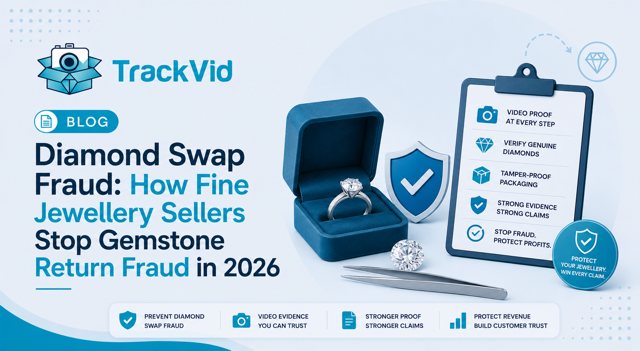
For sellers on Etsy, Amazon Handmade, Shopify and global marketplaces. Updated June 2026.
Diamond swap fraud is the single highest-per-incident loss category in ecommerce jewellery. The mechanism is documented and consistent. A buyer purchases a GIA-certified diamond ring, receives it, replaces the certified stone with a counterfeit, moissanite, or lower-grade natural diamond of similar appearance, and files a return citing a defect. The seller receives back what looks like the original piece, processes the refund, and only discovers the swap on the next inspection cycle, if at all. A single successful swap on a $12,000 diamond ring transfers roughly $8,000-9,600 from seller to fraudster.
According to NRF 2026 data, 9 percent of returns are fraudulent, and 64 percent of retailers tracking incidents report an increase in decoy returns. CBP seized $30 million in counterfeit Van Cleef & Arpels earrings in a single Louisville shipment. Jewellery and watches have been the top commodities seized by US Customs for intellectual property infringement three consecutive years. Signifyd research shows 24 percent of consumers admit returning a different item than purchased.
Sellers who deploy GIA or IGI laser inscription verification, dispatch packing video showing the inscription, and return inspection video win diamond swap fraud disputes at 75 to 90 percent versus under 20 percent for sellers relying on written descriptions alone.
The Four Patterns of Diamond Swap Fraud
Diamond swap fraud runs on four documented patterns, each with its own fraud economics and defensive response.
Pattern 1: The direct swap. Buyer receives a GIA-certified natural diamond, replaces the stone with a lab-grown diamond or moissanite of similar dimensions, and returns citing colour issues or dissatisfaction. Substitute stone cost $200-$800. Value transferred to fraudster $3,000-$15,000. Success rate against sellers without laser inscription verification approaches 90 percent.
Pattern 2: The bracket scam. Buyer purchases a known-authentic branded piece (Cartier, Tiffany, Van Cleef & Arpels, Rolex-set diamond) alongside a counterfeit of the same design. Returns the counterfeit in the original branded packaging citing a defect. Requires two transactions and higher upfront cost, but payout on high-end pieces regularly exceeds $20,000.
Pattern 3: The setting-only swap. Buyer receives a diamond ring with a 1-carat centre stone plus small accent diamonds. Returns the ring with the centre stone swapped and accents intact. The setting appears identical on quick inspection. Targets sellers who do not verify individual stone weights or accent specifications on return.
Pattern 4: The gemstone downgrade. Buyer receives a piece with a specific colour and clarity grade (G colour, VS1 clarity). Returns the same-dimension piece with a lower grade stone (I colour, SI2 clarity). Value difference between grade levels on a single 1-carat diamond can be $1,500-$4,000.
All four patterns share one defensive requirement: the seller needs specific evidence that the exact stone dispatched is different from the exact stone returned.
CCTV records everything. That is also exactly why it proves nothing specific.
Denver Fine Jewellery Seller Nathan: How $18,000 in Quarterly Losses Traced to Two Swap Events
Nathan runs a fine jewellery and estate diamond business from Denver, Colorado, listed on Shopify plus 1stDibs plus Etsy. Daily volume approximately 12 orders. Average order value $2,400, with 30 percent of orders above $5,000 (GIA-certified engagement rings and estate pieces).
For his first 18 months, Nathan lost roughly $6,000 per quarter to what he assumed were quality complaints. Buyers returned pieces citing "not as described," "colour looks different in person," or "stone doesn't match photos." He inspected visually, agreed the piece looked as sold, and processed the refund.
An estate piece return in March triggered full gemological re-inspection. The returned 1.28-carat diamond had the correct girdle inscription but the wrong internal inclusion pattern under 10x magnification. The stone was a professionally re-inscribed replacement using the buyer's copy of the GIA report number. His inspector proved the substitution by cross-referencing the original stone's inclusion coordinates from the GIA plotting diagram.
The audit revealed two prior swaps had gone through unchallenged. Combined loss $18,000 on two rings. He rebuilt his authentication stack: GIA girdle inscription photograph on every diamond above 0.5 carats at dispatch, high-magnification inclusion pattern image archived by Order ID, Order ID-linked packing video showing the piece and inscription, and gemologist verification protocol against dispatch archive before refund processing.
Swap fraud losses over the following two quarters dropped from $18,000 to $1,400. Dispute win rate on subsequent "not as described" returns moved from 15 to 82 percent. Three additional attempted swaps were caught pre-refund and reported to CBP.
The Four-Layer Diamond Authentication and Evidence Chain
Stopping diamond swap fraud requires four layers of authentication and documentation running together at dispatch. Each layer catches a specific fraud pattern.
Layer 1: GIA or IGI Laser Inscription Verification
Every diamond above 0.30 carats sold as certified should carry a girdle inscription with the GIA, IGI, or AGS report number, laser-etched and readable under 10x magnification. Photograph the inscription at dispatch. Store the image by Order ID. On return, verify against the dispatch photograph. Re-inscription is professionally possible but leaves detectable artefacts a gemologist can identify.
Layer 2: Internal Inclusion Pattern Documentation
The GIA plotting diagram documents precise coordinates and characteristics of internal inclusions in the specific stone. Every natural diamond has a unique inclusion signature acting as its fingerprint. Photograph at dispatch under 10x magnification with the same lighting used on the GIA report photograph. On return, cross-reference the returned stone's inclusion pattern against the dispatch archive. A swapped stone fails this check even if the inscription has been professionally reproduced. This is the definitive test that survives court scrutiny.
Layer 3: Precise Weight and Measurement Recording
Every stone dispatched needs recorded weight to two decimal places, diameter measurements to hundredths of a millimetre, and depth measurement. GIA-certified stones have these on the report, but many sellers do not re-verify against their own calibrated scales. Weight variance above 0.02 carats between dispatch and return is a red flag. Diameter variance above 0.05mm on a round brilliant is definitive.
Layer 4: Order ID-Linked Packing Video
The final layer ties authentication documentation to the specific shipping event. The packing video shows the certified stone in the piece, girdle inscription visible on close-up magnification, piece placed into shipping container, and tamper-evident seal applied. Tagged to the Order ID at packing.
When a return arrives, the receiving-station opening video documents the returned package, sealed inner container, and piece as removed. Dispatch packing video plus return-receipt video plus GIA inscription photograph plus inclusion pattern archive creates the complete evidence chain that wins any Etsy, Shopify, Amazon, or payment gateway dispute.
Together, these four layers reduce successful diamond swap fraud from the 5-8 percent industry norm to under 0.5 percent.
Return Inspection Protocol That Actually Catches Swaps
The return-side inspection determines whether a swap gets caught before or after the refund. Six steps separate merchants who catch swaps from merchants who process refunds on substituted stones.
Step 1: Photograph the sealed package before opening. Documents tamper-evident seal condition and indication of tampering in transit or by the buyer.
Step 2: Open on camera at a controlled inspection station. Same station, same lighting, consistent camera angle every time.
Step 3: Verify weight to two decimal places against dispatch record. Variance above 0.02 carats triggers escalation. Substitute stones rarely match exact dispatched weight.
Step 4: Read girdle inscription under 10x magnification and compare to dispatch photograph. Re-inscription artefacts include inconsistent depth, imperfect alignment, and secondary marks near the primary inscription.
Step 5: Cross-reference inclusion pattern against GIA plotting diagram and dispatch photograph. The definitive check. A swapped stone shows a different inclusion signature regardless of inscription accuracy.
Step 6: Only after all five verifications pass, process the refund. Failed verification triggers the fraud dispute protocol: hold refund, document discrepancy, file platform dispute with full evidence, report to CBP if pattern matches known rings.
Related: How the packing video evidence layer wins jewellery disputes across every platform
How TrackVid Fits Into the Diamond Swap Fraud Defence
TrackVid (trackvid.in) provides Order ID-linked packing video documentation for fine jewellery merchants globally. For diamond swap fraud specifically, TrackVid covers the shipping-side evidence layer tying authentication documentation (GIA verification, inclusion photograph, weight) to the specific dispatch event.
Every packing session records the piece, girdle inscription on high-magnification close-up, certificate and Order ID visible in frame, calibrated scale reading, and tamper-evident seal application. Tagged to Order ID at packing. Retrievable in under two minutes.
When a dispute arrives via Etsy, Amazon A-to-Z, Shopify Payments, Stripe, or PayPal, the packing video is submitted alongside the GIA inscription photograph and inclusion pattern archive. The combined evidence chain wins swap fraud disputes at 75-90 percent versus under 20 percent for merchants relying on written descriptions alone.
TrackVid works with existing cameras. Setup under 30 minutes. Used by 1,000+ ecommerce sellers globally including fine jewellery brands.
Five Questions to Audit Your Diamond Swap Fraud Exposure
1. For every diamond above 0.30 carats dispatched in the last 60 days, do you have a high-magnification girdle inscription photograph tagged to the Order ID? Missing inscription documentation is uncontestable at return.
2. Do you archive the internal inclusion pattern of each certified stone at dispatch, cross-referenced against the GIA plotting diagram? Inscription verification alone can be defeated by professional re-inscription. Inclusion pattern cannot.
3. When a return arrives, does inspection verify weight, inscription, and inclusion pattern against the dispatch archive before refund? Post-refund discovery is functionally uncontestable.
4. For your last five "not as described" returns above $2,000, was gemological verification against dispatch archive completed? Assumed-legitimate returns are how swap fraud persists undetected.
5. Do you have Order ID-linked packing video showing the piece, certificate, and tamper-evident seal at dispatch, retrievable in under five minutes? Without dispatch video, the platform dispute defaults to buyer testimony.
TrackVid works with your existing warehouse cameras. Setup takes under 30 minutes.
Schedule a free demo at trackvid.in/book-demo.html
In one session, you will see exactly where your recoverable revenue is going and what a structured proof system looks like in your fine jewellery operation.
Frequently Asked Questions
What is diamond swap fraud?
Diamond swap fraud is a return-based fraud pattern where a buyer purchases a GIA, IGI, or AGS-certified diamond, receives it, replaces the certified stone with a counterfeit, moissanite, lab-grown, or lower-grade natural diamond of similar appearance, and returns the piece citing a defect or dissatisfaction. The seller receives back what looks like the original piece and processes the refund. A single successful swap on a $12,000 diamond ring transfers roughly $8,000-9,600 from seller to fraudster. Per NRF 2026 data, 9 percent of returns are fraudulent and 64 percent of retailers report increases in decoy returns. Signifyd research shows 24 percent of consumers admit returning a different item than purchased.
How to prevent diamond swap fraud?
Preventing diamond swap fraud requires four dispatch-side layers plus a six-step return inspection protocol. Layer 1: GIA or IGI laser inscription verification photograph on every stone above 0.30 carats. Layer 2: internal inclusion pattern documentation cross-referenced against the GIA plotting diagram. Layer 3: precise weight and measurement recording to two decimal places against a calibrated scale. Layer 4: Order ID-linked packing video showing the piece and inscription. On return: verify weight, read inscription under 10x magnification, cross-reference inclusion pattern before processing refund. Merchants deploying all four layers reduce successful diamond swap fraud from 5-8 percent industry norm to under 0.5 percent.
How do I prove a returned diamond was swapped?
Proving a returned diamond was swapped requires three specific evidence artifacts documented at dispatch. First, the girdle inscription photograph tied to the Order ID, showing the GIA or IGI report number. Second, the internal inclusion pattern photograph under 10x magnification, cross-referenced against the GIA plotting diagram. Third, the weight and measurement record to two decimal places. On return, gemological verification against these dispatch artifacts identifies swaps that survive visual inspection. Weight variance above 0.02 carats, inscription artifacts inconsistent with GIA laser standards, and different inclusion patterns are the definitive markers. This evidence chain wins Etsy, Shopify Payments, Stripe, PayPal, and Amazon A-to-Z disputes at 75-90 percent.
How does GIA laser inscription help stop fraud?
GIA laser inscription is a girdle inscription of the GIA report number etched into the widest part of the stone using laser technology. Every GIA-certified diamond above 0.30 carats can be inscribed. The inscription is readable under 10x magnification and ties the specific stone to the specific GIA report and plotting diagram. Photographed at dispatch and archived by Order ID, the inscription lets a seller prove that a specific certified stone was dispatched, and lets a gemologist verify on return that the same stone has come back. Professional re-inscription of a substitute stone is possible but leaves detectable artifacts including inconsistent depth, imperfect alignment, and secondary marks.
How to verify diamond authenticity on return?
Verifying diamond authenticity on return requires six inspection steps in sequence. First, photograph the sealed package before opening. Second, open on camera at a controlled inspection station. Third, verify weight to two decimal places against dispatch record. Fourth, read the girdle inscription under 10x magnification and compare to dispatch photograph. Fifth, cross-reference the internal inclusion pattern against the GIA plotting diagram and dispatch photograph. Sixth, only after all five verifications pass, process the refund. Failed verification triggers the fraud dispute protocol: hold refund, document discrepancy, file the platform dispute, report to CBP if pattern matches known fraud rings.
What is the bracket scam in jewellery?
The bracket scam is a diamond swap fraud pattern where a fraudster purchases a known-authentic branded piece (Cartier, Tiffany, Van Cleef & Arpels, Rolex-set diamond) alongside a counterfeit of the same design from a separate source. Returns the counterfeit in the original branded packaging citing a defect. The seller processes the refund. The fraudster keeps the authentic piece. Payout on high-end branded pieces regularly exceeds $20,000. CBP has seized $30 million in counterfeit Van Cleef & Arpels earrings in a single shipment.
How do jewellers protect against gemstone fraud?
Combined dispatch documentation and return inspection. At dispatch: GIA/IGI laser inscription photograph, internal inclusion pattern archive, weight to two decimal places, Order ID-linked packing video showing the piece and certificate. On return: sealed-package photograph, controlled-station opening, weight verification, inscription reading under magnification, inclusion pattern cross-reference before refund processing. Sellers using this stack reduce gemstone return fraud from the 5-8 percent industry norm to under 0.5 percent.
Best evidence for diamond swap disputes?
The best evidence for diamond swap disputes combines four artifacts. First, high-magnification photograph of the girdle inscription taken at dispatch and archived by Order ID. Second, internal inclusion pattern photograph under 10x magnification cross-referenced against the GIA plotting diagram. Third, precise weight and measurement record to two decimal places on a calibrated scale. Fourth, Order ID-linked packing video showing the piece, certificate, and tamper-evident seal at dispatch, retrievable in under two minutes. This four-artifact evidence chain wins Etsy dispute resolution, Amazon A-to-Z Guarantee, Shopify Payments dispute portal, Stripe representment, and PayPal dispute resolution at 75-90 percent versus under 20 percent for merchants relying on written descriptions alone.
Sources: NRF Retail Returns Landscape Report 2026, GIA Inscription Standards Documentation 2026, IGI Certification Guidelines 2026, Signifyd State of Fraud and Returns Report 2025, CBP Jewellery IP Enforcement Data 2024-2026, Chargebacks911 2026 Chargeback Field Report, Corso Post-Purchase Resource Center Jewellery Returns Guide, Modern Retail AI Return Fraud Coverage April 2026, TrackVid internal seller data
TrackVid is a video proof and claim management platform used by 1,000+ ecommerce sellers globally on Etsy, Amazon, Shopify and major marketplaces. Officially authorised by Snapdeal. Learn more at trackvid.in.



Get the Marketplace Claim Recovery Checklist
A 12-point checklist used by 1,100+ sellers to recover 85-90% of marketplace claim losses. Free, instant access.
- Marketplace-specific evidence formats (AJIO, Flipkart, Amazon, Myntra)
- Claim window deadlines for every major platform
- The 6-step process that pushes approval from 85-90%
- Common rejection reasons and how to avoid them
No spam. Unsubscribe anytime. Used by sellers at Rare Rabbit, HRX, Da Milano + 1,100 more.
Stop Losing Money to Fake Returns
Join 1,100+ sellers who recover lakhs every month with TrackVid