
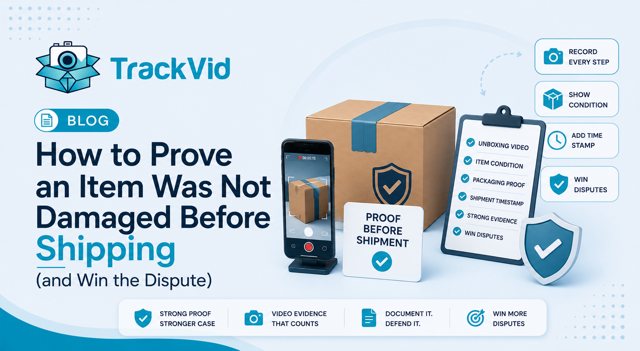
For ecommerce sellers on Shopify, Amazon, eBay and marketplaces worldwide. Updated July 2026.
To prove an item was not damaged before shipping, you need timestamped, order-linked evidence of its condition at the moment it left your facility, not a photo taken at some earlier point. A buyer claiming an item "arrived damaged" or "not as described" wins by default when the seller can only describe the condition instead of showing it against the order.
This is one of the most expensive gaps in ecommerce disputes. Return fraud costs retailers over 103 billion dollars a year, and 45 percent of consumers admit to some form of return policy abuse, according to Riskified data, including falsely claiming an item never arrived or arrived broken.
The seller usually packed it perfectly. The problem is proving that after the fact.
Why "Not Damaged Before Shipping" Is Hard to Prove
A buyer opens a Significantly Not As Described case on eBay or PayPal, or files a card dispute under Visa reason code 13.3 for defective or not-as-described merchandise. The claim is that the product arrived damaged. Your position is that it left you in perfect condition.
The dispute is not decided by who is telling the truth. It is decided by who can show it. And a written statement about the item's condition carries almost no weight against a buyer's photo of a broken product.
This is why sellers lose disputes they should win. The item genuinely was undamaged at dispatch, but the proof of that condition does not exist in a usable form. Condition is time-sensitive, and evidence created after the claim always looks reconstructed.
A damage dispute is won by proof of condition on dispatch, not by an argument about it afterward.
There are really three claims hiding inside one complaint. The item was damaged in transit, which is a carrier liability question. The item was defective when it left you, which is a quality question. Or the item was fine and the claim is not honest, which is fraud. Proof of condition at dispatch is what sorts one from the others. Without it, all three collapse into a single refund you pay.
Guidance across payment networks and marketplaces agrees on the fix: document the condition of goods before shipping and package them to survive transit. The sellers who follow that advice still lose if the documentation is not tied to the specific order.
Global Operator Story: Daniel and the 4,000 Dollar Monthly Hole
Daniel runs a homeware and small-electronics D2C brand shipping around 300 orders a day to customers across the US and UK. Fragile items are his best sellers and his biggest dispute source.
The recurring loss was the "arrived damaged" claim. A customer would open a not-as-described case or a card chargeback saying the item was cracked or defective on arrival. Daniel knew each unit had been checked and sealed, but he could not prove the condition it shipped in.
He had tried photographing items before boxing. The photos helped almost never, because they were not linked to the order and could have been taken at any time. His 3PL's cameras recorded the floor, not individual orders.
Across a typical month, Daniel was losing close to 4,000 dollars to damage and SNAD disputes he believed were either fraudulent or transit-caused, not his fault. His win rate on representment was poor because his evidence was generic.
He switched to recording each order being packed on video, with the clip linked to the Order ID, showing the intact item and the sealed box. The next "arrived damaged" chargeback, he submitted the packing video as compelling evidence and won the representment.
I was not losing because I was wrong. I was losing because I could not show I was right.
His dispute win rate climbed sharply, and the fraudulent claims that once cleared automatically now got contested with evidence that actually held.
What Proof That an Item Was Not Damaged Before Shipping Looks Like
Proving an item was not damaged before shipping requires four things, and all four have to be true at once for the evidence to survive a dispute.
It has to show condition, not just existence
A clip that shows a box being taped proves you shipped something. It does not prove the item inside was intact. The evidence must show the actual product, undamaged, before it is sealed.
It has to be tied to the specific order
Generic footage or a stray photo is order-agnostic and easy to dismiss. The proof must link to the Order ID so a reviewer can confirm it belongs to this transaction.
It has to be timestamped and tamper-evident
Condition is a moment in time. A credible timestamp on dispatch is what separates real proof from a picture that could have been staged after the complaint.
It has to be retrievable fast
Dispute and chargeback windows are short. Evidence you cannot find inside the response window is evidence you do not have.
Photos usually fail the first two tests. CCTV usually fails the second and fourth. Order-linked packing video is the only common format that passes all four.
Put practically, a condition-proof file that survives a dispute usually includes four elements:
- Video of the actual product, undamaged, before the box is sealed
- A visible timestamp establishing when the packing happened
- The Order ID or SKU linking the clip to the specific transaction
- Fast retrieval, so it reaches the response inside the dispute window
A photo typically satisfies the first element only. Order-linked packing video satisfies all four in one automated capture.
How Packing Video Wins Damage and SNAD Disputes
The sellers who consistently win "arrived damaged" and not-as-described disputes build condition proof at packing, before the claim exists.
TrackVid (trackvid.in) records every packing automatically and links each video to the Order ID and SKU at the moment of packing. That captures the intact item and the sealed box against the exact order, then stores it in searchable cloud so you can retrieve it in under two minutes when a dispute lands.
When a buyer claims an item was damaged before shipping was even possible on your side, you submit the packing video as compelling evidence in a chargeback representment or a SNAD response. It shows the product in good condition, sealed, tied to that order, with a timestamp. That is the evidence class that flips a dispute. Related: What actually counts as ecommerce dispute evidence
TrackVid works with existing cameras and sets up in under 30 minutes, so building this proof does not mean re-tooling your fulfilment. Learn more at trackvid.in.
The window to respond is short. Card networks give sellers a limited representment period, often 20 to 45 days depending on the scheme, and marketplace cases can move faster. Evidence you have to assemble after the claim rarely arrives in usable shape before the window closes, which is why the proof has to already exist. Signifyd data also shows the patterns behind these disputes rising, with empty-box returns up 65 percent and decoy or counterfeit item returns up 64 percent, so the volume of contestable claims is growing, not shrinking.
Losing these disputes costs more than the refund. Each chargeback adds a fee on top of the lost goods, and a rising chargeback ratio can push a merchant into a card scheme monitoring program with higher costs and stricter terms. Contesting a claim you can actually win is not only about that one order. It protects your standing with the processor over time.
This plays out the same across channels. On eBay it is a Significantly Not As Described case, on PayPal a dispute, on a card it is Visa reason code 13.3 or its Mastercard equivalent, and on Amazon it is an A-to-Z or SAFE-T decision. The mechanism differs. The deciding question does not: can you show the condition the item shipped in?
The point is not to accuse every buyer of fraud. Genuine transit damage happens. The point is that when a claim is wrong, you can prove the item left you intact and stop absorbing a loss that belongs elsewhere.
Related: How to win a chargeback dispute as an ecommerce seller
Five Questions to Check If You Can Defend a Damage Claim
1. Can you retrieve proof of condition for any order in under two minutes by Order ID?
If not, you cannot meet a chargeback response window.
2. Does your evidence show the actual item intact, not just a sealed box?
If not, it does not answer a not-as-described claim.
3. Is your condition proof timestamped and tied to the specific order?
If not, a reviewer can treat it as staged.
4. Do you know your win rate on damage and SNAD disputes this month?
If you do not track it, you are likely conceding winnable cases.
5. If disputes doubled during a peak sale, would your evidence process hold?
Manual photos do not scale. Order-linked video does.
A no on any of these is a dispute you are set up to lose before it even starts.
Schedule a free demo at trackvid.in/book-demo.html
In one session, you will see exactly where your recoverable revenue is going and what a structured proof system looks like in your specific operation.
Frequently Asked Questions
How to prove an item was not damaged before shipping?
Capture timestamped video of the intact item and sealed box, linked to the Order ID, at the moment of packing. Submit that clip as evidence in the dispute or chargeback response. A written statement or an unlinked photo is not enough, which is why sellers lose cases they should win.
Buyer says the item arrived damaged but it was fine when I shipped it. What do I do?
Pull your packing video for that order and submit it as compelling evidence. It shows the condition on dispatch, tied to the order and timestamped, which is what payment networks and marketplaces weigh. TrackVid records this automatically so the proof already exists when the claim lands.
What evidence beats a not-as-described or SNAD dispute?
Order-linked, timestamped video showing the product intact before sealing beats photos and CCTV. eBay SNAD, PayPal disputes, and Visa reason code 13.3 all hinge on condition, so proof of condition at dispatch is the strongest response you can file.
Is a photo enough to prove condition before shipping?
Usually not. A photo is order-agnostic and can be taken at any time, so reviewers give it little weight. Video linked to the Order ID and timestamped is far harder to dismiss. Related: Proof of packing and fulfilment for ecommerce
How do I fight a damaged-item chargeback?
Respond with compelling evidence through representment, and make packing video your core exhibit. It shows the item left you intact and sealed, which shifts a transit or fraudulent claim off your books. Return fraud tops 103 billion dollars a year according to NRF, so contesting these matters.
Does packing video help with fraudulent damage claims?
Yes. With 45 percent of consumers admitting some return policy abuse according to Riskified, false damage claims are common. Order-linked packing video lets you prove condition on dispatch and contest the ones that are not genuine, instead of refunding by default.
What is the best system to prove pre-shipment condition for ecommerce?
An automated packing video system that captures each item intact, links the clip to the Order ID and SKU, timestamps it, and stores it for fast retrieval. TrackVid does this and is used by 1,000+ sellers, which is why dispute win rates commonly move well past their starting point.
Sources: NRF (return fraud cost), Riskified (return policy abuse rate), Visa reason code 13.3 and PayPal / eBay SNAD dispute documentation, TrackVid seller data (dispute win rates).
TrackVid is a video proof and claim management platform used by 1,000+ ecommerce sellers on Amazon, Flipkart, AJIO, Myntra and Meesho. Officially authorised by Snapdeal. Learn more at trackvid.in.






Get the Marketplace Claim Recovery Checklist
A 12-point checklist used by 1,100+ sellers to recover 85-90% of marketplace claim losses. Free, instant access.
- Marketplace-specific evidence formats (AJIO, Flipkart, Amazon, Myntra)
- Claim window deadlines for every major platform
- The 6-step process that pushes approval from 85-90%
- Common rejection reasons and how to avoid them
No spam. Unsubscribe anytime. Used by sellers at Rare Rabbit, HRX, Da Milano + 1,100 more.
Stop Losing Money to Fake Returns
Join 1,100+ sellers who recover lakhs every month with TrackVid