
For platform, product and partnerships leaders at logistics software companies. Updated September 2026.
Direct Answer
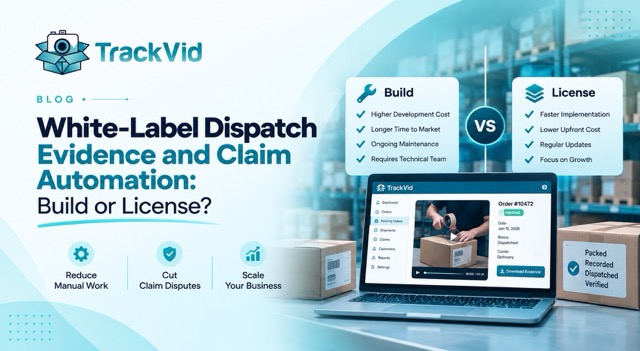
White-label dispatch evidence means licensing an existing order-linked video capture and claim automation platform to run under your own brand, rather than building the capability from scratch inside your own WMS, OMS or logistics product. It is the right choice when the capability is valuable to your customers but is not the thing that differentiates your core product, since building it in-house means an ongoing commitment to capture infrastructure, storage at scale, and claim automation logic that has to be maintained separately for every marketplace or retailer channel as their policies change. Building it yourself makes sense when this capability is meant to be a genuine core differentiator you want full control over. Licensing it white-label makes sense when your customers are asking for it, it strengthens your platform's stickiness, but your engineering roadmap has higher-priority work than maintaining evidence capture and claim logic indefinitely.
Quick Answer: Who Is This Actually For?
Three types of companies most commonly consider this. WMS and OMS platform vendors who get asked by their own customers for proof-of-packing or claim automation and do not want to build and maintain it themselves. Logistics system integrators and consultancies who want to offer a compliance and evidence layer as part of a broader implementation without becoming a software vendor for that specific piece. And marketplaces or fulfillment networks that want to offer seller-facing evidence tools under their own brand rather than sending sellers to a third-party product. If your product's core value proposition depends on owning this specific capability end to end, building it makes more sense than licensing it.
What Does White-Label Dispatch Evidence Actually Mean?
White-label dispatch evidence means the underlying capture, storage, retrieval and claim automation runs on a licensed platform, while your customers interact with it under your brand, through your product, without necessarily knowing a separate vendor is behind it.
What typically stays with the licensor. The core engineering: capture infrastructure, storage and retention, order-indexing, and the claim automation logic for each supported marketplace or retailer channel, which requires continuous maintenance as channel policies and APIs change.
What typically becomes yours. The branding, the customer relationship and billing, and usually the ability to package the capability alongside your own product's existing features, so it reads as part of your platform rather than a bolted-on third-party tool.
Why this distinction matters before you evaluate any specific partner. The exact technical integration model, whether that is an API, an embedded module, or another mechanism, varies by provider and is worth confirming directly rather than assuming. What matters more at the evaluation stage is whether the underlying capability is proven in production, not just described in a pitch deck.
What Does Building White-Label Dispatch Evidence In-House Actually Cost?
Worth being honest about the alternative to licensing white-label dispatch evidence before deciding to build, since the pitch for building it yourself usually undercounts the ongoing cost, not the initial one.
The initial build is the visible cost. Capture triggering, whether from a label scan or another event, order-indexed storage at a scale that grows with every order captured, and a retrieval interface fast enough to be usable during an actual dispute. This is a real engineering project, but it is not the part that surprises teams later.
The ongoing cost is where build estimates usually go wrong. Claim automation has to be built and maintained separately for every marketplace and retailer channel you support, and those channels change their APIs, claim requirements and policies on their own schedule, not yours. A claim-filing integration that works today can silently break when a marketplace updates its API, and someone has to be watching for that, indefinitely, for every channel.
Storage cost compounds in a way that is easy to underestimate at the proposal stage. Video and photo evidence at meaningful retention periods, long enough to cover the longest dispute window across every channel you support, is a genuinely different storage cost profile than most product roadmaps assume when the feature is first scoped.
The honest comparison. Building gives full control and no revenue share. Licensing gives a working capability without the ongoing maintenance burden, in exchange for a share of revenue or a licensing fee. Neither is universally right; it depends on whether this specific capability is meant to be your product's core differentiator or a feature that supports a different core differentiator.
When Does Building Make More Sense Than Licensing White-Label Dispatch Evidence?
Licensing is not always the better choice, and it is worth being direct about when building makes more sense.
- This capability is genuinely central to your product's value proposition, not a feature that supports something else you actually differentiate on
- You already have deep engineering capacity dedicated to logistics-specific infrastructure, and adding this scope does not meaningfully compete with other roadmap priorities
- Your customer base is concentrated enough that maintaining claim automation for a small, stable set of channels is a bounded, known cost rather than an open-ended one
- You want full control over the data and evidence retention policy, for regulatory, contractual or competitive reasons that make a third-party dependency unacceptable
The honest middle case. Many platform teams sit between these two positions, wanting the capability without wanting the specific engineering commitment. That is generally where white-label licensing earns its place: not as the default answer, but as the answer for teams who have made a deliberate call that this is not the piece of their product worth building and maintaining themselves.
How Are White-Label Dispatch Evidence Partnerships Typically Structured?
Three commercial models are common across white-label and OEM software partnerships generally, not specific to this category.
1. Revenue share. The licensor takes a percentage of what the partner charges its own customers for the capability. Aligns incentives well, since the licensor earns more as the partnership succeeds, but requires trust in reporting and a clear definition of what counts as attributable revenue.
2. Flat licensing fee. A fixed fee, often per seat, per location or per volume tier, paid regardless of how the partner prices it to their own customers. Simpler to administer and predictable for both sides, but does not automatically scale with the partner's own growth.
3. Referral or implementation fee. A one-time or ongoing fee tied to bringing a customer into the relationship, with the underlying platform priced more directly rather than bundled invisibly into the partner's own pricing. Common where the partner mainly wants to point customers at the capability rather than fully embed it under their own brand.
Which model to expect. Specific terms vary by partner and scale, and any credible partnership conversation should walk through pricing directly rather than publishing one-size-fits-all rates, since the right structure for white-label dispatch evidence depends on your customer base size, how deeply you want to embed the capability, and what portion of the ongoing relationship you want to own. A pilot with a small customer segment before a full rollout is common practice in this category, the same way any new platform partnership is usually proven at small scale before it is trusted at large scale.
Questions to Ask Before Signing a White-Label Agreement
- Is the underlying platform proven in production today, with a live deployment you can reference, or still in development?
- What exactly stays with the licensor versus what becomes your responsibility, technically and commercially?
- How are claim automation channels maintained as marketplace and retailer APIs change, and who bears that maintenance cost?
- What does retention and data ownership look like, and what happens to historical evidence if the partnership ends?
- How is revenue or fee calculation defined and audited, if the model includes revenue share?
- What is the actual integration timeline, based on a comparable prior partner, not a best-case estimate?
Where TrackVid Fits
TrackVid is a video proof and claim management platform used by 1,100+ ecommerce sellers and fulfillment operations, and is an authorized VMS partner for Snapdeal. Its core capabilities, order-linked capture, retrieval, and claim automation on supported marketplace channels, are what a white-label partnership would be built on.
What is proven today. The platform's backend has already been deployed and operated under a partner's own branding in production, not just as a roadmap item. This is worth stating plainly because it is the single most important question in the list above: whether the underlying capability is proven or theoretical. It is proven.
What to confirm directly rather than assume from this article. The exact technical integration mechanism, commercial terms, and which specific claim automation channels are currently supported for a white-label deployment all vary by partner and are worth a direct conversation rather than a generic answer here. This article intentionally does not name a specific existing partner or their branded offering; that level of detail belongs in a direct conversation, not a public guide.
What this does not extend to today. Big-box retail vendor compliance portal integration, PO or ASN-based linkage, is not a confirmed part of the current platform; if that is central to your use case, raise it directly.
Talk to our partnerships team
If you are evaluating build versus license for your own platform, we can walk through what is proven, what the integration actually looks like, and how partnerships are structured for a team at your scale. Reach out through trackvid.in to start that conversation.
Read Next in This Series
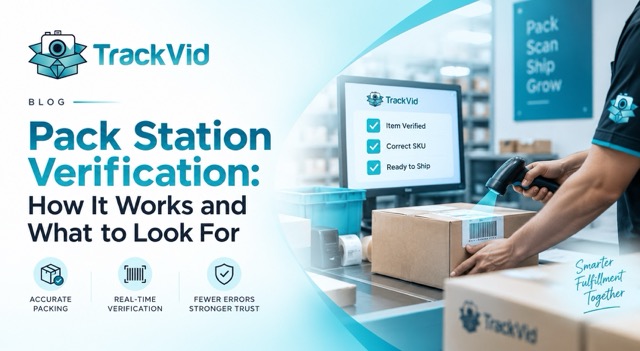
- Pack Station Verification: How It Works and What to Look For, the underlying capability this partnership motion is built on
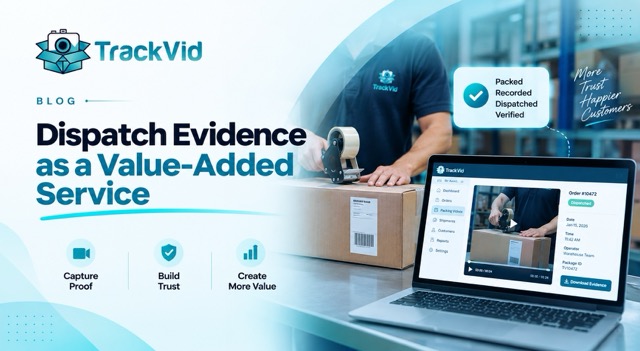
- Dispatch Evidence as a Value-Added Service, the parallel motion for 3PLs offering this directly rather than embedding it
Frequently Asked Questions
Should I build or license dispatch evidence software?
Build it if this capability is meant to be a core differentiator you want full control over and you have dedicated engineering capacity for ongoing channel maintenance. License it if your customers want the capability but it supports a different core differentiator, and the ongoing maintenance burden would compete with higher-priority roadmap work.
What does it take to build order-linked video capture in-house?
An initial build covering capture triggering, order-indexed storage at scale, and fast retrieval, plus an ongoing commitment to maintain claim automation separately for every marketplace and retailer channel as their APIs and policies change, which is usually the cost that surprises teams later.
Can I white-label a claim automation platform?
Yes, this is a recognized partnership model where the underlying capture and automation runs on a licensed platform while customers interact with it under the partner's own brand. Terms and technical integration details vary by provider and are worth confirming directly.
How do white-label logistics software partnerships work?
Commonly structured as revenue share, a flat licensing fee, or a referral or implementation fee, depending on how deeply the partner wants to embed the capability and how much of the ongoing customer relationship they want to own. Specific terms vary by partner and scale.
What is white-label dispatch evidence?
Order-linked video and photographic capture, retrieval and claim automation licensed from an existing platform and run under a partner's own brand, rather than built from scratch inside the partner's own product.
How much does it cost to build video proof software in-house?
Highly variable, but the ongoing cost of maintaining claim automation across every marketplace and retailer channel as APIs and policies change typically exceeds the initial build cost, and storage at meaningful retention periods is a cost profile many roadmaps underestimate at the proposal stage.
Who typically licenses white-label dispatch evidence?
WMS and OMS platform vendors responding to customer demand for evidence and claim capability, logistics system integrators offering a compliance layer without becoming a software vendor for that piece specifically, and marketplaces or fulfillment networks wanting seller-facing tools under their own brand.
What questions should I ask before signing a white-label agreement?
Whether the platform is proven in production with a referenceable live deployment, what stays with the licensor versus the partner, how claim automation channels are maintained over time, what happens to data if the partnership ends, and the realistic integration timeline based on prior partners.
Does a white-label partner see the underlying vendor's brand?
Typically no; the customer-facing experience runs under the partner's own brand, with the underlying vendor operating behind the scenes. Exact visibility depends on the specific partnership agreement and should be confirmed directly.
Is white-label dispatch evidence a proven model or an emerging one?
Both, depending on the provider. Ask specifically whether a prospective partner's platform has a live, referenceable production deployment under a partner's brand today, rather than assuming from marketing material that the model is proven.
Sources: general SaaS and logistics-technology OEM and white-label partnership structuring practices; TrackVid platform and partnership data
Specific commercial terms, technical integration details and supported channels for any white-label partnership vary and should be confirmed directly in conversation rather than assumed from this article.
TrackVid is a video proof and claim management platform for ecommerce operations, 3PLs and fulfillment centers, providing order ID-linked dispatch evidence and automated claim filing, available for direct use and for white-label partnership. Learn more at trackvid.in.
Get the Marketplace Claim Recovery Checklist
A 12-point checklist used by 1,100+ sellers to recover 85-90% of marketplace claim losses. Free, instant access.
- Marketplace-specific evidence formats (AJIO, Flipkart, Amazon, Myntra)
- Claim window deadlines for every major platform
- The 6-step process that pushes approval from 85-90%
- Common rejection reasons and how to avoid them
No spam. Unsubscribe anytime. Used by sellers at Rare Rabbit, HRX, Da Milano + 1,100 more.
Stop Losing Money to Fake Returns
Join 1,100+ sellers who recover lakhs every month with TrackVid