
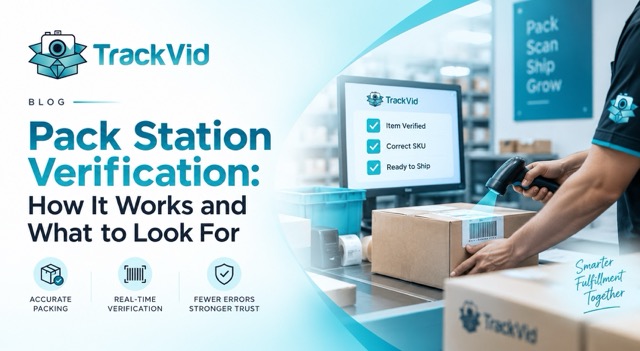
For operations and fulfillment leaders at warehouses and 3PLs. Updated September 2026.
Direct Answer
Pack station verification is the practice of confirming, at the moment an order is packed, that the correct items and quantities are going into the box before it is sealed, and keeping a record of that confirmation so a dispute afterward can be resolved with evidence instead of argument. It typically runs on four checks: the item matches the order, the quantity matches the order, the condition is acceptable, and the carton is sealed correctly. The pack station is the last point in the fulfillment process where an error can be caught before it becomes a customer complaint, a return, or a chargeback, which is why it is treated as its own control point rather than folded into general quality assurance. Verification can be manual, using a checklist and visual inspection, or automated, using barcode scanning and order-linked video or photo capture, and the right choice depends mostly on order volume and how much a wrong-item error actually costs when it happens.
Quick Answer: What Does a Pack Station Verification System Actually Check?
Four things, in order. First, that the item scanned or placed in the carton matches the SKU on the order. Second, that the quantity matches what was ordered, catching both shortages and overages. Third, that the item's condition is acceptable, since a correct item that is damaged is still a failed pack. Fourth, that the carton is sealed to a consistent standard, since inconsistent sealing is a leading cause of in-transit damage claims that have nothing to do with what went in the box. Systems differ mainly in whether they check these automatically as each order moves through, or rely on a packer's own attention and a periodic manual audit.
What Is Pack Station Verification?
Pack station verification is the control point where an order is checked against what is about to be shipped, immediately before the carton is sealed. It sits at the very end of the fulfillment chain, after picking, and it is the last moment an error can be caught inside the building rather than discovered by a customer.
Why this specific point in the process matters more than it might seem. Once a box is sealed and leaves the facility, any dispute about what was actually inside becomes one party's word against another's, unless a record exists. Picking errors, mixed-up variants, and short quantities can all originate earlier in the process, but the pack station is where they either get caught or get shipped. A warehouse can have excellent picking accuracy and still ship wrong items if nothing checks the box before it closes, and a warehouse with mediocre picking accuracy can still ship correctly if the pack station catches what picking missed.
What it protects against, practically:
- Wrong item and wrong variant shipments
- Short and over shipments
- Damaged or defective items packed without being caught
- False claims of a wrong or missing item, which order-linked evidence can disprove
- Downstream disputes with retailers, marketplaces or customers, where the pack station record is the evidence that resolves them
What it is not. Pack station verification is not receiving inspection, which happens when goods first arrive at the facility, and it is not a return-condition check, which happens on the way back in. It is specifically the outbound check at the moment of packing, which is a different point in the process with a different failure mode and a different cost if it is skipped.
Is This the Same as Security Camera Monitoring?
No, and the confusion is common enough to be worth addressing directly.
Most warehouses already have security cameras covering the packing area as part of general site surveillance. That footage exists, and it is genuinely useful for theft, safety and access questions. What it is not built for is answering "what was in order 4471983," because security camera systems are indexed by camera and time, not by order.
The practical difference. Finding a specific order's packing footage in a general security system means estimating roughly when that order was packed and scanning through unrelated footage until the right moment turns up. At any real volume, that is not a workable process, and it is also not what security systems are retained for; general surveillance retention is usually tuned for a security incident window, not a claim dispute window, and the two rarely match.
Pack station verification is a different, narrower thing by design. It is triggered by and indexed to the order itself, typically starting when the shipping label is scanned, so retrieval later is a search by order number rather than an investigation through unrelated footage. That distinction, order-indexed versus time-indexed, is the entire reason this is treated as its own category rather than a feature of a security system.
How Pack Station Verification Works
The mechanism is consistent across most implementations, whether manual or automated, and understanding it makes evaluating any specific system much easier.
1. A trigger starts the verification event. In an automated system this is typically the shipping label barcode scan, which both confirms which order is being packed and starts capture. In a manual system this is the packer pulling the order slip.
2. Each item is checked against the order. Automated systems scan item barcodes and validate SKU and quantity against the order in real time, flagging a mismatch before the box is sealed. Manual systems rely on the packer visually checking items against a printed or screen-based list.
3. Evidence is captured, where the system includes it. Video or photo capture of the pack, tied to the order ID, is what distinguishes a verification system from a verification checklist. This step is what makes a dispute answerable later rather than only preventable in the moment.
4. The record is stored and retrieved by order. Good systems index everything by order ID, SKU or tracking number, so retrieval later is a search rather than a manual review of unrelated footage or paperwork.
Why step 3 is the step most operations underinvest in. Steps 1, 2 and 4 prevent errors in the moment and make retrieval possible. Step 3 is what actually resolves a dispute after the fact, when the customer, retailer or marketplace claim says something different from what your own records say. A verification system with steps 1, 2 and 4 but no order-linked evidence catches mistakes but cannot prove what happened afterward. A verification system with all four steps can do both.
What Should a Verification System Check?
The four checks, and what a weak system tends to miss on each one.
| Check | What it confirms | What weak systems get wrong |
|---|---|---|
| Item / SKU match | The correct product and variant is going into the carton | Barcode scanning alone confirms a scan happened, not that the scanned item was actually placed in the box rather than set aside |
| Quantity match | The number of units matches the order, catching both shortages and overages | Manual counting under time pressure is where most quantity errors originate, and it leaves no record to review afterward |
| Condition | The item is not damaged, mislabeled or otherwise unacceptable to ship | Condition is the check most commonly skipped entirely, since it depends on a human actually looking rather than a scan |
| Seal and carton integrity | The carton is sealed to a consistent standard appropriate to its contents | Inconsistent sealing is a leading cause of in-transit damage claims that have nothing to do with what was originally packed |
The pattern underneath the table. Every weak point above shares the same root cause: a check that depends entirely on a person's attention, under time pressure, with no record if it fails. Automation does not eliminate human error. It catches more of it in the moment, and more importantly, it leaves a record for the errors it does not catch.
Manual vs Automated Verification
Which one fits depends mostly on volume and what an error actually costs, not on operation size alone.
Manual verification, a checklist and visual inspection, works when:
- Order volume is low enough that a packer can reasonably give full attention to each order
- Disputes are rare enough that the cost of occasionally being wrong is lower than the cost of a system
- SKU complexity is low, with few look-alike variants that commonly get confused
Automated verification, scanning plus order-linked evidence capture, earns its cost when:
- Volume makes consistent human attention unrealistic across every order, every shift
- Disputes, chargebacks or return-fraud claims are already a recurring cost
- SKU complexity is high, with variants, bundles or look-alike items that are easy to confuse under pressure
- Multiple people share pack stations, making it hard to trace which specific instance produced a specific error
The honest middle case. A lot of operations sit between these two states, high enough volume that manual checking is unreliable but not yet experiencing enough disputes to obviously justify a platform. The signal worth watching is not volume alone, but the trend in wrong-item and shortage claims over the last two or three months. If that trend is flat or improving, manual process discipline is probably still working. If it is rising, that is usually the volume outrunning the manual process before anyone officially decided to change it.
Common Gaps in Basic Setups
Most pack station verification setups, whether built in-house or bought as a platform, fail in a small number of predictable ways.
Sampled coverage instead of universal capture. Checking or recording a percentage of orders rather than all of them feels reasonable until the specific order in a dispute turns out to be one that was not covered. Fraud and genuine error both select for the gap, not for the sample.
Storage without action. Many setups record and store proof but stop there, leaving a human to manually retrieve footage, decide whether to dispute, and file the claim by hand. This is a real improvement over having no record at all, but it means the operational cost of actually using the evidence is still borne by a person, order by order, which is exactly the bottleneck that causes valid claims to go unfiled when volume rises.
Retention shorter than the actual dispute window. A system tuned to a default retention period that does not match the longest claim window an operation actually faces, whether that is a marketplace return window or a retailer chargeback window, is quietly useless for the disputes that arrive late.
No return-side capture. Verifying what went out solves half the dispute. A shortage or swap claim on the return side is much harder to resolve without a comparable record of what actually came back.
Retrieval that depends on remembering roughly when an order was packed. If finding a specific order's evidence requires scrubbing through footage by estimated time rather than searching by order number, the coverage exists but is not usable under real dispute-response time pressure.
Why this list matters more than a feature comparison. These gaps are not about which vendor has more cameras or better resolution. They are about whether the system actually closes disputes faster than the errors happen, which is a workflow question, not a hardware question.
Walk through your current pack station setup against this list. 15 minutes. No commitment.
Where TrackVid Fits
TrackVid is a video proof and claim management platform used by 1,100+ ecommerce sellers and fulfillment operations, and is an authorized VMS partner for Snapdeal. Its core function is pack station verification with order-linked video capture, built specifically to close the gaps in the previous section.
What it does, based on proven deployments:
- Automatic capture on every order, triggered by the shipping label scan, not a sample and not a manual step for the packer
- Order ID, AWB and SKU linked retrieval, so finding a specific order's evidence is a search rather than an investigation
- Return-side video capture, so both the dispatch and return ends of a shipment are documented
- Automated claim filing on supported marketplace claim channels, closing the gap between storing proof and actually acting on it, cutting manual filing time from 15 to 20 minutes down to under a minute per claim
- Return reconciliation that surfaces wrong-item and missing-item claims which would otherwise expire unfiled, catching exactly the cases a storage-only setup leaves for someone to notice manually
A live example: a single enterprise deployment captured 94,904 packing videos across 95,836 tracked orders, with 868 claims filed against that evidence and approval moving from 42.3 percent to 60.3 percent within a month of switching from partial to systematic capture.
What to confirm directly for your specific use case. Weight capture as a supplementary check, described above as a general industry practice, is not a confirmed TrackVid feature; ask directly if that is a requirement. Evidence linking today is by order ID, AWB and SKU rather than by PO or ASN, which matters if your use case is big-box retail vendor compliance specifically rather than marketplace or D2C fulfillment.
See order-linked retrieval and automated claim filing on real data. 15 minutes. No commitment.
Read Next in This Series
- Best Packing Video Software for Warehouses and 3PLs, the full buyer's guide across every approach and every evaluation criterion
- Retailer Chargebacks and the 3PL Liability Playbook, how pack station evidence connects to retailer dispute outcomes
Frequently Asked Questions
What is pack station verification?
The practice of confirming, at the moment an order is packed, that the correct items and quantities are going into the box before it is sealed, with a record kept so a dispute afterward can be resolved with evidence. It typically checks item match, quantity, condition and seal integrity.
How does pack station verification work?
A trigger, usually the shipping label scan, starts the process. Items are checked against the order, either by barcode scan or visual inspection. Evidence such as video or photos may be captured and tied to the order ID. The record is then stored and retrieved by order number when needed.
Is pack station verification the same as security cameras?
No. Security cameras are indexed by camera and time, built for site security and theft, not for answering what was in a specific order. Pack station verification is indexed to the order itself, so retrieval is a search by order number rather than a scan through unrelated footage.
What should a pack station verification system check?
Four things: that the item matches the order, that the quantity matches, that the condition is acceptable, and that the carton is sealed consistently. Some programs add weight capture as a supplementary check, though this varies by system and should be confirmed directly rather than assumed.
Do I need pack station verification for every order?
For dispute defense, yes. Sampled coverage fails predictably, because the order that ends up in a dispute is often the one that was not checked or recorded. Selective checking on high-value SKUs only makes sense if the goal is quality auditing rather than dispute evidence.
How much does pack station verification cost?
Varies by whether it is manual (mainly a process and training cost) or automated (a platform or hardware cost, often per station or per order). Compare the cost against what wrong-item, shortage and dispute-related losses currently cost, not against a software budget in isolation.
Can pack station verification reduce chargebacks?
It does not prevent a chargeback from being issued, since issuance is usually automated from received-goods data on the other end. What it changes is the dispute outcome, since documentary chargeback categories like shortage and labeling are far more winnable with order-level evidence than without it.
What is the difference between manual and automated verification?
Manual verification relies on a packer's attention and a checklist, with no record if something is missed. Automated verification scans and validates in real time and typically captures order-linked evidence, catching more errors in the moment and leaving a record for the ones it does not catch.
Does pack station verification slow down packing?
Well-designed automated systems are built to add no extra step for the packer, triggering from a scan that already happens as part of the normal process rather than requiring a separate action. Manual verification can slow packing if it adds a distinct checklist step outside the existing workflow.
What happens if a pack station verification system only stores footage but does not act on it?
Storage without action still leaves the operational work of retrieving, deciding on and filing a claim to a person, order by order. That is workable at low dispute volume, but it is exactly where valid claims stop getting filed once dispute volume rises faster than the team's manual capacity to work them.
Sources: warehouse packing verification process guidance from Rabot, Agile SCS and industry glossary references, 2025-2026; TrackVid platform data across 1,100+ ecommerce sellers and fulfillment operations; enterprise marketplace deployment data (94,904 packing videos, 95,836 tracked orders, 868 claims filed)
TrackVid is a video proof and claim management platform for ecommerce operations, 3PLs and fulfillment centers, providing order ID-linked dispatch evidence and automated claim filing on supported channels. Learn more at trackvid.in.
Get the Marketplace Claim Recovery Checklist
A 12-point checklist used by 1,100+ sellers to recover 85-90% of marketplace claim losses. Free, instant access.
- Marketplace-specific evidence formats (AJIO, Flipkart, Amazon, Myntra)
- Claim window deadlines for every major platform
- The 6-step process that pushes approval from 85-90%
- Common rejection reasons and how to avoid them
No spam. Unsubscribe anytime. Used by sellers at Rare Rabbit, HRX, Da Milano + 1,100 more.
Stop Losing Money to Fake Returns
Join 1,100+ sellers who recover lakhs every month with TrackVid