
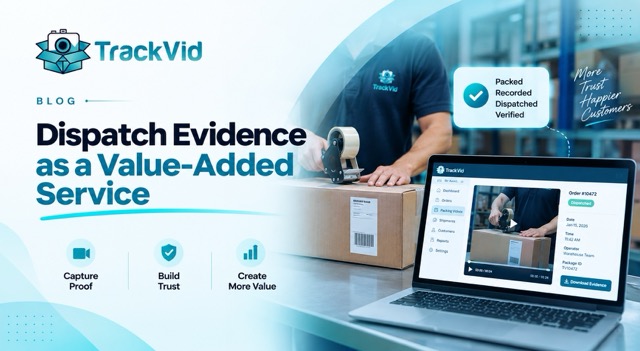
For 3PL executives, operations and business development leaders. Updated September 2026.
Direct Answer
Value-added services, or VAS, are the specialized activities a 3PL performs beyond basic storage and shipping, such as kitting, labeling, retail compliance preparation and quality inspection, priced and billed separately from core fulfillment fees. Dispatch evidence and claim or chargeback defense management fits naturally into this category, since it directly addresses retail compliance risk, the same territory kitting and relabeling already occupy, but most 3PLs still treat it as an internal cost they absorb rather than a service they sell. The shift is straightforward in concept: instead of quietly eating the labor cost of gathering evidence and filing disputes on a client's behalf, price it, put it in the contract as its own line, and report on it the way any other VAS is reported on. Three pricing approaches are common for this specific category: a flat platform or per-order fee, a cost-plus markup on the underlying platform and labor cost, and a success fee based on a percentage of what is actually recovered, the model most common in the adjacent chargeback-recovery software industry.
Quick Answer: Is This Actually a New Category, or Just Repackaged Compliance Work?
A bit of both, and that is exactly why it is underexploited. The compliance work itself, packing correctly, documenting it, disputing chargebacks when something goes wrong, already happens inside most 3PLs today, usually as unbilled overhead absorbed to avoid client friction. What changes when it becomes a VAS is not the work, it is whether the client sees it, pays for it, and holds the 3PL accountable to a defined service level for it. Most VAS categories, kitting or relabeling, transform a physical product. This one transforms risk into a documented, billable outcome, which is a less familiar shape for a 3PL's sales team but not a fundamentally different kind of service.
What Are 3PL Value-Added Services, and Where Does This Fit?
3PL value-added services are the specialized warehouse and logistics activities a 3PL performs beyond core storage, picking, packing and shipping, priced separately because they require distinct labor, equipment or process investment. The standard list of 3PL value-added services includes kitting and bundling, relabeling, custom packaging, quality inspection, retail display builds, and retail compliance preparation.
Retail compliance preparation is the category this belongs next to. Retailers increasingly demand compliance-ready shipments, and a failed retail audit or a missed compliance step can lead directly to a chargeback. That is already a recognized VAS category at most 3PLs, usually covering labeling, ticketing and carton prep to a specific retailer's specification. Dispatch evidence and claim defense is the natural extension of that same category: instead of only preparing a shipment to be compliant, it documents that the shipment was compliant and defends that documentation when a retailer, marketplace or customer disputes it.
Why most 3PLs have not made this move yet. The work already exists inside most operations in some form, someone gathers evidence when a dispute lands, someone files the claim, but it is treated as an internal operational task rather than a line item, largely because it grew organically out of firefighting rather than being designed as a service from the start. That is exactly the gap this article is about closing.
Why Is This a Different Shape of 3PL Value-Added Services?
Most 3PL value-added services are transactional and visible: a kit gets assembled, a label gets applied, a customer can see the physical result. Dispatch evidence and claim defense produces value differently, and that difference is worth understanding before pricing it.
The value shows up later, and it shows up as avoided loss rather than added output. Kitting adds something to a box today. Dispatch evidence prevents a chargeback from being uncontested next month, or wins a dispute that would otherwise have gone unfiled. That makes it harder to sell on a simple per-unit basis the way kitting sells, and easier to sell on outcomes, which is why the pricing section below leans on a different set of models than typical VAS pricing.
It also changes the client conversation from cost to risk. A brand evaluating a 3PL on cost per order rarely asks whether the 3PL can defend a chargeback on its behalf. Once that capability is offered explicitly, it becomes a genuine differentiator in a competitive RFP, not an assumed baseline, and 3PLs that can point to a defined evidence and claim-defense program win larger, more compliance-sensitive accounts specifically because of it.
How Do You Price 3PL Value-Added Services Like This?
Three models are worth comparing, each with a real trade-off, drawn both from standard VAS pricing practice and from the closest adjacent industry, chargeback-recovery software.
1. Flat fee, per order or per month. The simplest model, and the one that maps most directly to how other VAS lines are already priced, commonly $0.50 to $5.00 per order for standard value-added services depending on complexity. Predictable for the client, simple to sell, and easy to explain in a contract. The downside is that it does not automatically scale with the actual risk being managed; a client with a rising dispute rate pays the same fee as one with a falling one, which can make the line look like pure margin if the client's dispute rate happens to fall, or pure cost if it rises.
2. Cost-plus. The standard approach for specialized VAS generally: calculate the direct cost, platform fees, labor for evidence review and claim filing, and add a markup, commonly 15 to 35 percent in typical VAS pricing practice. This keeps the pricing logic consistent with how a 3PL likely already prices other specialized services internally, and it is defensible in a client conversation because the cost basis is transparent.
3. Success fee, a percentage of what is recovered. This is the dominant model in the adjacent chargeback-recovery software industry specifically, where a success fee of roughly 20 to 25 percent of recovered revenue, charged only on won cases, is the most common structure, sometimes layered with a monthly platform floor. It is the easiest model for a client to say yes to, since there is no cost when nothing is recovered, and it directly ties the 3PL's incentive to actually winning disputes rather than merely offering the capability.
The honest trade-off with a success fee that is worth stating plainly. A fee tied to recovered revenue means the 3PL earns more in months when the client's dispute volume rises, not falls, which is an odd incentive if the underlying goal is fewer disputes in the first place. The way most credible programs address this is by reporting on prevention, not just recovery, tracking the trend in dispute rate over time alongside the dollars recovered, so the relationship is measured on the outcome that actually matters to the client rather than only the metric the fee is calculated on.
A hybrid often works best in practice. A modest monthly platform fee that covers the baseline cost of running evidence capture, combined with a smaller success fee on actual recoveries, splits the difference: the 3PL is not entirely dependent on dispute volume for revenue, and the client still sees a cost that scales with value delivered rather than a flat charge regardless of outcome.
What to Actually Sell: Packaging the Service
Three tiers, increasing in scope and price, mirror how most 3PL value-added services are already sold.
Tier 1: Evidence capture and retention. The baseline offering, order-linked video or photographic evidence captured and retained for an agreed period covering the client's known dispute windows. Positioned as compliance readiness and audit protection rather than active dispute management. The lowest-commitment entry point for a client who is not yet convinced of the full service.
Tier 2: Evidence plus claim filing. Adds active filing of claims on supported channels using the captured evidence, converting the passive record into recovered dollars without the client's own team doing the retrieval and filing work. This is where the value becomes measurable in a monthly report rather than theoretical.
Tier 3: Managed dispute and chargeback defense. The highest-touch tier, adding human review and escalation for disputes that require judgment beyond automated filing, retailer-specific dispute portal navigation, and proactive reporting on dispute trends and root causes. This tier is where the pricing conversation naturally shifts toward the success-fee or hybrid model above, since the value is most directly tied to dollars recovered.
Why tiering matters for the sale, not just the pricing. A client unconvinced of the value can start at Tier 1 for minimal commitment, see the evidence exist and the reporting arrive, and upgrade once the pattern of avoidable losses becomes visible in their own data. Selling Tier 3 cold, with no Tier 1 track record behind it, is a much harder conversation than upgrading an existing relationship.
Setting SLAs That Make the Service Credible
A VAS without a defined service level is a promise, not a service. Borrowing the same discipline other VAS categories use for accuracy rates and turnaround times, four commitments make this credible as a contracted line rather than a vague value-add:
- Capture rate, the percentage of eligible orders with evidence actually captured, targeted near 100 percent rather than a sample
- Retrieval time, how quickly a specific order's evidence can be produced on request, since this is what determines whether a dispute gets filed inside its window at all
- Filing turnaround, how quickly a claim is filed once a dispute-eligible event is identified, since filing speed and window compliance are directly connected
- Reporting cadence, a regular report showing dispute volume, filed rate, win rate and recovered dollars, so the client sees the service working rather than taking it on faith
Talk through what a dispatch evidence service line would look like for your client book. 15 minutes. No commitment.
How Do You Launch This as a 3PL Value-Added Service Line?
Step 1: Audit What You Are Already Absorbing
Before pricing anything, quantify the dispute and chargeback labor your team already performs for clients without billing for it. Most 3PLs are surprised by how much of this already happens informally. This number is both the business case for the service and the starting point for cost-plus pricing if that is the model chosen.
Step 2: Choose a Pricing Model and Pilot With One Client
Pick flat fee, cost-plus or success fee based on which fits the relationship best, and pilot with a single existing client rather than rolling out across the book at once. A pilot surfaces operational gaps, evidence coverage holes, retrieval speed issues, before they show up in a client-facing SLA commitment.
Step 3: Define the SLA Before Selling the Service
Use the four commitments above, capture rate, retrieval time, filing turnaround, reporting cadence, and make sure the underlying evidence capture actually meets them before offering the service more broadly. An SLA promised but not met damages the relationship worse than not offering the service at all.
Step 4: Formalize It as a Contract Line and Report on It Monthly
Move the service from an informal favor to a named, priced line item in the service agreement, with its own reporting cadence separate from general account management updates. This is what makes it feel, and function, like the rest of the client's VAS spend rather than an occasional rescue.
Where TrackVid Fits
TrackVid is a video proof and claim management platform used by 1,100+ ecommerce sellers and fulfillment operations, and is an authorized VMS partner for Snapdeal. For a 3PL building this service line, it provides the underlying evidence and automation layer the four SLA commitments above depend on.
What it provides, based on proven deployments:
- Automatic order-linked capture on every order, the foundation for a capture-rate commitment near 100 percent rather than a sample
- Retrieval by order ID, AWB or SKU in under two minutes, the foundation for a credible retrieval-time SLA
- Automated claim filing on supported marketplace claim channels, cutting manual filing time from 15 to 20 minutes to under a minute, the foundation for a filing-turnaround commitment
- Return reconciliation surfacing claims that would otherwise expire unfiled, which is exactly the kind of avoidable loss a Tier 1 evidence-only client discovers in their own reporting and upgrades to Tier 2 to capture
A live example: a single enterprise deployment captured 94,904 packing videos across 95,836 tracked orders, with 868 claims filed against that evidence and approval moving from 42.3 percent to 60.3 percent within a month of systematic capture. An illustrative composite scenario covered in a related guide on this site shows the commercial version of this directly: a 3PL that fixed its evidence retrieval speed began billing brand clients for chargeback dispute management as a standalone fee-for-service line, using the same underlying infrastructure it had already deployed for its own operations.
On white-labeling this under a 3PL's own brand. TrackVid's backend can be deployed and operated under a partner's own branding rather than TrackVid's, which is a distinct commercial motion from simply using the platform internally. That deserves its own dedicated treatment rather than a paragraph here; if this is your specific interest, raise it directly on a call.
See the capture, retrieval and filing speed behind these SLA commitments on real data. 15 minutes. No commitment.
Read Next in This Series
- How to Dispute a Walmart Chargeback, includes the full illustrative 3PL case referenced above
- Who Is Liable When a 3PL Ships the Wrong Item?, the liability framework this service line helps a 3PL actually document and defend
Frequently Asked Questions
What are value-added services in 3PL?
Specialized warehouse and logistics activities beyond core storage, picking, packing and shipping, priced separately from base fulfillment fees. Common categories include kitting, relabeling, custom packaging, quality inspection, retail display builds and retail compliance preparation.
How do 3PLs price value-added services?
Most commonly per-unit or per-order, commonly $0.50 to $5.00 per order for standard services, or cost-plus, direct cost plus a 15 to 35 percent markup. For services closer to compliance and dispute defense specifically, a success fee based on a percentage of recovered revenue, common in the adjacent chargeback-recovery industry, is also used.
Can a 3PL sell chargeback defense as a service?
Yes, and it is an underexploited category. The evidence gathering and dispute filing work already happens inside most 3PLs informally when a dispute lands; the shift is pricing it, defining a service level for it, and reporting on it as its own line rather than absorbing it as unbilled overhead.
How much do 3PLs charge for VAS?
Varies widely by service type. Standard per-order VAS like custom packaging or kitting commonly runs $0.50 to $5.00 per order. Success-fee models in the adjacent chargeback-recovery space commonly charge 20 to 25 percent of recovered revenue, sometimes with a monthly platform floor added.
Should dispatch evidence be a separate line item?
Generally yes, for the same reason other compliance-related VAS categories like retail compliance prep are already billed separately: it requires distinct process and technology investment, and pricing it separately keeps its value visible to the client rather than folded invisibly into base fulfillment fees.
What is dispatch evidence as a service?
A 3PL offering, packaged in tiers, that captures order-linked evidence of what was packed and shipped, optionally files claims using that evidence, and in its fullest form manages dispute and chargeback defense on the client's behalf, priced and reported on as its own contracted line rather than informal support.
How do I package compliance evidence as a revenue line?
Tier it: start with evidence capture and retention as the base offering, add active claim filing as a mid tier, and add fully managed dispute defense with human escalation as the top tier. Let clients enter at the lowest tier and upgrade once the value shows up in their own reporting.
What is the downside of success-fee pricing for this service?
A fee tied to recovered revenue means the provider earns more when the client's dispute volume rises, not falls, which can misalign incentives if the underlying goal is fewer disputes overall. Reporting on prevention trends alongside recovery dollars is how credible programs address this.
Is this different from traditional 3PL value-added services like kitting?
In mechanism, no, it is priced and delivered the same way other VAS is. In shape, yes: most VAS transforms a physical product visibly and immediately, while dispatch evidence and claim defense produces value later, as avoided loss or recovered revenue, which changes how it needs to be sold and reported on.
Do clients actually pay extra for this, or expect it included?
Increasingly, compliance-sensitive clients expect some baseline evidence capture as table stakes, similar to how retail compliance prep is now often assumed. Active claim filing and managed dispute defense, the higher tiers, remain genuinely billable because they require ongoing labor and platform investment beyond passive capture.
Sources: 3PL value-added services pricing and category guidance from Buske, AMS Fulfillment, Argos, Racklify and Ops Engine, 2025-2026; chargeback-recovery service pricing models from Helpware, Chargeback.io, Redo and FintechSpecs, 2026; TrackVid platform data across 1,100+ ecommerce sellers and fulfillment operations; enterprise marketplace deployment data (94,904 packing videos, 95,836 tracked orders, 868 claims filed)
Pricing structures vary by market, client relationship and service scope. The models described here are common industry patterns, not TrackVid pricing recommendations; confirm current market rates directly before setting your own pricing.
TrackVid is a video proof and claim management platform for ecommerce operations, 3PLs and fulfillment centers, providing order ID-linked dispatch evidence and automated claim filing on supported channels. Learn more at trackvid.in.
Get the Marketplace Claim Recovery Checklist
A 12-point checklist used by 1,100+ sellers to recover 85-90% of marketplace claim losses. Free, instant access.
- Marketplace-specific evidence formats (AJIO, Flipkart, Amazon, Myntra)
- Claim window deadlines for every major platform
- The 6-step process that pushes approval from 85-90%
- Common rejection reasons and how to avoid them
No spam. Unsubscribe anytime. Used by sellers at Rare Rabbit, HRX, Da Milano + 1,100 more.
Stop Losing Money to Fake Returns
Join 1,100+ sellers who recover lakhs every month with TrackVid