
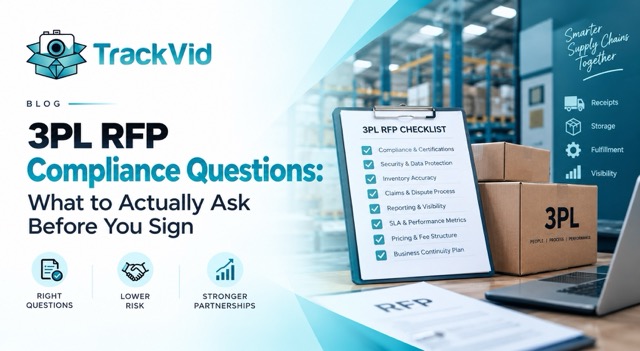
For supply chain, operations and procurement leaders evaluating 3PL partners. Updated September 2026.
Direct Answer
Most 3PL RFP templates treat compliance as a single line item, alongside certifications and standard operating procedures, and most 3PL answers to that line item are reassurance rather than evidence: statements like "we are fully compliant" or "we handle chargebacks" that cannot actually be verified before you sign. The compliance section of a 3PL RFP should instead ask for proof, not assurance, across three specific areas. First, evidence: can the provider show order-level proof of what was actually packed, for every order or only a sample, retained for how long, and retrievable how fast. Second, liability: what is the provider's actual contractual liability cap, and what standard of evidence determines fault when something goes wrong. Third, chargeback and dispute handling: does the provider file and defend disputes on your behalf, and what is their track record, not their promise, on response time and win rate. A provider that can answer these three areas specifically, with numbers rather than adjectives, has the operational maturity the rest of the RFP is trying to measure indirectly.
Quick Answer: What's the One Question That Separates Real Capability From Marketing?
Ask for a live demonstration of retrieving evidence for a specific order, on the spot, timed. A provider with real capability pulls it up in under two minutes. A provider without it either cannot do this at all, or takes long enough that the gap becomes obvious. Every other question in this guide is really a variation on the same test: can this be demonstrated, or only described.
Why Do 3PL RFP Compliance Questions Usually Fall Short?
Most 3PL RFP compliance questions fail before they are even asked, because the section is treated as a formality. A well-run RFP process is supposed to separate measured performance from marketing, forcing every provider to answer the same questions on the same terms so responses are genuinely comparable. Most RFP sections manage this for pricing and capacity, where numbers are unavoidable. The compliance section is where it most often breaks down, because "are you compliant" invites a yes with no way to check it before the contract is signed.
The pattern worth watching for. A common failure mode in 3PL evaluations is accepting "we integrate with most platforms" or an equivalent broad reassurance as a complete answer, when the actual question that matters is the exact workflow behind the claim. Compliance answers fail the same way: "we handle chargebacks" says nothing about response time, win rate, or who actually does the work.
Why this section matters more now than it used to. The majority of large shippers now work with at least one 3PL, and a growing share of shippers are consolidating the number of partners they use, which means each remaining relationship carries a larger share of the business and a bigger cost if the compliance capability turns out to be weaker than represented. Relationships that fail rarely fail on price. They fail on operations, and the warning signs are usually visible in how vague the RFP answers were in the first place.
What Do Generic 3PL RFPs Already Cover?
Worth naming briefly so this guide is a supplement, not a replacement, for a full RFP process. Standard 3PL RFP templates already cover scope of work, facility and capacity details, technology and WMS integration, industry certifications, pricing model and contract terms, and general SLA expectations. Retail compliance is often referenced at a category level: routing guides, EDI, ASN, labeling, and account-specific SOPs.
What is usually missing is specificity within that category. Asking whether a provider "handles retail compliance" is not the same as asking whether they can prove, order by order, that a specific shipment was packed and labeled correctly, and defend that proof when a retailer disputes it. The three question sets below are designed to sit inside your existing compliance section, not replace the RFP around it.
What Evidence and Proof Questions Belong in a 3PL RFP?
These are the first 3PL RFP compliance questions worth asking, because the foundation everything else depends on. If a provider cannot produce order-level evidence, the liability and dispute-handling answers that follow are theoretical.
- Do you capture evidence, video, photo or otherwise, of every order as it is packed, or only a sample?
- What triggers capture, an automatic scan, or a manual step a packer might skip under pressure?
- How is evidence indexed? Can you retrieve a specific order's evidence by order number, or only by estimating the time it was packed?
- What is your actual retrieval time for a specific order's evidence, demonstrated live rather than described?
- What is your retention period, and does it cover the longest dispute window across the retailers or marketplaces I sell through?
- Do you capture evidence on returns as well as outbound shipments?
What Liability and Accountability Questions Belong in a 3PL RFP?
The second set of 3PL RFP compliance questions determine what happens financially when your evidence review shows the provider was at fault, and they are the questions most RFPs skip entirely in favor of generic contract boilerplate.
- What is your contractual limitation of liability, stated as an actual number, not a reference to "standard terms"?
- Is that liability cap per pound, per occurrence, or some other basis, and what does it work out to for my specific product category?
- What evidence standard determines fault when a wrong-item or shortage claim happens? Who reviews it, and how is a disagreement resolved?
- Are you contractually required to maintain order-level evidence, and for how long, or is evidence retention entirely at your discretion?
- If my product is high-value and lightweight, does your standard cap realistically cover a claim, or should I expect to carry supplemental insurance?
- How is liability allocated when a retailer chargeback and an internal fulfillment error happen on the same shipment?
What Chargeback and Dispute Handling Questions Belong in a 3PL RFP?
The third set of 3PL RFP compliance questions is where you find out whether the provider is a passive record-keeper or an active partner in defending your revenue.
- When a retailer or marketplace disputes a shipment, do you file and manage that dispute, or is that my team's responsibility using evidence you provide?
- What is your actual filed rate, the share of disputable chargebacks you file within the required window, not the share you could theoretically file?
- What is your win rate on disputes you handle, and how is it tracked?
- How quickly after a dispute is flagged is evidence assembled and a claim filed?
- Do you proactively identify claims I might not know about, such as a return that never actually arrived, or only respond to disputes I bring to you?
- Can you provide references from existing clients specifically on dispute outcomes, not just general satisfaction?
How Do You Read the Answers to These 3PL RFP Compliance Questions?
What a vague answer usually means, translated.
| What they say | What it usually means |
|---|---|
| "We have cameras on the pack stations" | Likely general security footage, not order-linked evidence. Ask the retrieval question directly |
| "We are fully compliant" | Compliant with what, specifically? Ask for the standard or certification by name |
| "We handle chargebacks for our clients" | Ask for the filed rate and win rate. "We handle it" without numbers usually means informal, ad hoc effort |
| "Our liability terms are standard for the industry" | Ask for the actual number. Standard terms still vary widely and are usually lower than shippers assume |
| "We integrate with most platforms" | Ask for the exact workflow for your specific systems. A vague integration claim often means a manual workaround, not a real integration |
| "We'll get back to you on that" during the RFP stage | If they cannot answer a compliance question during a competitive process, when incentive to look good is highest, do not expect a better answer once you are a signed client |
Sample Questions You Can Copy Directly
A condensed set for the compliance section of your own RFP document, organized to sit alongside your existing template.
- Describe your evidence capture process for outbound orders. Is it applied to 100 percent of orders or a sample?
- Demonstrate live retrieval of evidence for a specific order number, timed.
- State your evidence retention period and confirm it covers a 90-day dispute window.
- State your contractual limitation of liability in dollars per pound or per occurrence.
- Describe the evidence standard used to determine fault in a wrong-item or shortage dispute.
- Confirm whether you file chargeback and marketplace disputes on our behalf, and describe the process.
- Provide your filed rate and win rate on chargeback disputes over the last 12 months, with methodology.
- Confirm evidence capture applies to returns as well as outbound shipments.
Use these questions in your next RFP, then see what a real answer to each one looks like on live data. 15 minutes. No commitment.
Where TrackVid Fits
TrackVid is a video proof and claim management platform used by 1,100+ ecommerce sellers and fulfillment operations, and is an authorized VMS partner for Snapdeal. It is worth understanding as a brand evaluating 3PLs for one specific reason: a weak answer to the questions above does not have to be a dealbreaker for an otherwise strong 3PL relationship.
Why this matters for how you read the answers to your 3PL RFP compliance questions. Order-level evidence capture and claim automation can be deployed independently of your 3PL's own systems, running at the pack station regardless of which fulfillment provider you use. That means a 3PL that scores well on capacity, pricing and operational fit, but weakly on evidence and dispute handling specifically, does not automatically have to be disqualified. The gap can be closed independently rather than forcing a choice between an otherwise good operational fit and strong compliance capability.
What TrackVid provides directly, based on proven deployments:
- Order-linked video capture on every order, independent of what capture capability, if any, your 3PL already has
- Retrieval by order ID, AWB or SKU in under two minutes, the same benchmark this guide recommends testing any 3PL against
- Automated claim filing on supported marketplace claim channels, and return reconciliation surfacing claims that would otherwise expire unfiled
A live example: a single enterprise deployment captured 94,904 packing videos across 95,836 tracked orders, with 868 claims filed against that evidence and approval moving from 42.3 percent to 60.3 percent within a month of systematic capture.
What this does not solve. It does not change your 3PL's contractual liability terms, which remain a direct negotiation with the provider, and it does not extend, today, into big-box retail vendor compliance portals specifically; confirm that directly if it is your use case. What it does is remove evidence capability as a reason to compromise on 3PL selection, since it does not have to come from the same vendor as fulfillment itself.
See what independent evidence capture looks like alongside your existing 3PL setup. 15 minutes. No commitment.
Read Next in This Series
- Who Is Liable When a 3PL Ships the Wrong Item?, the full liability framework behind the accountability questions above
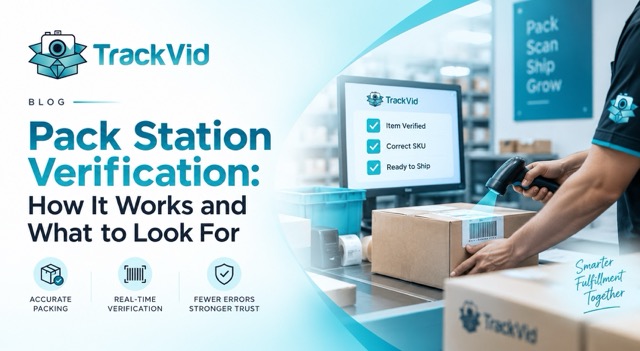
- Pack Station Verification: How It Works and What to Look For, what a real evidence capture answer should actually look like
Frequently Asked Questions
What questions should I ask a 3PL about compliance?
Ask for evidence, not assurance: whether they capture order-level proof on every shipment or a sample, how fast they can retrieve a specific order's evidence, their actual contractual liability cap, and their filed rate and win rate on chargeback disputes, not general statements about being compliant.
What should be in the compliance section of a 3PL RFP?
Beyond standard certifications and SOPs, include specific questions on evidence capture and retention, the liability cap and evidentiary standard for fault determination, and whether the provider actively files and manages chargeback disputes or only supplies raw data for you to handle.
How do I evaluate a 3PL's compliance capability?
Ask for a live, timed demonstration of retrieving evidence for a specific order, and ask for actual numbers, retention period, liability cap, filed rate, win rate, rather than accepting general reassurance. A provider with real capability can demonstrate it on the spot.
What is a red flag answer from a 3PL during an RFP?
Smooth, adjective-heavy answers with no specifics: "we are fully compliant," "we handle chargebacks," "we integrate with most platforms." A provider who answers with real numbers, even numbers that reveal a gap, is more trustworthy than one who reassures without specifics.
Should my 3PL RFP ask about evidence and proof specifically?
Yes. Most generic RFP templates mention compliance and retail readiness but rarely ask how a provider proves what was actually packed and shipped. That is the evidence that resolves a dispute after the fact, and it is worth its own dedicated questions rather than being assumed under general compliance.
What liability questions should I ask a 3PL?
Ask for the actual contractual limitation of liability in dollars, per pound or per occurrence, what evidentiary standard determines fault, and whether that cap realistically covers your product category, especially if it is lightweight and high-value.
How do I know if a 3PL can actually defend a chargeback?
Ask for their filed rate, the share of disputable chargebacks they actually file within the required window, and their win rate, with methodology, rather than a general statement that they handle disputes. Ask for client references specifically on dispute outcomes.
Can I use a compliance evidence platform independently of my 3PL?
Yes. Order-level evidence capture and claim automation can run at the pack station regardless of which 3PL handles fulfillment, which means a weak compliance answer from an otherwise strong 3PL does not have to be a dealbreaker in your selection.
What is the single best test question for a 3PL RFP?
Ask for a live, timed demonstration of retrieving evidence for a specific order number. A provider with real capability does this in under two minutes. This single test reveals more than most of the written RFP responses combined.
Do most 3PLs actually have order-level evidence capture?
It varies widely and is not yet standard across the industry, which is exactly why it is worth asking about explicitly rather than assuming it is included in a general compliance or technology answer.
Sources: 3PL RFP and evaluation guidance from Fulfyld, Buske, Taylor Logistics, BGDC Distribution, Evolution Fulfillment and AnkerPak, 2025-2026; TrackVid platform data across 1,100+ ecommerce sellers and fulfillment operations; enterprise marketplace deployment data (94,904 packing videos, 95,836 tracked orders, 868 claims filed)
TrackVid is a video proof and claim management platform for ecommerce operations, 3PLs and fulfillment centers, providing order ID-linked dispatch evidence and automated claim filing on supported channels, deployable independently of any specific 3PL. Learn more at trackvid.in.
Get the Marketplace Claim Recovery Checklist
A 12-point checklist used by 1,100+ sellers to recover 85-90% of marketplace claim losses. Free, instant access.
- Marketplace-specific evidence formats (AJIO, Flipkart, Amazon, Myntra)
- Claim window deadlines for every major platform
- The 6-step process that pushes approval from 85-90%
- Common rejection reasons and how to avoid them
No spam. Unsubscribe anytime. Used by sellers at Rare Rabbit, HRX, Da Milano + 1,100 more.
Stop Losing Money to Fake Returns
Join 1,100+ sellers who recover lakhs every month with TrackVid