
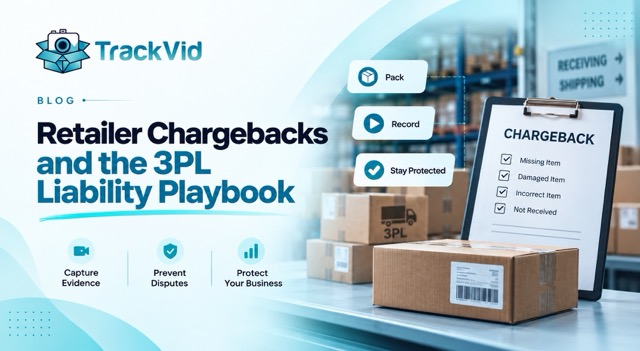
For supply chain, operations and finance leaders at brands and 3PLs. Updated September 2026.
Direct Answer
Retailer chargebacks are deductions a retailer takes from a supplier's payment when the retailer judges that a shipment failed to meet its vendor compliance requirements: wrong quantity, missed delivery window, incorrect labeling, a mismatched ASN, or a packaging failure. Industry-wide, retailer chargebacks and deductions are estimated at well over five billion dollars a year, and for an individual supplier they commonly run one to five percent of gross invoice value, higher at some retailers and in some categories. Major retailers including Walmart, Target, Amazon Vendor, Costco, Kroger, CVS and Walgreens all run formal vendor compliance programs with their own scorecards, penalty schedules and dispute processes. When a 3PL handles fulfillment on a brand's behalf, liability for a chargeback is a contract question, not an automatic assumption, and most chargeback categories are disputable and reversible when the supplier or 3PL can produce the specific evidence the retailer's own process asks for.
Quick Answer: Who Pays When a 3PL Is Involved?
Liability follows the service agreement, not intuition. Some brand-3PL contracts make the 3PL responsible for chargebacks traceable to its own packing, labeling or shipping errors. Others leave all retailer chargebacks with the brand regardless of cause, with the 3PL responsible only for its own internal SLAs. A growing number of contracts now split chargebacks by root cause once the evidence exists to establish one, which is only possible if packing-level evidence was captured at the time of shipment. Where the contract is silent or the root cause is disputed, the party with the weaker documentation usually ends up absorbing the cost, whatever the contract intended.
What Are Retailer Chargebacks?
Retailer chargebacks are deductions the retailer takes from what it owes a supplier, issued when the retailer's systems flag a shipment as non-compliant with its vendor requirements.
The scale is larger than most suppliers assume until they add it up. Industry estimates put retailer chargebacks and deductions at well over five billion dollars a year across US retail. For an individual supplier, deductions commonly run one to five percent of gross invoice value, and can reach five to ten percent of revenue at scale for suppliers with weak compliance processes. An eighty million dollar supplier at the higher end of that range is absorbing several million dollars a year, often without a clear picture of how much of it was actually valid.
Why chargebacks exist at all. Retailers run enormous, tightly scheduled supply chains where a late, short or mislabeled shipment creates real cost: a truck slot wasted, a shelf that goes empty, a receiving team that has to hand-process an exception. Chargeback programs are the retailer's mechanism for passing that cost back to the party that caused it. The programs are not arbitrary, but they are blunt, and the burden of proving a specific shipment was compliant falls on the supplier.
The common categories, across most retailers:
- Shortage or overage. Quantity received does not match quantity invoiced
- Late delivery or missed appointment. Shipment arrived outside the required window
- Labeling and packaging non-compliance. Cartons, pallets or items not prepared to the retailer's specification
- ASN accuracy and timing. Advance ship notice missing, late or mismatched to the actual shipment
- Routing guide violations. Wrong carrier or method used against the retailer's required routing
- Pricing discrepancies. Invoiced price does not match the retailer's system of record
What most suppliers get wrong about chargebacks. They treat the deduction as final. Retailers themselves build dispute processes into these programs, precisely because chargebacks are issued algorithmically from received-goods data and are wrong often enough to require a formal appeal path. A chargeback is a claim by the retailer, not a verdict, and it stays that way until the dispute window closes without action.
The Major Retailer Compliance Programs
Every major retailer runs some version of this. The names and mechanics differ enough that suppliers serving multiple retailers usually need a separate playbook for each.
| Retailer | Program | What it governs | Typical penalty structure |
|---|---|---|---|
| Walmart | OTIF, SQEP | On-time in-full delivery; packing, labeling and ASN compliance before goods leave the supplier's facility | OTIF assessed on cost of non-compliant goods; SQEP per-occurrence, commonly in the tens to low hundreds of dollars per violation |
| Target | Vendor compliance guide | Routing, labeling, ASN, delivery windows | Per-occurrence and percentage-based deductions depending on violation type |
| Amazon Vendor | Vendor compliance program | Packaging, labeling, ASN, delivery appointment compliance | Chargebacks issued per violation, escalating with repeat non-compliance |
| Costco | Vendor compliance | Delivery windows, labeling, packaging | Flat and percentage-based deductions, strict enforcement on appointment windows |
| Kroger, CVS, Walgreens, Ulta | Retailer-specific vendor programs | Similar categories: shortage, labeling, ASN, delivery | Vary by retailer, generally smaller individual amounts at higher frequency |
Who Is Liable: Brand or 3PL?
This is the question that determines whether a chargeback becomes an internal cost allocation argument or gets disputed and potentially reversed.
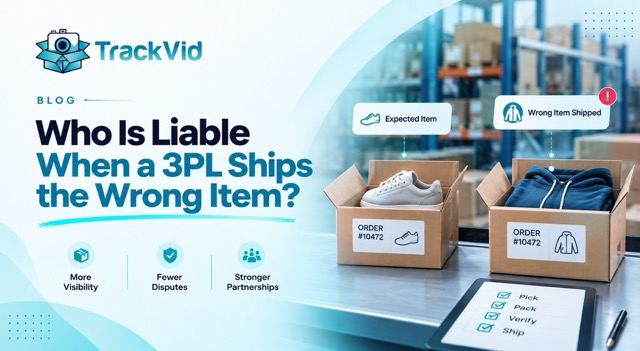
When the brand ships direct, liability for a chargeback traceable to packing, labeling or shipment preparation sits with the brand's own operation, full stop.
When a 3PL handles fulfillment, liability depends on the service agreement, and three structures are common:
- 3PL bears chargebacks traceable to its own errors. Requires the contract to define what "traceable" means and, in practice, requires evidence to establish root cause. Without evidence, "traceable" is unenforceable and defaults to argument
- Brand bears all chargebacks regardless of cause, with the 3PL judged only against its own internal SLAs (on-time pick rate, pack accuracy rate, and so on) which may or may not track with what the retailer actually penalized
- Chargebacks are split by documented root cause, an increasingly common structure as brands push liability downstream, but one that only functions if the 3PL can actually produce shipment-level documentation when a dispute arises
The uncomfortable truth for most 3PL-brand relationships. Most service agreements were written before either party had order-level packing evidence to point to, so root-cause language in the contract is often aspirational rather than operational. When a chargeback lands, the conversation defaults to negotiation rather than evidence, and the party with weaker documentation typically absorbs more of the cost than the contract's own language would suggest, simply because there is nothing to point to.
What changes this. A 3PL that captures order-level video and photographic evidence at pack, tied to the order or PO and retained through the dispute window, converts "traceable to the 3PL" from a contract phrase into an answerable question. This is also, increasingly, a commercial differentiator: 3PLs that can prove clean packing win larger accounts and can push some liability discussions back to the brand's own inventory and listing accuracy instead.
Liability gets most of the attention, but a quieter lever sits upstream: where inventory lives, and how B2B orders flow out of the same stack as DTC. OTIF and routing penalties at retailers like CVS, Target, and Ulta are driven as much by distance to the receiving DC as by what happens at pack.
ShipBob is an ecommerce fulfillment expert with 50+ fulfillment centers across the US, Canada, UK, EU, and Australia, running DTC and B2B EDI fulfillment from a shared inventory pool. The Inventory Placement Program moves stock closer to demand automatically, shortening zones and transit times into retail DCs.
Fewer long-zone shipments means fewer trips through a vendor compliance portal, which is the cheaper outcome even when your evidence discipline is strong.
Which Chargebacks Are Recoverable?
Not all chargebacks are equally winnable, and knowing the difference determines where a dispute team should spend its time.
Generally recoverable with the right evidence:
- Shortage and overage disputes, with signed proof of delivery and item-level quantity records
- Labeling and packaging non-compliance, with photographic evidence of the shipment as prepared
- ASN accuracy disputes, with transmission logs and timing records
- Pricing discrepancies, which are purely documentary
Generally difficult to reverse:
- On-time delivery penalties, which usually require documented external causes like carrier failure, weather or system outages to overturn
- Chargebacks issued after a return-to-vendor or post-audit process, which several retailers exclude from standard dispute channels entirely
The pattern underneath the categories. Documentary chargebacks, the ones a retailer's own systems can verify against a record, are winnable at high rates when the record exists. Judgment-based chargebacks, the ones that hinge on whether a delay was excusable, are winnable rarely and mostly through escalation rather than evidence. Suppliers who sort their chargeback backlog by this distinction before deciding where to spend dispute effort recover meaningfully more than suppliers who work every chargeback the same way.
What Is Dispatch Evidence?
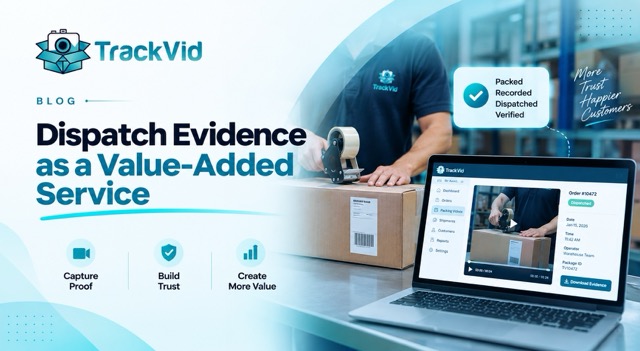
Dispatch evidence is order-level video, photographic and documentary proof of how a shipment was packed, labeled and staged before it left a facility, captured and retained specifically to answer compliance and dispute questions after the fact.
Why this needs its own term. The word most people reach for is "video management system," and that term already means something else entirely: physical security surveillance software indexed by camera and time, built for a completely different question than a chargeback dispute asks. Dispatch evidence is order-indexed, not time-indexed. You retrieve it by asking what happened to a specific shipment, not what happened at a specific place and time. That distinction is the entire reason the category exists separately from warehouse security.
What qualifies as dispatch evidence, practically:
- Video or photographic capture of an order as it was packed, tied to the order or PO ID
- Confirmation of what was scanned, packed and sealed, and when
- Weight, quantity or condition data where a facility's systems capture it
- Return-side capture, so the receiving end of a dispute is documented as well as the shipping end
What does not qualify. General warehouse CCTV, sampled quality-audit photos, or manual logs kept inconsistently by shift. These may be useful for other purposes but do not answer a compliance question at the specific-shipment level that a chargeback dispute requires.
Building a Defense Program Against Retailer Chargebacks
A practical sequence for a supplier or 3PL that is currently disputing chargebacks reactively and wants to move to a defensible, evidence-based program.
1. Audit your current chargeback backlog by category and recoverability, using the pattern above. Most operations discover a large share of their write-offs were in the recoverable categories and simply were not disputed in time or with sufficient evidence.
2. Map every dispute window you face, retailer by retailer. Windows range from roughly two weeks to several months depending on the program and the deduction type. A program that works for one retailer's window can silently fail another's.
3. Fix evidence capture at the point of packing, not at the point of dispute. Evidence assembled after the fact from memory, incomplete photos or generic CCTV rarely meets a retailer's evidence bar. Evidence captured automatically at pack, indexed by order, does.
4. Assign continuous filing, not batch filing. Chargebacks disputed in periodic batches lose valid disputes to window expiry. A team or system that files as chargebacks post, rather than in monthly sweeps, recovers a meaningfully larger share of what is actually recoverable.
5. Route liability conversations through evidence, not negotiation, if a 3PL is involved. A documented root cause resolves a liability question in minutes. An undocumented one becomes a recurring point of friction between brand and 3PL that erodes the relationship regardless of who ultimately pays.
6. Track win rate and recovery by category over time. This is what tells you whether the program is working and where the next investment in evidence capture would pay off fastest.
Bring your chargeback backlog and we will help you sort it by what is actually recoverable. 15 minutes. No commitment.
Where TrackVid Fits
TrackVid is a video proof and claim management platform used by 1,100+ ecommerce sellers and fulfillment operations, and is an authorized VMS partner for Snapdeal. Its proven deployments are in marketplace and D2C ecommerce fulfillment, where it captures order-level dispatch evidence and automates claim filing.
What is proven today:
- Order-level video and photographic evidence on every shipment, captured automatically from the label scan, the same evidence class that labeling and packaging disputes require
- Retrieval by order ID or tracking reference in under two minutes in existing deployments
- Return-side video capture, documenting both ends of a shipment
- Automated claim filing on supported marketplace claim channels, cutting manual filing time from 15 to 20 minutes down to under a minute
- Return reconciliation surfacing claims that would otherwise expire unfiled
What a big-box retail vendor compliance use case would still need confirmed. TrackVid's evidence today is linked by order ID, AWB and SKU rather than by PO or ASN, and its claim automation connects to marketplace claim systems rather than to a retailer's own dispute portal such as Retail Link, APDP or HighRadius. A 3PL or supplier evaluating dispatch evidence specifically for a retailer vendor compliance program should confirm PO-level linkage and any portal-side integration directly rather than assuming it from this guide.
The principle that carries across, whether or not the integration does. The evidence discipline this hub describes, order-indexed, captured automatically at pack, retained through the dispute window, is the same discipline behind TrackVid's proven marketplace deployments. A live example: a single enterprise marketplace deployment captured 94,904 packing videos across 95,836 tracked orders, with 868 claims filed against that evidence and approval moving from 42.3 percent to 60.3 percent within a month of systematic capture.
Talk through your chargeback categories and volume, and we will confirm what maps directly today versus what would need to be built. 15 minutes. No commitment.
Read Next in This Series
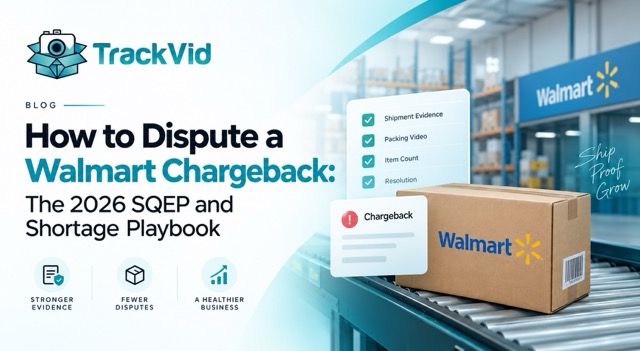
- How to Dispute a Walmart Chargeback, the detailed portal-by-portal, evidence-by-type playbook for Walmart specifically
- Best Packing Video Software for Warehouses and 3PLs, how to evaluate dispatch evidence platforms if you are building this capability from scratch
Frequently Asked Questions
What are retailer chargebacks?
Deductions a retailer takes from a supplier's payment when its systems flag a shipment as non-compliant with vendor requirements, covering categories like shortage, late delivery, labeling and packaging errors, ASN mismatches and pricing discrepancies. Industry-wide, chargebacks and deductions are estimated at well over five billion dollars a year across US retail.
Why do retailers charge back suppliers?
Retail supply chains run on tight scheduling, and a late, short or mislabeled shipment creates real downstream cost: wasted dock appointments, empty shelves, manual receiving exceptions. Chargeback programs pass that cost back to the party the retailer's data indicates caused it, though the underlying determination is not always correct.
Who is liable for a chargeback, the brand or the 3PL?
Determined by the service agreement, not by default assumption. Some contracts assign chargebacks to whichever party's error caused them, others leave all chargebacks with the brand, and a growing number split by documented root cause, which requires shipment-level evidence to establish.
How much do vendor compliance chargebacks cost suppliers?
Commonly one to five percent of gross invoice value, and up to five to ten percent of revenue at scale for suppliers with weak compliance processes. For a supplier doing eighty million dollars in retail sales, that can mean several million dollars a year in deductions.
Which retailers have chargeback programs?
Most major US retailers, including Walmart (OTIF and SQEP), Target, Amazon Vendor, Costco, Kroger, CVS and Walgreens. Programs differ in names, portals and penalty structures, but generally audit the same underlying categories: quantity accuracy, delivery timing, labeling and packaging, ASN accuracy and pricing.
How do you dispute a retailer chargeback?
Identify the correct dispute channel for that retailer and chargeback type, gather the specific evidence that chargeback category requires (commonly proof of delivery, item-level quantity records, or photographic evidence of packaging and labeling), and file within the retailer's dispute window, which can range from roughly two weeks to several months depending on the program.
What is dispatch evidence?
Order-level video, photographic and documentary proof of how a shipment was packed, labeled and staged before leaving a facility, captured to answer compliance and dispute questions after the fact. It is order-indexed rather than time-indexed, which is what distinguishes it from general warehouse security video.
Can a 3PL be held liable for a chargeback?
Yes, where the service agreement assigns chargebacks traceable to the 3PL's own errors. In practice, enforcing that liability split requires evidence establishing root cause. Without it, liability tends to default to negotiation rather than the contract's stated terms.
Which chargebacks are hardest to win?
On-time delivery penalties, which usually need a documented external cause like carrier failure or a system outage to reverse, and chargebacks issued through return-to-vendor or post-audit processes, which several retailers exclude from standard dispute channels entirely.
Does capturing packing evidence actually reduce chargebacks?
It does not prevent a chargeback from being issued, since issuance is largely automated from received-goods data. What it changes is the dispute outcome: documentary chargeback categories such as shortage, labeling and ASN accuracy are far more winnable when order-level evidence exists to answer the retailer's specific claim.
Sources: retailer vendor compliance and chargeback documentation for Walmart, Target, Amazon Vendor and Costco, 2025-2026; industry chargeback and deduction cost estimates; TrackVid platform data across 1,100+ ecommerce sellers and fulfillment operations; enterprise marketplace deployment data (94,904 packing videos, 95,836 tracked orders, 868 claims filed)
Chargeback programs, penalty structures, dispute windows and evidence requirements are set individually by each retailer and revised periodically. Verify current terms with the specific retailer before making decisions based on the guidance here.
TrackVid is a video proof and claim management platform for ecommerce operations, 3PLs and fulfillment centers, providing order ID-linked dispatch evidence and automated claim filing on supported channels. Learn more at trackvid.in.
Get the Marketplace Claim Recovery Checklist
A 12-point checklist used by 1,100+ sellers to recover 85-90% of marketplace claim losses. Free, instant access.
- Marketplace-specific evidence formats (AJIO, Flipkart, Amazon, Myntra)
- Claim window deadlines for every major platform
- The 6-step process that pushes approval from 85-90%
- Common rejection reasons and how to avoid them
No spam. Unsubscribe anytime. Used by sellers at Rare Rabbit, HRX, Da Milano + 1,100 more.
Stop Losing Money to Fake Returns
Join 1,100+ sellers who recover lakhs every month with TrackVid