
For Flipkart sellers preparing for the festive sale. Updated August 2026.
Direct Answer
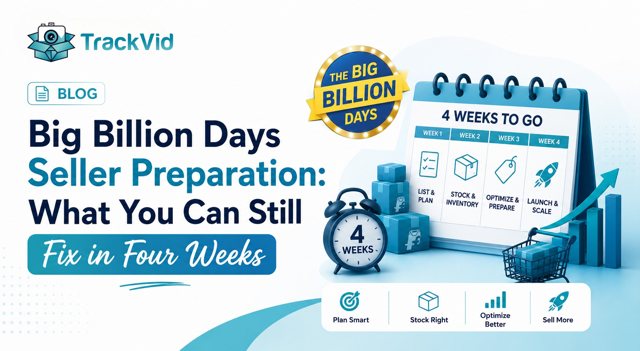
Big Billion Days seller preparation looks different depending on how many weeks you have left, and most published checklists assume twelve. Written in late August 2026, with the sale widely expected to open around 23 September, sellers have roughly four weeks. That matters because two preparation items have long lead times and may already be closed: the deal submission portal in Flipkart Seller Hub typically opens six to eight weeks before the event, and Flipkart Fulfillment enrolment takes three to four weeks. What remains changeable in four weeks is the operational half: repricing against the 2026 fee changes, inventory reconciliation and buffering, catalogue and ad campaign work, packing throughput capacity, and the claim evidence layer. That operational half is also where most of the money is, because Big Billion Days can generate 15 to 20 percent of annual revenue and drive order volume five to ten times normal levels.
Quick Answer: Is It Too Late to Prepare for Big Billion Days?
No, but the list is shorter than it was in July. Deal submission and Flipkart Fulfillment enrolment are the two items with lead times long enough that four weeks may not be sufficient, so check both today rather than assuming. Everything operational is still fully within reach: repricing takes days, inventory reconciliation and buffering takes two to three weeks, catalogue and ad work takes one to two weeks, packing throughput capacity takes three to four weeks if you start now, and a claim evidence layer takes under a week. The operational items are also the ones that decide whether the volume you get is profitable, so a compressed timeline is not a reason to skip them.
What Can You Still Change Four Weeks Out?
Almost every Big Billion Days seller preparation guide is written as an evergreen checklist, which means it cannot tell you the one thing you actually need to know: whether a given item is still open to you today.
Here is that table.
| Preparation item | Typical lead time | Realistic at four weeks out |
|---|---|---|
| Deal submission via Seller Hub portal | Portal opens 6 to 8 weeks before the event | Check today. May already be closed |
| Flipkart Fulfillment enrolment | 3 to 4 weeks onboarding | Too tight to rely on for this sale |
| Seller metrics improvement | Builds over months | Largely locked in already |
| Repricing against 2026 fee changes | Days | Fully open |
| Inventory forecast and buffer stock | 2 to 3 weeks with supplier lead time | Open, but start this week |
| Catalogue and listing optimisation | 1 to 2 weeks | Fully open |
| Ad campaign structure for BBD | 1 to 2 weeks | Fully open |
| Packing throughput capacity | 3 to 4 weeks to deploy and stabilise | Open, but only just |
| Claim evidence layer | Under a week | Fully open |
| Ship-confirm and dispute ownership process | Days | Fully open |
At four weeks out, half the standard checklist is already closed to you. The half that is left is the operational half, and that is the half that decides whether the volume is worth having.
If deal submission has closed for you this year, note it and move on. Your organic and ad-driven volume during BBD will still be several times normal, and everything below applies regardless.
When Is Big Billion Days 2026?
Flipkart had not officially confirmed 2026 dates at the time of writing, and it typically confirms four to six weeks before the event.
What is expected. Most trackers point to a start around 23 September 2026, with Flipkart Plus early access roughly 24 hours ahead of general opening. Some sources suggest late September running into the first week of October. The sale historically runs five to seven days, timed ahead of Diwali, and opens in the same window as Amazon's Great Indian Festival.
Recent history, for pattern rather than prediction: the sale ran 6 to 12 October in 2024 and 28 September to 5 October in 2025.
What to do with that uncertainty. Plan against the earliest credible date rather than the most likely one. If you prepare for 23 September and the sale opens in October, you have a comfortable week. If you prepare for October and it opens on 23 September, you are short by ten days at exactly the wrong moment. Confirm the actual dates in Seller Hub the day they are announced and compress or extend the sprint below accordingly.
What Actually Happens to a Seller During BBD
Big Billion Days seller preparation only makes sense once you understand the shape of the event, which is what makes the sprint below deliberate rather than arbitrary.
Traffic and orders multiply, not increase. Sellers commonly report order volumes running five times normal, with platform traffic five to ten times higher than a regular week. Many brands generate 15 to 20 percent of annual revenue in this single window.
Volume arrives in bursts, not evenly. Deal windows, bank offer periods and Plus early access all concentrate demand into specific hours. Your daily total is a poor guide to what your packing line actually has to survive.
Returns arrive after the sale, not during it. Return windows run their course, so the return wave lands seven to twenty-one days later, and the claim windows on those returns are short: AJIO 3 days, Flipkart 48 to 72 hours, Myntra around 48 hours, Amazon SAFE-T 7 days, Meesho 7 days. Your claims workload peaks when the sale already feels finished.
The 2026 changes added a new cost to getting it wrong. Since 23 August 2026, Flipkart charges ₹30 per shipment not made ready by the Dispatch By Date, ₹60 for a seller cancellation or auto-cancellation after three missed deadlines, and ₹90 when an order is both delayed and cancelled. Amazon separately moved to a cancellation fee of 2 to 10 percent of order value from 17 August. Both changes land in the same festive window.
For depth on each, see our Flipkart ₹30, ₹60 and ₹90 Seller Penalties guide, our Amazon Cancellation Fee guide and our Flipkart Seller Policy Changes 2026 reference at trackvid.in.
The 4-Week Big Billion Days Seller Preparation Sprint
Week 4 (Now): Confirm, Reprice, Forecast
Big Billion Days seller preparation starts with knowing where you actually stand. Confirm your participation status today. Open Seller Hub and check whether the deal submission portal is open, whether your submissions were approved, and what your committed discount and inventory quantities are. If it has closed, you know where you stand and can plan around organic and ad-driven volume instead.
Reprice against the 2026 fee changes, because most sellers have not. If you sell fashion, commission went to zero at any price point in July 2026. If you sell under ₹1,000 in other categories, commission has been zero since November 2025. Sellers running BBD discounts calculated against an old rate card are either leaving margin on the table or discounting from a number that no longer applies.
Forecast by SKU, not by category. Use last festive season's actual sell-through for your top SKUs, apply your expected growth, and produce unit-level numbers your supplier can act on. Category-level forecasts are how sellers end up with the wrong stock in the right quantity.
Week 3: Inventory, Catalogue and Campaigns
Reconcile stock across every channel and set buffers. Oversell is the most expensive avoidable failure of the sale, because it now triggers a ₹60 Flipkart penalty or a 2 to 10 percent Amazon cancellation fee on top of losing the order. Pull fast-movers at a threshold quantity rather than at zero.
Finish catalogue work now, not during the sale. Titles, images, description content and review depth on the SKUs you expect to carry the sale. Listings edited during a sale lose ranking momentum at the worst possible moment.
Build BBD ad campaigns separately from your evergreen ones. Keep them structurally distinct so you can scale and kill them without disturbing your baseline performance. Keep ACoS under your effective commission rate, which for fashion sellers is now a very different number than it was last year.
Week 2: Capacity, Measured Properly
This is the week most sellers skip in their Big Billion Days seller preparation, and it is the one that decides whether the volume is profitable.
Work in burst windows, not daily totals. Take last festive season's order arrival by hour. Find the largest batch arriving between one courier pickup cutoff and the next. Divide by the hours available before that cutoff. That is your required parcels per hour.
Measure your actual output honestly. Time your packing line for one hour during a genuinely busy period. Not a supplier's rated figure and not your calm-Tuesday number.
Compare the two. If required exceeds actual, orders will age past their Dispatch By Date regardless of how hard anyone works, and every one of those is a ₹30 charge that can escalate to ₹90.
Then close the gap with the right tool. A gap under 50 parcels per hour is a process and staffing fix. A gap above 150 per hour cannot be closed with headcount in four weeks, because a trained packer manages 40 to 80 parcels an hour and experienced packers are not available to hire in September. That is the threshold at which automation is the only arithmetic that works, and a three to four week deployment window is exactly what you have left.
Week 1: Evidence, Process and Ownership
Deploy the claim evidence layer. Order ID-linked packing capture on every parcel, recording item, quantity, condition, weight, tamper-evident seal and shipping label in one frame. This takes under a week to stand up and it is what decides your recovery in October.
Fix ship-confirm timing. Confirm dispatch at the moment of handover, assigned to the person doing the handover. On Amazon a parcel that shipped on time but was confirmed the next morning can still trigger a cancellation fee.
Name owners, by shift. One named person on the dispute and claim queue per shift, and one on the unshipped-order sweep. Not "whoever has time," which during BBD means nobody.
Write the escalation rule. Any order that misses one dispatch deadline gets escalated immediately, because three missed deadlines triggers auto-cancellation at the ₹90 tier.
Sale Week and After: Execute, Then Sweep
During the sale, run a daily unshipped-order sweep sorted by deadline proximity, and file marketplace claims same-day inside each platform's window rather than batching everything to the end.
On day 5 and day 12 after the sale, reconcile every return received against claims filed. The gap is unfiled claims still inside their windows, and this sweep is usually the single most profitable hour of the whole festive period.
Within 30 days, run the post-mortem: dispatch breach rate, cancellation count, claims filed versus expired, settlement gap against expected payout. Those four numbers are next year's sprint plan.
For the full claims-side system, see our Big Billion Days Seller Claims playbook, and for the wider operational build see our Sale Season Operations Playbook at trackvid.in.
Agra Seller Imran: 7.8% Dispatch Breach to 1.1%
Imran runs a footwear business from Agra selling on Flipkart, Amazon, Myntra and Meesho. Normal volume runs about 400 orders a day. During last year's festive sale his peak reached roughly 2,600 a day, with about 15,600 orders across the sale week. BBD accounted for close to 19 percent of his annual revenue.
What last year looked like:
- Dispatch breach rate across the sale: 7.8 percent, or roughly 1,220 shipments
- Seller cancellations, almost entirely oversell: 210
- Peak packing throughput measured: about 240 parcels an hour across four stations
- Required throughput in his worst burst window: about 620 parcels an hour
- Claim-eligible returns after the sale: about 890
- Claims filed inside window: 34 percent
- Win rate on those filed: 40 percent
Modelled against the penalty tiers introduced in August 2026, that dispatch performance would now cost roughly ₹52,000 for a single sale week. His unrecovered claim value was considerably larger at approximately ₹5.1 lakh.
"We treated the sale as a demand problem. Get the deals approved, get the stock in. Nobody in the building had ever measured how many parcels we could physically pack in an hour," Imran said.
The four-week sprint he ran:
Week 4: confirmed deal status, repriced his catalogue against the July 2026 fashion commission change which he had not accounted for, and forecast at SKU level.
Week 3: cross-channel stock reconciliation with buffers on his top 45 SKUs, catalogue work finished, BBD ad campaigns built separately.
Week 2: measured the gap properly for the first time. The 380 parcels-per-hour shortfall was far beyond what hiring could close in the time available, so a TrackVid TV-450 went onto the main line with installation and operator training, giving three weeks of normal running before the sale.
Week 1: Order ID-linked packing capture via TrackVid, ship-confirm moved to point of handover, named owners assigned per shift.
Results across the following festive sale, at comparable volume:
- Measured peak throughput: 240 to 780 parcels an hour
- Dispatch breach rate: 7.8 percent to 1.1 percent
- Seller cancellations from oversell: 210 to 44
- Modelled penalty exposure: ₹52,000 to about ₹8,400
- Claims filed inside window: 34 percent to 93 percent
- Win rate on filed claims: 40 percent to 86 percent
- Claim value recovered: ₹5.1 lakh previously unrecovered, reduced to about ₹96,000 unrecovered
Roughly ₹4.5 lakh recovered in a single festive window, and the larger share of it came from the claims side rather than the penalties. The machine solved the dispatch problem he could see. The capture running on it solved the claims problem he could not.
Apne burst window ki capacity aur unfiled claims ka number nikaalke dekhiye. 30 minutes. No commitment.
How Much Packing Capacity Do You Actually Need for BBD?
This is the calculation almost nobody in Big Billion Days seller preparation actually runs, and it takes about fifteen minutes.
Step one: find your worst burst window. Pull last festive season's orders by hour. Identify the largest number arriving between one courier pickup cutoff and the next.
Step two: divide by hours available. If 2,100 orders arrive between 2pm and 7pm against a 7pm cutoff, you need 420 parcels an hour, not the 260 an hour your daily average suggests.
Step three: measure actual output. One hour, timed, during a busy period, including labelling, weighing and checks. Most sellers find their real number is 30 to 40 percent below what they assumed.
Step four: apply the gap to the right answer.
| Gap in parcels per hour | What actually closes it |
|---|---|
| Under 50 | Process fixes and one additional packer |
| 50 to 150 | Hiring works, if you can find and train experienced packers before September |
| Above 150 | Headcount cannot close it. A trained packer manages 40 to 80 an hour, so a 300 gap means four to seven experienced hires for a seasonal window |
And the honest qualifier. If your gap runs into the hundreds, this is the last window in which a machine can be deployed, trained on and stabilised before the sale opens. An automatic packaging machine running 600 to 1,200 parcels an hour with one or two operators replaces roughly ten to fifteen packers of bagging throughput. Deployed in the final week it gets abandoned under pressure. Deployed now it is routine by the time volume arrives.
Full specifications, throughput data and the proof camera in action.
Where TrackVid and the TV-450 Fit
Most of the Big Billion Days seller preparation above costs nothing and needs no vendor. Run those items first.
Two pieces need infrastructure, and both sit at your packing station, which during BBD is the single point where money is won and lost in both directions.
TrackVid is a video proof and claim management platform used by 1,100+ ecommerce sellers on Flipkart, Amazon, Myntra, AJIO, Nykaa, Meesho, Snapdeal, Shopify and WooCommerce, officially authorized by Snapdeal. Brands using it include Rare Rabbit, Wrogn, The Indian Garage Co, The Bear House, HRX, Nike, Jordan, Tommy Hilfiger and Snitch.
For the festive sale specifically it captures Order ID-linked packing video automatically, files claims across Flipkart SPF, Myntra PPMP, Amazon SAFE-T, AJIO, Meesho and Nykaa in roughly 30 seconds against 15 to 20 minutes manually, automates AJIO's 24 to 48 hour CCTV-required email responses which do not pause for the festive rush, retrieves any order in under two minutes, and reconciles returns to surface claims that would otherwise expire unnoticed. Setup is typically under 30 minutes on existing warehouse cameras, which is why this is a week-one item rather than a week-four one.
The TrackVid TV-450 is an automatic packaging machine running 600 to 1,200 parcels an hour with a bag length range of 200mm to 800mm, supplied with onsite installation, operator training, warranty and PE bag roll supply. Its built-in proof camera links every sealed parcel to its Order ID, so the machine that closes your burst-window gap also generates the evidence that recovers your claims in October.
Read the capacity section above before deciding. The machine earns its place only if your burst requirement genuinely exceeds your line's output. If it does not, TrackVid alone is the correct call for this sale.
In 30 minutes we run your burst-window requirement, your modelled penalty exposure and your unclaimed balance on your real numbers.
Five Questions to Audit Your BBD Readiness
1. Where does your Big Billion Days seller preparation actually stand on deal submission: approved, rejected, or did the portal close before you submitted? Most sellers do not check until the sale opens, which is too late to plan around.
2. Have you repriced against the 2026 fee changes? Fashion commission went to zero at any price in July, and BBD discounts calculated on an old rate card are wrong in one direction or the other.
3. What is your required parcels per hour inside your worst burst window, against your measured actual output? If you cannot answer, you do not know whether you will make your dispatch dates.
4. What was your dispatch breach rate last festive season? Multiply by expected volume and by ₹30 for your floor, before escalation to the ₹60 and ₹90 tiers.
5. How many claim-eligible returns did last year's sale produce, and how many did you file inside window? For most sellers this is the largest number in the whole festive P&L and the least measured.
Four weeks is enough for the half of the checklist that decides your margin. 30 minutes. No commitment.
Frequently Asked Questions
How do I prepare for Big Billion Days as a seller?
Work backwards from the sale date in four phases. Confirm deal status and reprice against the 2026 fee changes, then reconcile inventory and finish catalogue and ad work, then measure burst-window packing capacity against actual output, then deploy claim evidence capture and assign named owners per shift.
Big Billion Days ki taiyari kaise kare?
Char hafte ka plan banao. Pehle deal status check karo aur naye 2026 fee changes ke hisaab se pricing update karo. Phir har channel par stock reconcile karo aur buffer rakho. Phir burst window ki parcel per hour capacity naapo. Aakhir me packing video Order ID se link karo.
Is it too late to prepare for Big Billion Days?
No, but the list is shorter. Deal submission and Flipkart Fulfillment enrolment have long lead times and may already be closed, so check both today. Everything operational remains open: repricing takes days, inventory and catalogue work one to three weeks, packing capacity three to four weeks, and claim evidence capture under a week.
When is Big Billion Days 2026?
Flipkart had not officially confirmed dates at the time of writing and typically confirms four to six weeks ahead. Most trackers expect a start around 23 September 2026 with Plus early access roughly 24 hours earlier, running five to seven days. Plan against the earliest credible date rather than the most likely one.
How much do orders increase during Big Billion Days?
Sellers commonly report order volumes around five times normal, with platform traffic five to ten times higher than a regular week. Many brands generate 15 to 20 percent of annual revenue in the single window. The volume arrives in bursts around deal windows and bank offer periods rather than spreading evenly across the day.
Flipkart sale ke liye stock kitna rakhna chahiye?
SKU level par forecast karo, category level par nahi. Pichle festive season ka actual sell-through lo, expected growth lagao, aur top SKUs par buffer rakho. Zero par nahi, ek threshold quantity par listing pull karo. Oversell ab sabse mehenga failure hai kyunki ₹60 penalty bhi lagta hai aur order bhi jaata hai.
How much packing capacity do I need for Big Billion Days?
Calculate the largest batch of orders arriving between two courier pickup cutoffs during peak, then divide by hours available. That is your required parcels per hour. Compare against your line timed for one real hour during a busy period. Most sellers find their actual output is 30 to 40 percent below what they assumed.
Will a packing machine help during Big Billion Days?
Only if your burst-window requirement exceeds your line's output. Under a 50 parcel per hour gap, process fixes suffice. Above 150 per hour, headcount cannot close it, since a trained packer manages 40 to 80 an hour and experienced packers are hard to hire in September. Deployment needs three to four weeks to stabilise.
What happens to returns after Big Billion Days?
The return wave lands seven to twenty-one days after the sale, when it already feels finished. Claim windows on those returns are short and do not extend for volume: AJIO 3 days, Flipkart 48 to 72 hours, Myntra around 48 hours, Amazon SAFE-T and Meesho 7 days. Missed windows are permanently unrecoverable.
What is the TrackVid TV-450?
An automatic packaging machine for ecommerce parcel packing, running 600 to 1,200 parcels an hour with a bag length range of 200mm to 800mm. Its built-in proof camera links every sealed parcel to its Order ID, feeding the TrackVid claim platform. Supplied with installation, training, warranty and bag supply.
Sources: Flipkart Seller Hub deal submission and fulfilment documentation; Flipkart Big Billion Days seller preparation guidance from Pinnacle Growth Consulting, WareIQ and GoNukkad (2026); Flipkart and Amazon seller policy notices, August 2026; historical Big Billion Days scheduling data; TrackVid platform data across 1,100+ sellers; WROGN pilot data (94,904 videos, 95,836 tracked orders, 868 claims filed)
Big Billion Days dates, deal submission windows and fulfilment onboarding timelines are set by Flipkart and vary year to year. Confirm current dates and portal status in Seller Hub before finalising any preparation calendar based on the timings here.
TrackVid is a video proof and claim management platform used by 1,100+ ecommerce sellers on Flipkart, Amazon, Myntra, AJIO, Nykaa, Meesho, Snapdeal, Shopify and WooCommerce. Officially authorized by Snapdeal. The TrackVid TV-450 is an automatic packaging machine with a built-in proof camera, supplied with onsite installation, operator training, warranty and PE bag roll supply. Learn more at trackvid.in.




Get the Marketplace Claim Recovery Checklist
A 12-point checklist used by 1,100+ sellers to recover 85-90% of marketplace claim losses. Free, instant access.
- Marketplace-specific evidence formats (AJIO, Flipkart, Amazon, Myntra)
- Claim window deadlines for every major platform
- The 6-step process that pushes approval from 85-90%
- Common rejection reasons and how to avoid them
No spam. Unsubscribe anytime. Used by sellers at Rare Rabbit, HRX, Da Milano + 1,100 more.
Stop Losing Money to Fake Returns
Join 1,100+ sellers who recover lakhs every month with TrackVid