
For Flipkart and Amazon India sellers heading into the festive season. Updated August 2026.
Direct Answer
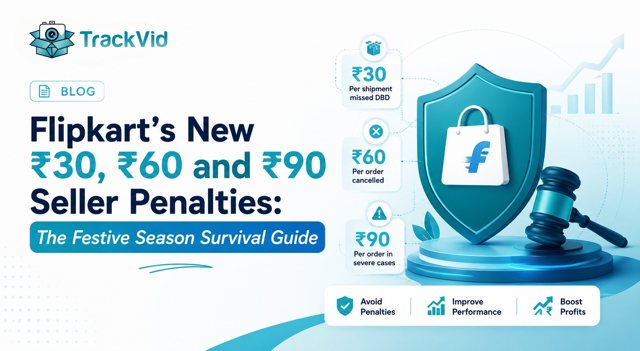
The new Flipkart seller penalty structure took effect on 23 August 2026 and works in three tiers. A shipment not made ready for pickup by the committed Dispatch By Date attracts ₹30 per shipment. An order cancelled by the seller, or auto-cancelled after three missed dispatch deadlines, attracts ₹60 per shipment. An order that is both delayed and subsequently cancelled attracts ₹90 per shipment. Sellers in their first three months on the platform are exempt. The structure replaces the earlier practice of locking seller accounts for a period after a Dispatch By Date breach, so accounts now stay operational while individual orders are charged instead. Amazon India made a parallel change on 17 August, moving to a graded cancellation fee of 2 to 10 percent of order value on Easy Ship and Self Ship, plus 18 percent GST. At festive volume the arithmetic gets serious quickly: a seller shipping 14,000 orders across the sale week with a 6 percent dispatch breach rate is looking at roughly ₹25,000 before any escalation to the ₹60 and ₹90 tiers.
Quick Answer: How Do You Avoid the Flipkart Dispatch Penalty?
You avoid the ₹30, ₹60 and ₹90 penalties by closing the packing throughput gap inside your burst window, because a Dispatch By Date is a cutoff time rather than a daily target. A trained packer manages 40 to 80 parcels an hour. An automatic packaging machine such as the TrackVid TV-450 runs 600 to 1,200 parcels an hour with one or two operators, which is roughly the bagging throughput of ten to fifteen manual packers. Machines with a built-in proof camera go further, because the same capture that proves the parcel was sealed before the cutoff also defends the return claim that arrives three weeks later.
What Are Flipkart's New Seller Penalties?
The Flipkart seller penalty structure covers order fulfilment lapses and has been in force since 23 August 2026.
| Penalty | What triggers it |
|---|---|
| ₹30 per shipment | Shipment not made ready for pickup by the committed Dispatch By Date (DBD) |
| ₹60 per shipment | Order cancelled by the seller, or automatically cancelled after three missed dispatch deadlines |
| ₹90 per shipment | Order both delayed past DBD and subsequently cancelled |
New sellers get a grace period. Sellers within their first three months on the platform are not covered by the policy.
The consequence changed shape, not just size. Under the earlier regime, a Dispatch By Date breach could result in the seller's account being locked for a period, which hit the business harder in absolute terms. The new structure charges individual orders while keeping the account operational. Flipkart has positioned this as encouraging better planning and improving customer experience rather than as a revenue measure.
Whether that trade favours you depends entirely on your volume. For a small seller with occasional breaches, per-order charges are gentler than a lockout. For a high-volume seller during the festive sale, a 6 percent breach rate across 14,000 orders produces a bill that a temporary lockout never would have.
The escalation path is the part sellers underestimate. Failing to mark an order ready for dispatch before the deadline can trigger an SLA breach, which affects seller performance metrics and in some cases results in the order being treated as a seller cancellation. That is the mechanism by which a ₹30 problem quietly becomes a ₹90 problem. You do not choose to escalate. The system escalates for you when the order sits unshipped long enough.
Why Did Flipkart Change the Policy Now?
Timing is the whole story. The Flipkart seller penalty landed weeks before the festive season, when order volumes multiply and fulfilment reliability is what marketplaces compete on.
The scale context. Flipkart said earlier this year that its platform had more than 1.4 million sellers and that it was strengthening monitoring and enforcement to improve compliance and platform reliability. Governing fulfilment quality across a seller base that size is not possible through account-level enforcement alone, because locking accounts removes supply at exactly the moment the platform needs it most.
The competitive context. India's e-retail market grew 19 to 21 percent in value terms in 2025 per Bain & Company's How India Shops Online 2026 report, reaching around 290 to 300 million online shoppers, with a seller base that has tripled over five years. Marketplaces are also under pressure from quick commerce on delivery speed, which makes a missed dispatch deadline more costly to them than it used to be.
The seller pushback is worth understanding, because it identifies the real risk to you. Vinod Kumar, Trustee of the Forum for Internet Resellers, Sellers and Traders (FIRST INDIA), has argued that not every cancellation or delay is seller-caused, pointing to logistics failures, platform issues, demand spikes and customer-related factors. His summary line was that sellers should not become the default financial shock absorbers of the e-commerce ecosystem, and he called for transparent attribution of responsibility.
That is the practical concern. If a courier executive does not arrive for pickup, the shipment is not made ready for collection through no fault of yours, and the charge still applies. Attribution is the unresolved question in this policy, and it is why keeping your own timestamped record of when a parcel was sealed, labelled and staged is worth more now than it was last month.
What Will These Penalties Cost During Big Billion Days?
This is the section to run against your own numbers before the sale opens, because each Flipkart seller penalty is small and the volume is not.
Base exposure at the ₹30 tier alone:
| Peak orders/day | Orders across a 7-day sale | At 3% DBD breach | At 6% DBD breach | At 10% DBD breach |
|---|---|---|---|---|
| 500 | 3,500 | ₹3,150 | ₹6,300 | ₹10,500 |
| 1,000 | 7,000 | ₹6,300 | ₹12,600 | ₹21,000 |
| 2,000 | 14,000 | ₹12,600 | ₹25,200 | ₹42,000 |
| 3,500 | 24,500 | ₹22,050 | ₹44,100 | ₹73,500 |
| 5,000 | 35,000 | ₹31,500 | ₹63,000 | ₹1,05,000 |
- 700 breached shipments dispatched late but not cancelled: 700 × ₹30 = ₹21,000
- 140 breached shipments subsequently cancelled: 140 × ₹90 = ₹12,600
- 90 orders cancelled by the seller without a DBD breach: 90 × ₹60 = ₹5,400
- Total exposure: ₹39,000 across one sale week
That is roughly ₹39,000 removed from the most profitable week of your year, on orders you already paid to acquire, pick, pack and ship. It sits alongside your referral fees, collection fees, shipping fees, and the return losses that arrive a fortnight later.
The compounding point. Dispatch breaches and return claims are not separate problems in a festive week. Both are symptoms of a packing operation running past its capacity. The same overloaded station that misses the pickup cutoff is also the one packing without proper verification, which produces the wrong-item and short-shipment claims that land in October. For the claim side of that, see our Big Billion Days Seller Claims playbook at trackvid.in.
Why Do Sellers Actually Miss the Dispatch By Date?
Almost every guide to this policy will tell you to dispatch on time. That is advice, not a diagnosis. Here is what actually causes a Dispatch By Date breach at festive volume.
Cause 1: Packing throughput hits a ceiling. This is the dominant structural cause and the least discussed. A trained packer typically manages 40 to 80 parcels an hour depending on product, and materially fewer once labelling, weighing and quality checks are included. Five packers give you roughly 275 parcels an hour on a good day.
Cause 2: The Dispatch By Date is a cutoff, not a daily total. This is the detail that breaks otherwise well-staffed operations. Orders arrive across the day, but courier pickup happens at a fixed time. If 1,200 orders land between 1pm and 5pm and the pickup is at 6pm, your daily capacity is irrelevant. You need 300 parcels an hour inside that specific window. Sellers who calculate capacity on daily totals consistently under-provision for the burst.
Cause 3: Errors discovered at the pack station. A short-picked or mismatched item stops the line, and during festive weeks these rise because catalogues broaden and lookalike variants multiply. See our Order Accuracy playbook at trackvid.in.
Cause 4: Manpower that does not scale on demand. The standard festive answer is to hire temporary packers. Untrained packers work slower, make more errors, and need supervision from your fastest existing staff, which lowers their output too. Adding people to a packing line has real diminishing returns.
Cause 5: Courier-side failure that is charged to you anyway. Pickup executives miss slots during the festive rush. The shipment was ready. The charge still lands.
What this diagnosis implies. Causes 1 and 2 are throughput problems, and throughput problems are not solved by trying harder or by adding a sixth packer to a five-packer line. Cause 5 is an attribution problem, and attribution problems are solved by records. Neither is solved by a checklist telling you to dispatch on time.
The same packing table decides two different losses. One is a penalty going out. The other is a claim coming back.
What Should You Look For in a Packing Machine for Marketplace Dispatch?
An automatic packaging machine for Indian marketplace dispatch should deliver 600 to 1,200 parcels an hour, handle a bag length range wide enough for your SKU mix, capture Order ID-linked proof of every sealed parcel, and arrive with Indian onsite installation, operator training, warranty and consumable bag supply. Throughput alone is not a differentiator, because almost every autobagger on the market reaches that range. What separates machines for marketplace sellers specifically is whether the machine produces usable evidence and whether anyone will service it locally.
The seven criteria that actually matter for a marketplace seller:
1. Sustained throughput inside a burst window, not peak rated speed. Ask for parcels per hour measured over a continuous shift, not a headline figure from a two-minute demo.
2. Bag length range against your SKU mix. A range of 200mm to 800mm covers most apparel, accessories, footwear and small hard goods. Narrower ranges force you to keep a manual line running alongside, which defeats the purpose.
3. Order ID-linked proof capture. This is the criterion most buyers do not know to ask about, and it is the one that decides whether the machine earns money or only saves it. A machine with a built-in proof camera records what went into every bag and links it to the order. Without it, you are still manually reconstructing evidence from CCTV when a claim arrives.
4. Indian onsite installation and operator training. A directly imported machine arrives on a pallet with a manual in translated English. Budget for the engineer you will have to find yourself.
5. Local warranty and spares. A machine down for three weeks during the festive sale costs more than the machine.
6. Consumable supply built into the deal. PE bag roll supply included means one vendor relationship rather than a separate sourcing problem at peak.
7. Integration with your claim workflow. The proof the machine captures is worthless if filing a claim still takes fifteen minutes. It needs to feed a system that files inside the marketplace window.
Imported autobagger against the TrackVid TV-450:
| Directly imported autobagger | TrackVid TV-450 | |
|---|---|---|
| Throughput | 600 to 1,200 parcels/hour | 600 to 1,200 parcels/hour |
| Bag length range | Varies | 200mm to 800mm |
| Onsite installation | Buyer arranges | Included |
| Operator training | Buyer arranges | Included |
| Warranty and service in India | Varies | Included |
| PE bag roll supply | Buyer sources separately | Included |
| Order ID-linked dispatch proof | Not available | Built-in proof camera |
| Marketplace claim filing | Manual, 15 to 20 min per claim | Automated via TrackVid, around 30 seconds |
| Ways it pays back | Labour and penalties avoided | Labour and penalties avoided, plus claim revenue recovered |
Full specifications, throughput data and the proof camera in action.
The 5-Step Zero-Penalty Dispatch System
Step 1: Model Your Exposure Before the Sale, Not After the Invoice
Every Flipkart seller penalty you pay this season is forecastable today. Pull last festive season's data and calculate three figures: your dispatch breach rate as a percentage of orders, your seller-cancellation rate, and how many breached orders subsequently cancelled.
Apply the new penalty tiers to those historical numbers. The output is what last year's performance would cost under this year's rules. That figure is the business case for everything below, and it takes about twenty minutes to produce.
Step 2: Map Your Pickup Cutoffs, Then Calculate Burst Capacity
Daily capacity is the wrong measurement. Work in windows.
- List every courier pickup cutoff time for every channel you ship on.
- Plot order arrival by hour from last festive season, not from a normal week. The shape is different.
- Identify your worst burst window: the largest number of orders arriving between one cutoff and the next.
- Divide by the hours available. That is your required parcels-per-hour, and it is usually two to four times what sellers assume.
- Compare against actual measured throughput, not theoretical. Time your line for one hour during a busy day and use the real number.
The gap between required and actual, expressed in parcels per hour, is the precise size of your penalty problem.
Step 3: Fix Throughput Structurally, Not With Headcount
If Step 2 shows a gap of 100 parcels an hour, you need roughly two more experienced packers, who do not exist to hire for one week in September. If it shows a gap of 400 an hour, headcount is not an available answer at all.
Automated bagging changes the arithmetic rather than stretching it. An automatic packaging machine runs 600 to 1,200 parcels an hour continuously with one or two operators, which is roughly the raw bagging throughput of ten to fifteen manual packers.
See throughput specifications for the TrackVid TV-450 →
One honest caveat worth stating plainly: a bagging machine solves bagging. It does not pick, and it does not verify. If your bottleneck is picking accuracy rather than packing speed, fix picking first. The machine removes the ceiling on a specific stage, and that stage is the one most commonly binding during festive bursts.
Step 4: Build a Timestamped Handover Record
Because attribution is the open question in this policy, your own record of when each parcel was sealed, labelled and staged for pickup is the only evidence you will have if a charge is applied for a courier-side failure.
- Capture per order, linked to Order ID, with the shipping label visible and the timestamp recorded.
- Log the handover event to the courier, with the manifest reference.
- Retain it for the full penalty reconciliation cycle, not just until dispatch.
This record has a second job, which is the reason it is worth building even if the penalty never gets contested. It is the same artefact that defends a wrong-item or empty-box claim when the return arrives three weeks later.
Step 5: Cut Seller Cancellations at the Source
The ₹60 and ₹90 tiers are triggered by cancellation, so the cheapest penalty reduction available is not cancelling.
- Reconcile inventory before the sale, not during it. Most seller cancellations are oversell caused by stale stock counts across channels.
- Buffer stock on your top SKUs rather than listing to the last unit at festive volume.
- Kill the three-strikes escalation early. Since an order auto-cancels after three missed dispatch deadlines, any order that misses one deadline should be escalated immediately rather than left in the queue to age into a ₹90 charge.
- Run a daily unshipped-order sweep during the sale, sorted by how close each order is to its next deadline.
Ludhiana Seller Harpreet: Modelling ₹72,570 of Exposure
A note on this case study: the penalty policy is only days old, so no seller has yet been charged across a full festive season under it. What follows models Harpreet's actual dispatch performance from last festive season against the new penalty tiers. This is exactly the calculation in Step 1, and you can run it on your own data today.
Harpreet runs a hosiery and winterwear business from Ludhiana, selling on Flipkart, Amazon, Myntra and Meesho. Peak festive volume last season reached about 3,500 orders a day, roughly 24,500 across the sale week.
Last season's actual dispatch performance:
- Dispatch breach rate: 6.2 percent, giving 1,519 breached shipments
- Of those breached shipments, 260 aged out and were subsequently cancelled
- Seller-initiated cancellations without a DBD breach: 190, almost all oversell
- Packing line: five packers across three stations, measured throughput about 275 parcels an hour
- Worst burst window: roughly 2,100 orders arriving between 2pm and 7pm against a 7pm pickup cutoff, requiring around 420 parcels an hour
Modelled against the new penalty tiers:
- 1,259 breached but not cancelled: 1,259 × ₹30 = ₹37,770
- 260 breached and subsequently cancelled: 260 × ₹90 = ₹23,400
- 190 seller-cancelled without breach: 190 × ₹60 = ₹11,400
- Total modelled exposure: ₹72,570 for one sale week
"We always knew we were late on some orders. We never had a number attached to it. Seeing seventy-two thousand rupees on a spreadsheet made it a decision instead of a complaint," Harpreet said.
What changed before this season:
Step 2 revealed the real problem. The line was not slow on average. It was 145 parcels an hour short inside the single window that mattered, and no amount of daily-average capacity fixed that.
Five weeks out, a TrackVid TV-450 automatic packaging machine was installed on the main line, with onsite installation and operator training. Measured throughput settled at about 850 parcels an hour with two operators. The machine's built-in proof camera feeds TrackVid, so each bagged parcel is captured and linked to its Order ID at the same moment it is sealed.
Four weeks out, inventory was reconciled across all four channels and buffer stock set on the top 40 SKUs, targeting the oversell cancellations.
Through the sale, a daily unshipped-order sweep ran sorted by deadline proximity, so no order aged into the three-strike auto-cancellation.
Results across the following festive sale, at comparable volume:
- Dispatch breach rate: 6.2 percent to 0.8 percent
- Breached shipments: 1,519 to 196
- Breached-then-cancelled: 260 to 12
- Seller cancellations from oversell: 190 to 40
- Measured burst throughput: 275 to 850 parcels per hour
- Modelled penalty exposure: ₹72,570 to ₹9,000
- Wrong-item and short-shipment claims filed with dispatch evidence: win rate rose from 41 percent to 87 percent, recovering approximately ₹2.6 lakh that had previously been written off
The second number is the one Harpreet did not expect. The machine was bought to solve a penalty problem on the way out. The proof camera on it solved a claims problem on the way back, and the claims recovery was larger than the penalty saving.
Apne last festive season ke numbers par exposure model karke dekhiye. 30 minutes. No commitment.
How Does Amazon's New Cancellation Fee Compare?
Amazon India changed its cancellation fee structure on 17 August 2026, so most multichannel sellers are absorbing two policy changes in the same month.
| Cancelled order value | Amazon cancellation fee |
|---|---|
| Below ₹10,000 | 10% |
| ₹10,001 to ₹50,000 | 8% |
| ₹50,001 to ₹1 lakh | 5% |
| Above ₹1 lakh | 2% |
The structural difference matters for planning. Flipkart's charges are fixed amounts per affected shipment. Amazon's scale with order value, and the rate is highest on low-value orders. A cancelled ₹800 order on Amazon costs ₹80 plus GST. The same cancellation on Flipkart costs ₹60. But a cancelled ₹8,000 order costs ₹800 plus GST on Amazon against ₹60 on Flipkart.
What that implies: if you sell low-value, high-volume goods, Flipkart's fixed per-shipment charge is the bigger aggregate risk because it applies to every breach regardless of ticket size. If you sell higher-value goods, Amazon's percentage fee is the sharper individual exposure. Sellers doing both need two different mitigation priorities, and the common factor underneath both is not cancelling in the first place.
Can You Dispute a Flipkart Seller Penalty?
An honest answer: press coverage of this policy has not described a documented dispute or waiver mechanism, and seller representatives are actively raising attribution as an unresolved concern. Confirm the current position directly on your Flipkart seller portal notification before assuming either way, because policies of this kind are often refined after launch.
What that uncertainty means practically:
Treat prevention as the primary control. Until an attribution process is clearly documented, the reliable way to not pay a penalty is to not breach the deadline. Steps 2 and 3 above are where that gets decided.
Keep the record anyway. If an attribution or dispute route does exist or is introduced, the seller who can produce a timestamped, Order ID-linked record showing the parcel was sealed and staged before the cutoff is in a completely different position from the seller arguing from memory. The cost of keeping that record is near zero once the capture runs automatically, and its value on the returns side is independent of whether the penalty route ever opens.
Reconcile your penalty charges monthly. Pull the charges applied, match them against your own dispatch records, and quantify how many relate to orders you can show were ready on time. Even without a formal dispute path, that number is what you take to your category manager, and it is what industry bodies need in aggregate to make the attribution case.
For the wider festive readiness picture, see our Sale Season Operations Playbook and Reduce RTO playbook at trackvid.in.
Where TrackVid and the TV-450 Fit
Most of this playbook is planning and inventory work your existing team can run. Two pieces are infrastructure, and they sit at the same physical place in your warehouse.
Your packing station decides two different losses in two different directions.
Going out, it decides whether the parcel makes the Dispatch By Date, which is now a Flipkart seller penalty of ₹30, ₹60 or ₹90 per shipment. Coming back, it decides whether you can prove what was inside when a return is claimed as wrong, short or empty, which is a claim-value question three weeks later.
The TrackVid TV-450 is an automatic packaging machine running 600 to 1,200 parcels an hour with a bag length range of 200mm to 800mm. It removes the bagging throughput ceiling that causes most festive dispatch breaches, replacing the output of roughly ten to fifteen manual packers on the bagging stage. It ships with onsite installation, operator training, warranty and PE bag roll supply.
What separates it from an ordinary autobagger is the built-in proof camera. Every parcel it seals is captured and linked to its Order ID, which means the machine solving your dispatch penalty problem is simultaneously generating the evidence that defends your return claims.
View the TV-450 machine page →
TrackVid is the video proof and claim management platform that evidence feeds into. It is used by 1,100+ ecommerce sellers across Flipkart, Amazon, Myntra, AJIO, Nykaa, Meesho, Snapdeal, Shopify and WooCommerce, and is officially authorized by Snapdeal. Brands using TrackVid include Rare Rabbit, Wrogn, The Indian Garage Co, The Bear House, HRX, Nike, Jordan, Tommy Hilfiger and Snitch.
For this specific problem, together they deliver:
- Burst-window throughput of 600 to 1,200 parcels an hour, which is what actually closes a Dispatch By Date gap rather than stretching a manual line
- Timestamped, Order ID-linked capture of every sealed parcel, giving you a handover record for penalty attribution
- Claim filing in roughly 30 seconds against 15 to 20 minutes manually, across Flipkart SPF, Myntra PPMP, Amazon SAFE-T, AJIO, Meesho and Nykaa
- AJIO CCTV-required email automation, which matters because that window is 24 to 48 hours and does not pause for the festive rush
- Return reconciliation that surfaces unfiled claims and not-delivered returns automatically
- Retrieval by Order ID in under two minutes, indexed by Order ID, SKU and AWB rather than by timestamp
WROGN's pilot shows the evidence side at scale. Across 94,904 packing videos and 95,836 tracked orders, 868 claims were filed with structured evidence, and approval moved from 42.3 percent in June to 60.3 percent in July within a single month.
In 30 minutes we run your burst-window capacity calculation and your modelled penalty exposure on your real numbers, and show what the TV-450 and TrackVid would change in your operation.
Five Questions to Audit Your Penalty Exposure
1. What was your dispatch breach rate last festive season, as a percentage of orders? Multiply it by expected sale volume and by ₹30. That is your Flipkart seller penalty floor, before any escalation.
2. How many orders did you cancel yourself last festive season, and how many of those were oversell? At ₹60 each, oversell has become a directly billable cost rather than a soft one.
3. What is your required parcels-per-hour inside your worst burst window, and what is your measured actual? Daily capacity tells you nothing. The gap inside the window is the entire problem.
4. If a courier executive misses a pickup slot during the sale, can you prove the parcel was sealed and staged before the cutoff? If not, the charge lands on you with nothing to say about it.
5. Is the same packing station also generating your return-claim evidence? If it is not, you are paying for two separate solutions to one physical bottleneck.
Festive season se pehle throughput aur evidence dono ready ho jaayein. 30 minutes. No commitment.
Frequently Asked Questions
What is Flipkart's new seller penalty?
A three-tier structure effective 23 August 2026. ₹30 per shipment if not made ready for pickup by the committed Dispatch By Date. ₹60 if the seller cancels, or the platform auto-cancels after three missed dispatch deadlines. ₹90 if an order is both delayed and subsequently cancelled. Sellers in their first three months are exempt.
Flipkart seller penalty kya hai?
23 August 2026 se Flipkart ne teen level ka penalty lagaya hai. Dispatch By Date tak parcel ready na hua to ₹30. Seller ne cancel kiya ya teen deadline miss hone par auto-cancel hua to ₹60. Late bhi hua aur cancel bhi hua to ₹90. Naye sellers ko teen mahine chhoot hai.
What replaced the old Flipkart policy?
Previously a Dispatch By Date breach could get the seller's account locked for a period. The new structure charges individual orders while keeping the account operational. For low-volume sellers that is gentler. For high-volume sellers in a festive week, per-order charges add up to more than a lockout would have.
How much can Flipkart penalties cost during Big Billion Days?
A seller shipping 14,000 orders across the sale week at a 6 percent dispatch breach rate faces roughly ₹25,200 at the ₹30 tier alone. Add escalation to the ₹60 and ₹90 tiers and realistic total exposure reaches around ₹39,000. At 35,000 orders and a 10 percent breach rate the base figure alone crosses ₹1 lakh.
Flipkart 30 60 90 fine se kaise bache?
Do cheezein decide karti hain. Pehla, burst window me throughput. Daily capacity nahi, pickup cutoff se pehle wale ghanton me kitne parcel nikal sakte ho, wo dekho. Doosra, oversell band karo, kyunki seller cancellation seedha ₹60 hai. Order ek deadline miss kare to turant escalate karo, warna teen strike ke baad ₹90 ho jaata hai.
Why do sellers miss the Dispatch By Date?
Mainly packing throughput. A trained packer manages 40 to 80 parcels an hour, and the Dispatch By Date is a cutoff rather than a daily total, so what matters is output inside the burst window before pickup. Other causes are pack-station errors, temporary staff working slower, and courier executives missing pickup slots.
Can I dispute a Flipkart seller penalty?
Press coverage has not described a documented dispute or waiver route, and seller bodies are raising attribution as an unresolved concern. Confirm the current position on your seller portal. Meanwhile keep timestamped, Order ID-linked proof that each parcel was sealed and staged before the cutoff, and reconcile applied charges monthly.
What is Amazon's new cancellation fee?
Effective 17 August 2026 for Easy Ship and Self Ship sellers, a graded fee based on cancelled order value: 10 percent below ₹10,000, 8 percent for ₹10,001 to ₹50,000, 5 percent for ₹50,001 to ₹1 lakh, and 2 percent above ₹1 lakh, plus 18 percent GST. It replaces the earlier referral-fee-linked calculation.
Does a packing machine actually reduce dispatch penalties?
It removes the bagging throughput ceiling, the most common structural cause of festive dispatch breaches. An automatic packaging machine runs 600 to 1,200 parcels an hour against 40 to 80 for a manual packer. It does not pick or verify, so fix picking accuracy first if that is your bottleneck.
What is the best packing machine for a Flipkart seller?
Look for sustained throughput of 600 to 1,200 parcels an hour, a bag length range covering your SKU mix, Order ID-linked proof capture, and Indian installation, training and warranty. The TrackVid TV-450 meets these and adds a built-in proof camera feeding automated claim filing, giving it two payback lines instead of one.
What is the TrackVid TV-450?
An automatic packaging machine for ecommerce parcel packing, running 600 to 1,200 parcels an hour with a bag length range of 200mm to 800mm. Its built-in proof camera links every sealed parcel to its Order ID, feeding the TrackVid claim platform. Supplied with installation, training, warranty and bag supply.
How much faster is an automatic packing machine than manual packing?
Roughly ten to fifteen times on the bagging stage. A trained packer manages 40 to 80 parcels an hour including labelling and checks. An automatic packaging machine runs 600 to 1,200 parcels an hour with one or two operators. The gap matters most inside the burst window before pickup cutoff.
Should I hire temporary packers instead?
Temporary staff work slower, make more errors, and need supervision from your fastest packers, which lowers their output too. Adding people to a packing line has real diminishing returns. If your burst-window gap is 100 parcels an hour, headcount can work. If it is 400, it cannot.
Sources: Flipkart seller policy coverage in The Economic Times, Business Standard, Inc42, Storyboard18, Daily Pioneer and The Week (August 2026); Amazon India seller forum notice dated 17 August 2026; Bain & Company How India Shops Online 2026; Forum for Internet Resellers, Sellers and Traders (FIRST INDIA) seller representations; TrackVid platform data across 1,100+ sellers; WROGN pilot data (94,904 videos, 95,836 tracked orders, 868 claims filed)
Penalty structures, exemptions and fee rates are set by the marketplaces and can be revised after launch. Verify current terms on your Flipkart and Amazon seller portals before making operational or financial decisions based on the figures here.
TrackVid is a video proof and claim management platform used by 1,100+ ecommerce sellers on Flipkart, Amazon, Myntra, AJIO, Nykaa, Meesho, Snapdeal, Shopify and WooCommerce. Officially authorized by Snapdeal. The TrackVid TV-450 is an automatic packaging machine with a built-in proof camera, supplied with onsite installation, operator training, warranty and PE bag roll supply. Learn more at trackvid.in.






Get the Marketplace Claim Recovery Checklist
A 12-point checklist used by 1,100+ sellers to recover 85-90% of marketplace claim losses. Free, instant access.
- Marketplace-specific evidence formats (AJIO, Flipkart, Amazon, Myntra)
- Claim window deadlines for every major platform
- The 6-step process that pushes approval from 85-90%
- Common rejection reasons and how to avoid them
No spam. Unsubscribe anytime. Used by sellers at Rare Rabbit, HRX, Da Milano + 1,100 more.
Stop Losing Money to Fake Returns
Join 1,100+ sellers who recover lakhs every month with TrackVid