
For dropshipping sellers on Shopify, WooCommerce, Amazon, eBay, and Etsy globally. Updated May 2026.
Dropshipping chargebacks are the fastest-growing operational threat for online sellers in 2026, and the standard advice for handling them is incomplete in a way that is costing dropshippers thousands every month. A chargeback happens when a customer disputes a transaction directly with their bank instead of resolving it with you. As a dropshipper, you lose the sale revenue, pay a dispute fee of $20 to $100, and risk your payment processor account if your chargeback rate exceeds Visa's 1 percent threshold.
By 2026, chargeback fraud alone is expected to cost merchants globally $28.1 billion, according to Ethoca. For dropshipping businesses specifically, chargebacks in dropshipping carry an additional layer of risk: because you are the seller of record regardless of who physically ships the product, every dispute comes back to you. Your supplier does not handle it. Your platform does not absorb it. You do.
The two most searched questions about dropshipping chargebacks are "how do I fight them" and "how do I prevent them." Most guides answer half of each. This guide answers both completely.
The Chargeback Problem Every Dropshipping Guide Gets Wrong
Ask ten dropshipping educators about chargeback prevention and you will get ten versions of the same answer: use 3DS2 authentication, enable AVS and CVV matching, add a fraud scoring tool, and monitor your chargeback threshold. This advice is correct. It is not sufficient.
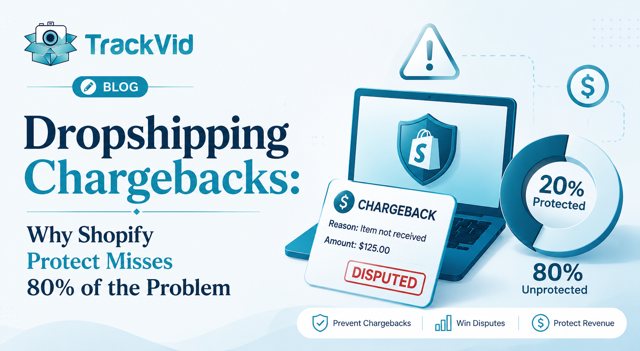
Shopify Protect does not cover many common chargeback reasons such as "item not received" or "not as described," so many disputes will not qualify. This is not a small carve-out. These two reason codes are where the majority of dropshipping chargeback losses actually live.
According to Chargebacks911, friendly fraud, where a real customer disputes a legitimate transaction after receiving the product, accounts for 60 to 80 percent of all ecommerce chargeback losses. Friendly fraud operates entirely after checkout. It passes every fraud filter cleanly because the buyer is real, the card is genuine, and the transaction was legitimate. It happens after the product ships, when the customer files a dispute claiming non-delivery, product condition issues, or wrong item.
Checkout fraud tools prevent chargebacks from stolen cards. They cannot prevent chargebacks from real customers who lie about what they received.
Every dropshipping chargeback guide focuses on the checkout layer. The post-purchase layer, where 60 to 80 percent of losses originate, is almost never covered. That gap is the entire reason dropshippers who implement every recommended fraud prevention tool still see chargeback rates they cannot explain.
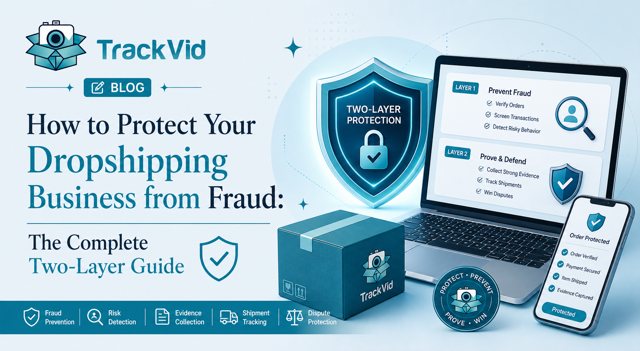
Two Layers of Dropshipping Chargeback Protection
Winning on chargebacks in dropshipping requires understanding that there are two completely separate categories of chargeback and two separate protection layers, one for each.
Layer 1: Pre-purchase fraud prevention. This covers chargebacks from stolen card use, account takeover, and CNP (card-not-present) fraud. The buyer is not a real, consenting customer. Layer 1 tools include 3DS2 authentication, AVS and CVV matching, device fingerprinting, behavioral fraud scoring from tools like Signifyd, NoFraud, or Kount, and chargeback alert services from Ethoca or Verifi. These tools work. They were built for this category.
Layer 2: Post-purchase fraud prevention. This covers chargebacks from real customers who dispute legitimate transactions after delivery. The buyer received the product. They are claiming they did not receive it, received a different product, or received a damaged product. Layer 2 tools are dispatch documentation: order-linked packing video that independently verifies what was sent for each specific order.
Most dropshippers have Layer 1. Almost none have Layer 2. The 60 to 80 percent of chargebacks that originate post-purchase flow through the Layer 2 gap every month as unrecoverable losses.
The complete protection framework is both layers operating simultaneously. Layer 1 at checkout, Layer 2 at dispatch.
Why Dropshipping Chargebacks Are Worse Than Regular Ecommerce Chargebacks
Every ecommerce business faces chargebacks. Dropshippers face them with a structural disadvantage that traditional retailers do not have.
A traditional retailer who disputes a "wrong item received" chargeback can walk to their warehouse, check the dispatch record, review their packing team's process, and confirm what was sent. They have physical proximity to the fulfillment event.
A dropshipper whose supplier ships directly to the customer has no proximity to the fulfillment event at all. When a customer files a "wrong item received" chargeback, the dropshipper cannot verify what the supplier packed. They cannot produce order-level evidence of what was dispatched because they were not present when it was dispatched. They submit their listing description, their order confirmation, and their supplier's tracking number. None of these answer the bank's actual question: what was in the specific parcel sent to this specific customer?
This is why dropshipping chargebacks on "item not as described" and "wrong item received" reason codes are won at a dramatically lower rate than chargebacks on marketplace sellers who fulfill their own orders. The evidence gap is structural.
There is a practical fix. Dropshippers using 3PL warehouses, self-managed fulfillment centers, or semi-dropshipping models where they personally pack and ship have the same opportunity as any warehouse seller to create dispatch documentation. Order-linked packing video recorded at the moment of dispatch, automatically linked to the Order ID, gives the dropshipper the evidence they need to contest the specific order the bank is asking about.
For dropshippers who are genuinely supplier-direct with no physical contact with the product, the Layer 2 question is about supplier evidence. Requiring suppliers to record packing for high-value orders and provide order-linked video is becoming standard practice among dropshippers who have experienced significant "not as described" losses.
Amsterdam Seller Sophie: €11,400 a Month That Shopify Protect Would Not Touch
Sophie runs a D2C fashion accessories dropshipping brand from Amsterdam on Shopify, dispatching approximately 260 orders per day. She uses a 3PL warehouse for packing and dispatch. Her revenue was growing. Her chargeback rate was growing with it.
She had implemented Shopify's native fraud detection, enabled 3DS2 for high-risk transactions, and added NoFraud to her checkout stack. Her payment fraud chargebacks dropped. Her total chargeback rate did not.
When she reviewed her dispute breakdown by reason code, the pattern was clear. Fifty-eight percent of her chargebacks cited "item not as described." Another 24 percent cited "item not received" on orders where her tracking showed confirmed delivery, including several where customers appeared to be claiming the parcel arrived empty rather than undelivered. Nine percent were legitimate payment fraud caught by her checkout tools. The remaining nine percent were miscellaneous.
Shopify Protect was not covering a single one of the 82 percent that cited product condition or delivery. Every one of those was landing on Sophie's account as a direct loss.
Her evidence for the "item not as described" disputes was her product listings and supplier photos. She was submitting these alongside tracking confirmation and losing the majority. The bank was not asking whether her listings were accurate. The bank was asking whether the specific item dispatched for the specific order matched the description. Her listing photos could not answer that. They showed what she generally sells. They could not show what was in order number 10421 specifically.
Her monthly chargeback cost was €11,400. Shopify Protect covered zero of it because the reason codes were explicitly excluded.
I had every checkout fraud tool my Shopify plan offered. The fraud that was hitting me was not at checkout. It was happening after the product shipped and I had no evidence of what we actually sent.
After Sophie implemented order-linked packing video at her 3PL warehouse through TrackVid, every order dispatched had a packing video linked to the Order ID stored in indexed cloud. When a dispute arrived for order 10421, the exact packing video for that order was retrieved in under two minutes and submitted as primary representment evidence.
Her dispute win rate on "item not as described" chargebacks moved from 14 percent to 71 percent within 60 days. Her monthly chargeback cost dropped from €11,400 to under €3,200. The Layer 2 gap closed. The Layer 1 tools she already had continued doing their job.
The Specific Chargebacks Shopify Protect Does Not Cover and Why
Understanding exactly what Shopify Protect excludes helps dropshippers calculate what is actually at risk and where Layer 2 is needed.
Shopify Protect covers eligible chargebacks for fraudulent transactions where the card was stolen or used without the cardholder's knowledge. It provides automatic reimbursement for qualifying orders up to the covered amount.
It does not cover:
"Item not received" chargebacks. If a buyer claims they never received the order , including "arrived empty" claims , Shopify Protect does not apply. The seller must produce their own evidence.
"Item not as described" chargebacks. If a buyer claims the product did not match the listing, Shopify Protect does not apply. The seller must produce their own evidence.
"Wrong item received" chargebacks. Same exclusion. Seller's own evidence determines the outcome.
All disputes above Shopify Protect's coverage threshold. Orders above the covered amount are fully the seller's responsibility.
These three reason codes collectively represent the majority of dropshipping chargeback losses. They are the dispute types where friendly fraud operates , real buyers making false claims , and they are precisely the disputes where the bank's decision comes down to what the seller can independently prove about what was dispatched.
Order-linked packing video is the evidence that answers the bank's question for all three. It directly shows what was in the parcel for the specific disputed order. It does not require the seller to assert their position. It demonstrates it with independently verifiable footage.
Related: Chargeback representment: what evidence wins disputes by reason code →
How to Fight Chargebacks in Dropshipping by Reason Code
Winning dropshipping chargebacks requires submitting evidence that answers the specific question the bank is asking for that reason code. Submitting the same package regardless of reason code is the most common and most preventable representment failure.
"Item Not Received" Chargebacks
The bank's question: was the item shipped and delivered to the buyer's address?
Primary evidence: carrier tracking with delivery confirmation to the buyer's address and GPS timestamp. For orders above $150, signature confirmation significantly strengthens the case.
Where dropshippers specifically lose this: carriers marking "delivered" without GPS confirmation, packages delivered to shared reception areas, and the "arrived empty" variant where the buyer acknowledges the parcel arrived but claims nothing was inside. Delivery confirmation proves the parcel arrived. It does not prove what was inside. The "arrived empty" variant requires packing video.
"Item Not as Described" Chargebacks
The bank's question: did the specific item dispatched for this order match the product description?
Primary evidence: order-linked packing video showing the specific item being packed for the disputed Order ID. This is the evidence that directly answers the bank's question at the order level. Listing screenshots and supplier product photos answer whether your listing was accurate. They do not answer whether order number 10421 specifically contained the described item.
This is the reason code where dropshippers have the weakest evidence position and the lowest win rates without dispatch documentation. It is also the most common chargeback reason code on fashion, electronics, and home goods dropshipping stores.
"Wrong Item Received" Chargebacks
The bank's question: was the correct item dispatched for this order?
Primary evidence: order-linked packing video showing the correct item being packed for the disputed Order ID. Without this, the seller cannot independently demonstrate what was inside the specific parcel. Inventory records, SKU reports, and supplier confirmations answer what was generally stocked and ordered. None of them answer what was specifically dispatched for order 10421.
"Unauthorized Transaction" Chargebacks
The bank's question: did the cardholder authorise this purchase?
Primary evidence: device fingerprinting, AVS match, billing address confirmation, and prior purchase history from the same card and account. For returning customers, Visa's CE3.0 compelling evidence rules allow prior undisputed identical transactions as evidence of cardholder participation. This is where Layer 1 tools and Shopify Protect are effective.
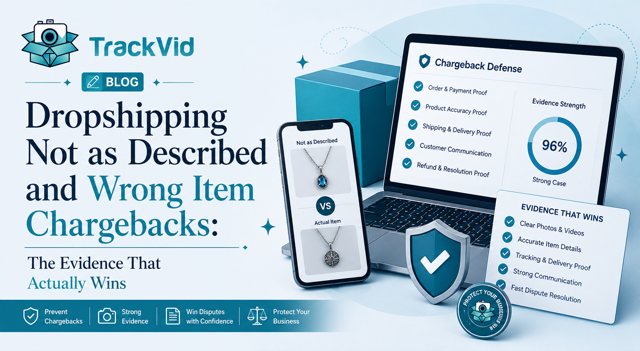
What Evidence Wins Dropshipping Chargebacks
The pattern across winning submissions is consistent. Banks evaluating chargeback representment make decisions based on which side has more specific, independently verifiable evidence. General evidence that establishes the seller's overall practices loses to specific evidence that addresses the exact disputed transaction.
For dropshipping chargebacks on product condition reason codes, the evidence hierarchy is:
Order-linked packing video showing the specific item packed for the specific Order ID. This is the highest-impact evidence for "item not as described," "wrong item received," and "arrived empty" INR variants because it answers the bank's specific question directly.
Carrier delivery documentation with GPS confirmation and timestamp. Primary for "item not received" disputes where non-delivery is the claim.
Product listing screenshots from the time of purchase. Supporting evidence that shows the description was accurate. Not primary for any dispute type.
Communication records including pre-purchase and post-purchase buyer messages. Supporting evidence that establishes buyer acknowledgment of the product.
Prior purchase history from the same account. Supporting evidence for "unauthorized transaction" disputes showing the buyer has previously engaged with the store.
A well-structured representment submission maps each piece of evidence to the specific bank question it answers, in a labeled, organised package with a brief rebuttal letter. The rebuttal letter identifies the dispute type, states the seller's position in one sentence, and maps each document to the specific claim it addresses.
How to Reduce Chargebacks in Dropshipping: The Two-Layer Action Plan
Reducing chargebacks in dropshipping requires both layers in operation simultaneously.
Layer 1 implementation (if not already in place):
Enable 3DS2 for all transactions or at minimum high-risk transactions above your average order value. Configure AVS and CVV matching through your payment processor. Add a behavioral fraud scoring tool such as Signifyd, NoFraud, or Kount for stores processing above $50K monthly. Enroll in pre-dispute resolution through Ethoca or Verifi to intercept disputes before they become formal chargebacks.
Layer 2 implementation (the layer most dropshippers are missing):
At your 3PL or self-managed warehouse, implement order-linked packing video for every order. Every packing session should be recorded with the video automatically linked to the Order ID. Evidence should be stored in indexed cloud, retrievable by Order ID in under two minutes when a dispute arrives. The footage must show the product, the label, and the packing process clearly enough to serve as primary evidence in a bank submission.
For supplier-direct dropshipping where you have no physical access to the fulfillment: require high-value order suppliers to provide packing video with Order ID references as part of your supplier agreement. For orders above $100, this requirement protects both parties.
TrackVid provides the Layer 2 infrastructure for dropshipping businesses using 3PL and warehouse fulfillment. Every packing session is recorded and linked to the Order ID at the moment of packing. Evidence is stored in indexed cloud, retrievable in under two minutes. Representment packages for all three product dispute reason codes are prepared from the same evidence base.
TrackVid works with existing warehouse cameras. Setup takes under 15 minutes.
Related: How to reduce chargebacks in ecommerce: the two-layer guide →
Schedule a free demo at trackvid.in/book-demo.html
Dropshipping Chargeback Rates: What Is Normal and When to Act
The Visa VAMP programme (Visa Acquirer Monitoring Program) automatically enrolls merchants who exceed 100 chargebacks monthly at a rate above 1 percent. The previous threshold was 0.9 percent under the US VDMP programme. The new VAMP standard applies globally and carries escalating fees, intensified monitoring, and ultimately processor termination if rates are not reduced.
According to Chargebacks911, average ecommerce chargeback rates sit between 0.5 and 0.8 percent. Dropshipping businesses typically run higher due to longer shipping times from overseas suppliers, product quality inconsistencies between supplier batches, and limited control over the customer experience at the fulfillment stage.
A dropshipping business approaching 0.7 percent should treat chargeback reduction as an active priority, not a reactive one. At 0.9 percent, both layers need to be operational. At 1 percent, the account is already in monitoring territory.
The fastest lever for reducing chargebacks in dropshipping for most stores is not adding another checkout fraud tool. It is implementing Layer 2 dispatch documentation, because the majority of their chargebacks are in reason codes those tools do not address.
Five Questions Every Dropshipper Should Ask About Their Chargeback Position
- What percentage of your chargebacks cite "item not as described," "wrong item," or "item not received" on confirmed-delivery orders? If more than 40 percent of your chargebacks cite these reason codes, your losses are post-purchase in origin. Layer 1 tools will not reduce them. Layer 2 documentation is the specific fix.
- What evidence are you submitting for "item not as described" chargebacks? If the answer is listing screenshots and tracking, you are submitting evidence that answers the catalogue question and not the order-specific question. The bank is asking what was in order 10421. Only packing video for order 10421 answers that.
- Does your 3PL or warehouse operation record packing video linked to Order IDs? If your warehouse records time-based CCTV for security purposes, you have footage but not order-linked evidence. Time-based footage cannot be matched to a specific disputed order and does not win product dispute chargebacks.
- Are you approaching Visa's 1 percent VAMP threshold? If your chargeback rate is above 0.7 percent, both layers need to be active immediately. The window between 0.9 percent and account action is narrower than most dropshippers realise.
- What is your representment win rate on product dispute chargebacks specifically? If your win rate on "item not as described" and "wrong item" chargebacks is below 25 percent, the evidence gap is structural. Order-linked packing video for those specific reason codes typically improves win rates to 65 to 90 percent, according to TrackVid data.
Frequently Asked Questions
What are chargebacks in dropshipping?
Chargebacks in dropshipping occur when a customer disputes a transaction with their bank rather than resolving it with the dropshipping store directly. As the seller of record in a dropshipping business, the dropshipper is liable for every chargeback regardless of who physically shipped the product. Dropshipping chargebacks come from two categories: payment fraud chargebacks from stolen card use, covered by checkout fraud tools and Shopify Protect for eligible transactions; and friendly fraud chargebacks from real customers disputing legitimate transactions after delivery, which account for 60 to 80 percent of chargeback losses according to Chargebacks911 and are not covered by Shopify Protect for "item not received" or "item not as described" reason codes.
How do I fight a chargeback in dropshipping?
Fighting a chargeback in dropshipping requires submitting evidence matched to the specific reason code. For "item not received" chargebacks, carrier tracking with GPS delivery confirmation is primary evidence. For "item not as described" and "wrong item received" chargebacks, order-linked packing video showing what was dispatched for the specific disputed order is the primary evidence. Listing screenshots and supplier photos lose these disputes because they prove catalogue accuracy, not what was in the specific order. Merchants using order-linked packing video for product dispute chargebacks report win rates of 65 to 90 percent, compared to under 25 percent on standard documentation, according to TrackVid data.
Why do I keep getting chargebacks on my dropshipping store?
Persistent chargebacks despite checkout fraud prevention indicate a post-purchase fraud problem. Friendly fraud, where real customers dispute legitimate transactions, accounts for 60 to 80 percent of ecommerce chargeback losses and operates entirely after checkout. It passes every fraud filter because the buyer is real and the transaction is genuine. The fraud happens after the product ships, when the customer files a dispute claiming non-delivery, wrong item, or product condition issues. Checkout tools do not prevent these. Post-purchase dispatch documentation does: order-linked packing video that independently verifies what was sent for each specific order.
Does Shopify Protect cover dropshipping chargebacks?
Shopify Protect covers eligible chargebacks from fraudulent transactions where the card was used without the cardholder's knowledge. It does not cover chargebacks citing "item not received," "item not as described," or "wrong item received." These three reason codes represent the majority of dropshipping chargeback losses. For all of these, the seller must produce their own evidence. Order-linked packing video is the specific evidence that wins product condition and delivery disputes for dropshipping sellers.
What evidence wins a dropshipping chargeback?
The evidence that wins a dropshipping chargeback depends on the reason code. For "item not received" disputes, carrier tracking with GPS delivery confirmation and timestamp is primary. For "item not as described" and "wrong item received" disputes, order-linked packing video showing the specific item dispatched for the specific Order ID is the highest-impact evidence available. This is the evidence type that product listing screenshots cannot replace, because listings prove catalogue accuracy and banks ask about specific orders. Submit evidence in a structured package with a brief rebuttal letter mapping each document to the specific claim.
How to reduce chargebacks in dropshipping 2026?
Reducing chargebacks in dropshipping in 2026 requires two layers. Layer 1: 3DS2 authentication, AVS and CVV matching, behavioral fraud scoring, and pre-dispute resolution enrollment through Ethoca or Verifi. Layer 2: order-linked packing video at your warehouse or 3PL, stored in indexed cloud and retrievable by Order ID when a dispute arrives. Layer 1 reduces payment fraud chargebacks. Layer 2 reduces friendly fraud chargebacks that account for 60 to 80 percent of total losses. Merchants who implement both layers consistently achieve chargeback rates below 0.5 percent and dispute win rates above 65 percent, according to Chargebacks911 and TrackVid data.
What is the chargeback rate for dropshipping?
Average ecommerce chargeback rates run between 0.5 and 0.8 percent, according to Chargebacks911. Dropshipping businesses typically run higher due to longer supplier shipping times, product quality variability between supplier batches, and limited visibility into the customer's fulfillment experience. Visa's VAMP programme automatically enrolls merchants who exceed 100 chargebacks monthly at a rate above 1 percent, triggering monitoring, fees, and potential processor termination if not resolved. For dropshippers above 0.7 percent, active chargeback reduction across both the checkout and post-purchase layers is a business continuity requirement, not an optional optimisation.
Does packing video help dropshipping chargebacks?
Yes, significantly, for product condition and delivery dispute chargebacks. Order-linked packing video is the highest-impact evidence type for "item not as described," "wrong item received," and "arrived empty" item not received variants. It directly and independently answers the bank's question about what was dispatched for the specific disputed order, which no other evidence type can do at the order level. Merchants using TrackVid for order-linked packing video on product dispute chargebacks report win rates of 65 to 90 percent compared to the industry average below 25 percent using standard documentation. Packing video reduces chargebacks in two ways: it wins disputes when they are filed, and it deters organised fraud operations that avoid sellers with strong dispatch documentation.
Sources: Ethoca 2023 Chargeback Outlook Report, Chargebacks911 Chargeback Field Report 2026, Visa VAMP Programme documentation, Shopify Protect policy 2026, Chargebacks911 Friendly Fraud Research 2026, LexisNexis Risk Solutions True Cost of Fraud 2024, Justt.ai Merchant Chargeback Rights February 2026, CyberSource 2026 Global Fraud Report, TrackVid internal seller data
TrackVid is a video proof and claim management platform used by 1,100+ ecommerce sellers globally. Officially authorised by Snapdeal. Learn more at trackvid.in.
Get the Marketplace Claim Recovery Checklist
A 12-point checklist used by 1,100+ sellers to recover 85-90% of marketplace claim losses. Free, instant access.
- Marketplace-specific evidence formats (AJIO, Flipkart, Amazon, Myntra)
- Claim window deadlines for every major platform
- The 6-step process that pushes approval from 85-90%
- Common rejection reasons and how to avoid them
No spam. Unsubscribe anytime. Used by sellers at Rare Rabbit, HRX, Da Milano + 1,100 more.
Stop Losing Money to Fake Returns
Join 1,100+ sellers who recover lakhs every month with TrackVid