
For Shopify Payments merchants. Updated June 2026.
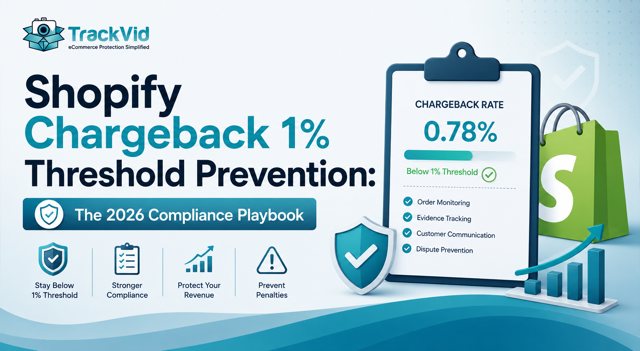
The Shopify chargeback 1 percent threshold is the hardest compliance line ecommerce merchants face in 2026. Cross it and Shopify Payments suspends your account, sometimes with fund retention, and recovery takes 4-6 months. 2026 makes it harder. Visa's Acquirer Monitoring Program dropped from 2.2 to 1.5 percent in April 2026. Mastercard Scam Monitoring goes live July 24, 2026, investigating merchants with combined refund plus chargeback rates over 5 percent. Together, these three thresholds have narrowed the merchant tolerance zone dramatically.
The average retailer chargeback rate sits at 0.52 percent per Swell 2026 data. Most merchants operate uncomfortably close to the 1 percent line without realizing how narrow the margin is. A single problematic week (roughly 10 chargebacks on a 1,000-order store) can push ratio above threshold. Recovery is measured in months, not weeks.
Chargeback ratios respond to the 5-lever strategy in this blog. Merchants deploying the complete stack drop ratios from 0.7-1.0 to 0.2-0.3 percent within 60 days. The critical mechanic: successfully resolved CE 3.0 disputes are excluded from Visa's ratio calculation, making video-backed representment the primary lever for reducing reported dispute rate.
The 1 percent threshold is not a suggestion. It is an operational deadline.
Miami Wellness Merchant David: How the Suspension Warning Became a 0.24% Ratio in 60 Days
David runs a Shopify D2C wellness and beauty brand from Miami. Skincare, supplements, and premium wellness. Daily volume approximately 280 orders. Average order value $92. Monthly GMV roughly $770,000.
His chargeback ratio had climbed through 2025. Started at 0.4 percent. Hit 0.6 percent mid-2025. Hit 0.83 percent by end of 2025. First Shopify Payments warning letter in January 2026. Hit 1.02 percent in March 2026 and received the suspension notice with 30-day resolution deadline.
The suspension notice specified three requirements. Submit a documented chargeback reduction plan within 15 days. Achieve monthly ratio below 0.75 percent for 3 consecutive months. Hold back $47,000 as reserve against future chargebacks during resolution.
His dispute win rate sat at 19 percent. He was losing 81 percent of chargebacks. Every loss added to his ratio. His representment submissions included order confirmations, tracking screenshots, and general written explanations. What they did not include was Order ID-linked packing video showing the specific product at dispatch.
He deployed the 5-lever stack over 30 days:
- Lever 1: TrackVid Order ID-linked packing video on every dispatch, tagged automatically at packing
- Lever 2: Adult signature required on all orders above $100, photo delivery confirmation below
- Lever 3: Chargeflow dispute automation feeding video into Visa CE 3.0-formatted representments
- Lever 4: Fraud screening at checkout via Signifyd for high-risk orders
- Lever 5: Serial returner and disputer flagging in Shopify customer records with enhanced review
Results in 60 days:
- Dispute win rate: 19% → 82%
- Chargeback ratio: 1.02% → 0.24%
- Monthly chargeback losses: $12,800 → $2,600
- Shopify Payments account status: off suspension track within 45 days
- Reserve holdback released: $47,000 recovered by month three
- Chargeback volume itself: dropped 33 percent by month four
David's month-four analysis showed something important. The Visa CE 3.0 exclusion mechanic (successfully resolved disputes excluded from ratio calculation) was the specific lever that pulled his ratio down fastest. Every dispute won with video-backed evidence dropped his reported ratio without affecting his actual transaction volume.
Ready to see this in your Shopify store? Book a 30-minute demo and we will show you exactly which of your recent chargebacks would have been excluded from your ratio calculation with the correct evidence chain.
How the Shopify Chargeback Ratio and 1 Percent Threshold Are Calculated
Understanding the math is the foundation of managing to the threshold. Shopify Payments calculates chargeback ratio as chargebacks divided by transactions over a rolling monthly window.
Formula: (Total chargebacks in month) / (Total transactions in month) × 100.
What counts as a chargeback: Any dispute filed with a card-issuing bank flowing through Visa, Mastercard, Amex, or Discover. Includes disputes won via representment, lost, and in review. Successfully resolved CE 3.0 disputes (Visa) and Compelling Evidence disputes (Mastercard) are excluded from Visa's AMP threshold calculation, though they still initially count in Shopify's raw ratio.
What counts as a transaction: All successful sales in the calculation window regardless of value. High-volume low-AOV stores have more absorptive capacity than low-volume high-AOV stores.
Practical example: A store doing 1,000 monthly orders can absorb up to 10 chargebacks before 1.0 percent. A store doing 100 orders can absorb only 1. A single problematic week can push either above threshold.
The critical mechanic: every dispute WON with CE 3.0-compliant evidence still counts in Shopify's raw ratio initially but is subsequently excluded from Visa's regulatory threshold calculation. Video-backed representment reduces regulatory pressure faster than any other intervention.
The Three Thresholds That Matter for Shopify Payments Merchants in 2026
Three separate thresholds now apply simultaneously to Shopify Payments merchants. Understanding which one you are closest to determines which lever to pull first.
Threshold 1: Shopify Payments 1 Percent Suspension Threshold
Ratio above 1 percent triggers immediate account review and potential suspension. Recovery requires documented reduction plan, sustained 3-month ratio below 0.75 percent, and often reserve holdback of 30-90 days of transaction volume. Timeline typically 4-6 months.
Best defense: Keep operational ratio below 0.5 percent to provide margin against spikes.
Threshold 2: Visa Acquirer Monitoring Program (Dropped to 1.5% in April 2026)
Visa's AMP threshold dropped from 2.2 to 1.5 percent in April 2026. Merchants crossing AMP face acquirer scrutiny including higher processing fees, holdbacks, and card acceptance restrictions. Successfully resolved CE 3.0 disputes are excluded from AMP calculation, making video-backed representment the primary lever for reducing reported dispute rate.
Best defense: Physical dispatch evidence plus CE 3.0-formatted representment plus 24-48 hour response window.
Threshold 3: Mastercard Scam Monitoring (Live July 24, 2026)
Mastercard's new compliance framework live July 24, 2026. Merchants with combined refund plus chargeback rate above 5 percent in a rolling 30-day window (minimum 500 transactions) face acquiring bank investigation. Consequences: higher fees, holdback reserves, card acceptance restrictions.
Best defense: Refund policy tightening plus chargeback prevention combined. Aggressive return policies (14-day windows, condition requirements) reduce legitimate refund volume and Mastercard SM exposure.
Key 2026 insight: A merchant can be under Shopify's 1 percent threshold, above Visa AMP's 1.5 percent, and above Mastercard SM's 5 percent combined threshold simultaneously. Each threshold has different math and different consequences.
The 5-Lever Shopify Chargeback 1 Percent Threshold Management Strategy
Managing to the Shopify chargeback 1 percent threshold and its related compliance thresholds requires five levers deployed together. Each addresses a different failure mode.
Lever 1: Physical Dispatch Evidence
Order ID-linked packing video showing product, shipping label, and tamper-evident seal at dispatch. Tagged automatically at packing. Retrievable in under two minutes. Wins CE 3.0 representments at 70-85 percent versus under 20 percent for manual responses.
Impact on ratio: Every dispute won with video evidence moves the CE 3.0 exclusion needle for Visa AMP threshold calculation.
Lever 2: Delivery Verification
Signature-required delivery on orders above $100, adult signature above $500. Photo confirmation below signature threshold. Missing signature is a top-3 reason for representment loss.
Impact on ratio: Reduces INR chargebacks 20-30 percent and increases representment win rate on the ones that come through.
Lever 3: Dispute Automation Feeding Evidence
Chargeflow, Justt, Kount handle representment submission, format evidence per CE 3.0 and Mastercard Compelling Evidence standards, and submit before deadline. Without physical dispatch evidence, automation submits weak responses. With evidence, win rate moves to 70-85 percent.
Impact on ratio: No dispute goes unresponded due to missed deadlines. Late submissions are automatic losses.
Lever 4: Fraud Screening at Checkout
Signifyd, NoFraud, or Shopify's built-in fraud analysis flag high-risk orders at checkout. Auto-decline, flag for review, or hold for signature confirmation.
Impact on ratio: Reduces chargeback volume 30-60 percent by preventing risky orders.
Lever 5: Serial Returner and Disputer Flagging
Shopify customer records note serial returners (30+ percent return rate on 5+ orders) and serial disputers (2+ chargebacks). Future orders from flagged customers trigger enhanced screening, signature-required delivery, and refund hold protocols.
Impact on ratio: Prevents repeat chargebacks from documented problem customers.
Together, the five levers cut chargeback ratios from 0.7-1.0 percent to 0.2-0.3 percent within 60 days. Missing any lever leaves specific gap that fraud operators exploit.
Related: Complete guide to how to win chargeback disputes on Shopify
What to Do If You Are Already Approaching the Threshold
If your Shopify Payments chargeback ratio is currently between 0.5 and 1.0 percent, you have a 30-60 day window before crossing into suspension territory.
Immediate (this week): Deploy Order ID-linked packing video on every current dispatch. Every disputed order dispatched from today has video evidence available.
Week 1-2: Activate dispute automation (Chargeflow, Justt) to submit all active disputes before deadline.
Week 2-3: Add signature-required delivery on orders above $100. Activate fraud screening on high-risk checkouts.
Week 3-4: Flag serial returners and disputers in Shopify customer records. Deploy refund hold protocols on flagged patterns.
Week 5-8: Measure ratio impact. Expected reduction: 50-70 percent within 60 days if all five levers are deployed correctly.
If you have already crossed 1 percent: Contact your Shopify Payments account manager immediately. Submit documented reduction plan within 15 days. Expect reserve holdback of 30-90 days of transaction volume during recovery. Recovery requires downward-trending dispute volume for 3 consecutive months.
How TrackVid Enables Shopify Chargeback 1 Percent Threshold Management
TrackVid (trackvid.in) provides the Order ID-linked packing video that Lever 1 requires. Every packing session records the item, shipping label, calibrated scale weight, and tamper-evident seal. Tagged automatically to Order ID at packing. Retrievable in under two minutes.
For chargeback ratio management:
- CE 3.0 exclusion enabler: Video-backed representments win at 70-85 percent, removing disputes from Visa AMP calculation
- Ratio impact: Every 10 percent improvement in dispute win rate reduces reported ratio 0.05-0.15 percentage points
- Direct submission format: Videos formatted for Shopify Payments dispute portal, Chargeflow, Justt, and Kount
- Multi-network: Same evidence supports Visa 13.1, Mastercard 4855, Amex F29, Discover RG, and Visa 10.4
- Multi-platform: Shopify Payments, Stripe, PayPal, Amazon A-to-Z
Merchants running TrackVid as Lever 1 with dispute automation as Lever 3 report chargeback ratio reductions from 0.7-1.0 to 0.2-0.3 percent within 60 days. Merchants under suspension report recovery within 45-90 days.
TrackVid works with existing cameras. Setup under 15 minutes. Used by 1,000+ ecommerce merchants globally.
Five Questions to Audit Your Shopify Chargeback Threshold Exposure
1. What is your current Shopify Payments chargeback ratio? Above 0.5 percent puts you on the warning path. Above 1 percent triggers suspension.
2. What is your current dispute win rate? Under 30 percent indicates missing Tier 1 evidence and reduces your effective ratio via the CE 3.0 exclusion mechanic.
3. For the last 10 lost disputes, can you retrieve Order ID-linked packing video showing the specific product at dispatch? If not, you are stuck at the manual 20 percent win rate ceiling.
4. Are you tracking your Mastercard-specific combined refund plus chargeback rate against the 5 percent Scam Monitoring threshold going live July 24, 2026?
5. If your Shopify Payments account received a suspension notice today, do you have documented downward-trending dispute defense processes to submit within the 15-day resolution deadline?
TrackVid works with your existing warehouse cameras. Setup takes under 15 minutes.
Book a 30-minute demo at trackvid.in/book-demo.html
In one session, you will see exactly which of your recent chargebacks would have been won with the correct evidence chain, and what a 0.24 percent chargeback ratio looks like in your specific Shopify operation.
Frequently Asked Questions
What is the Shopify chargeback threshold?
The Shopify chargeback 1 percent threshold applies to all Shopify Payments merchants. Ratio above 1 percent triggers immediate account review and potential suspension. Recovery requires documented reduction plan, sustained 3-month ratio below 0.75 percent, and often reserve holdback of 30-90 days of transaction volume. Additional 2026 thresholds: Visa Acquirer Monitoring Program at 1.5 percent (dropped from 2.2 percent April 2026) and Mastercard Scam Monitoring at 5 percent combined rate (live July 24, 2026). Merchants must manage all three simultaneously.
How do I avoid Shopify Payments suspension?
Avoiding Shopify Payments suspension requires keeping chargeback ratio below 0.5 percent to provide margin against sudden spikes. Deploy the 5-lever ratio management stack: physical dispatch evidence (Order ID-linked packing video), signature-required delivery on orders above $100, dispute automation (Chargeflow, Justt), fraud screening at checkout (Signifyd, NoFraud), and serial returner and disputer flagging in Shopify customer records. Merchants running all five levers report ratios of 0.2-0.3 percent consistently. Additional protection: monitor ratio weekly (not monthly), respond to disputes within 24-48 hours, and set up email alerts for new dispute notifications.
What happens if I hit the 1 percent chargeback ratio?
Three consequences. First, immediate account review with potential suspension notice within 15-30 days. Second, resolution requirements: documented reduction plan, sustained 3-month ratio below 0.75 percent, and reserve holdback of typically 30-90 days of transaction volume. Third, potentially higher processing fees during resolution. Timeline typically 4-6 months. Shopify Payments may restrict payment types, holdback transaction volumes, or in severe cases fully terminate the account, requiring migration to Stripe, Braintree, or another processor.
How do I recover from Shopify Payments suspension?
Three actions within specific timeframes. First (within 15 days): submit documented reduction plan detailing 5-lever defense stack deployment. Second (within 30 days): deploy Order ID-linked packing video, dispute automation, signature delivery, fraud screening, and customer flagging. Third (over 3 months): demonstrate sustained monthly ratio below 0.75 percent. Reserve holdback typically releases after ratio maintenance. Full restoration typically 4-6 months. Response speed on active disputes is critical: every loss during recovery extends the timeline. Video-backed CE 3.0 representment is the fastest lever to demonstrate improvement.
How is chargeback ratio calculated on Shopify?
Chargebacks divided by transactions in a rolling monthly window, expressed as percentage. All chargebacks count in raw calculation (won, lost, in review). Successfully resolved CE 3.0 disputes are excluded from Visa's AMP threshold calculation but still count in Shopify's raw ratio initially. Transactions include all successful sales regardless of value. Practical example: 5 chargebacks on 1,000 monthly transactions equals 0.5 percent ratio. 10 equals 1.0 percent. High-volume low-AOV stores have more absorptive capacity than low-volume high-AOV stores.
Does Shopify Protect affect chargeback ratio?
Shopify Protect provides fraud reimbursement but does not directly reduce chargeback ratio. Reimbursed chargebacks still count in the raw ratio numerator. Coverage is limited to Shop Pay orders shipped within 7 days, tracked, delivered to a US address, categorized as payment fraud (not friendly fraud or "item not as described"). For ratio reduction, CE 3.0-compliant representment wins are the primary lever because they exclude disputes from Visa AMP threshold calculation, unlike Shopify Protect which addresses financial loss but not compliance ratio.
What is the Visa AMP threshold in 2026?
Visa's Acquirer Monitoring Program threshold dropped from 2.2 to 1.5 percent in April 2026. Merchants crossing AMP face acquirer scrutiny including higher processing fees, holdbacks, and card acceptance restrictions. However, successfully resolved CE 3.0 disputes are explicitly excluded from AMP calculation. This makes video-backed representment the primary lever: every dispute won with CE 3.0 evidence reduces reported dispute rate without affecting transaction volume. Manual responses that lose still count. Video-backed responses that win are excluded.
How do CE 3.0 wins affect chargeback ratio?
CE 3.0 wins have a dual effect. In Shopify Payments' raw ratio calculation, CE 3.0 wins still count in the numerator initially because the chargeback was filed regardless of outcome. In Visa's AMP threshold calculation, successfully resolved CE 3.0 disputes are explicitly excluded. This makes video-backed representment with CE 3.0 evidence the specific mechanic for reducing regulatory dispute rate. For Mastercard, successfully resolved Compelling Evidence disputes have similar exclusion in Scam Monitoring calculations (live July 24, 2026). Practical strategy: win as many disputes as possible with CE 3.0 evidence to move the regulatory needle.
Sources: Shopify Payments Chargeback Policy Documentation 2026, Chargeflow Shopify Chargeback Guide 2026, Beast Insights Shopify Chargeback Cost Analysis 2026, Visa Acquirer Monitoring Program 2026 Update, Visa CE 3.0 Compendium Documentation, Mastercard Scam Monitoring Framework July 2026, Mastercard Compelling Evidence Framework 2026, Swell 2026 Shopify Merchant Statistics, TrackVid internal merchant data
TrackVid is a video proof and claim management platform used by 1,000+ ecommerce merchants globally on Shopify, Amazon, Etsy, eBay and major marketplaces. Officially authorised by Snapdeal. Learn more at trackvid.in.




Get the Marketplace Claim Recovery Checklist
A 12-point checklist used by 1,100+ sellers to recover 85-90% of marketplace claim losses. Free, instant access.
- Marketplace-specific evidence formats (AJIO, Flipkart, Amazon, Myntra)
- Claim window deadlines for every major platform
- The 6-step process that pushes approval from 85-90%
- Common rejection reasons and how to avoid them
No spam. Unsubscribe anytime. Used by sellers at Rare Rabbit, HRX, Da Milano + 1,100 more.
Stop Losing Money to Fake Returns
Join 1,100+ sellers who recover lakhs every month with TrackVid