
For sellers on Shopify, Amazon, eBay, Stripe, PayPal, Bol.com, Noon, MyDeal, and any card-not-present marketplace. Updated July 2026.
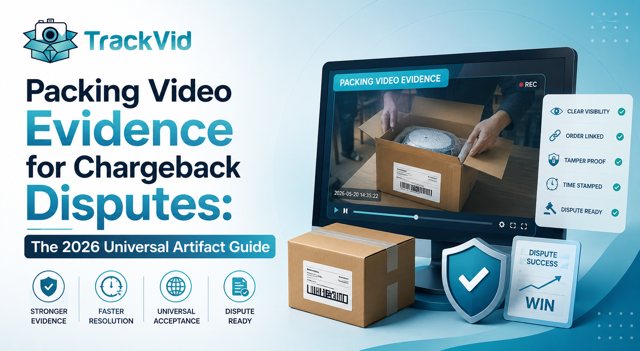
If you are losing chargebacks despite tracking, delivery confirmation, and clean order records, the problem is not documentation quantity. It is documentation type. Card issuers and network dispute reviewers do not weigh screenshots and text explanations as decisive evidence. They weigh artifacts. In the 2026 chargeback landscape shaped by Visa Compelling Evidence 3.0, Mastercard Compelling Evidence, Amex Prior Undisputed Transactions, and Discover Card Verification, one artifact wins consistently across every network: packing video evidence chargeback documentation tied to the Order ID at dispatch.
The chargeback industry is under strain. Chargebacks911 projects 337 million disputes globally by year-end 2026 (a 41 percent increase from 2023). Merchants pay $4.61 in operational and lost-goods cost for every $1 of chargeback loss per LexisNexis Risk Solutions. Per Sift's 2026 Digital Trust Index, first-party fraud now accounts for 45 percent of all chargebacks, up from 20 percent in 2022. Traditional defense responses (tracking, order confirmation, communication logs) fail at 65 to 75 percent because disputes now target the merchant's evidence gap, not shipping performance.
The playbook in this blog is used by global sellers whose chargeback representment win rate went from 27 to 83 percent within 60 days after deploying Order ID-linked packing video as their primary dispute artifact.
Chargebacks are not settled by argument. They are settled by artifact.
Why Most Packing Video Evidence Chargeback Submissions Fail
Chargeback representment is fundamentally different from a marketplace dispute. Amazon UK A-to-Z investigations, eBay UK Money Back Guarantee cases, and Noon Seller Lab disputes give sellers a portal to submit narrative plus evidence. Chargebacks do not. Card issuers evaluate representment packages against network-specific reason code requirements, and each has its own evidence hierarchy the merchant must map to precisely.
What most merchants submit: Order confirmation from Shopify or Amazon, tracking screenshot with delivery confirmation, shipping label photo, written narrative explaining the transaction was legitimate.
Why card issuers reject these packages:
Card issuers operate under network rules that predefine what qualifies as evidence for each reason code. Visa reason code 10.4 (card-not-present fraud) requires prior undisputed transactions or CE 3.0 data via Order Insight. Mastercard 4855 requires proof of value delivery. Amex F29 requires cardholder identification and delivery to billing address. Discover RG requires evidence the goods matched the description. None accept "we shipped it, here's the tracking" as sufficient. All accept Order ID-linked dispatch documentation that establishes condition, content, and dispatch.
What actually wins packing video evidence chargeback submissions across all networks: Order ID-linked packing video showing the specific item at dispatch, in correct condition, matched to the transaction, with calibrated scale weight and tamper-evident seal captured in the same frame. This single artifact serves as compelling evidence under Visa CE 3.0 for reason code 10.4, as proof of value delivery under Mastercard CE for 4855, as delivery documentation for Amex F29, and as description-match evidence for Discover RG.
The reason codes where packing video evidence chargeback wins consistently:
- Visa 10.4 (Other Fraud, Card-Absent Environment)
- Visa 13.1 (Merchandise/Services Not Received)
- Visa 13.3 (Not as Described or Defective Merchandise)
- Mastercard 4855 (Non-Receipt of Merchandise)
- Mastercard 4834 (Point-of-Interaction Error)
- Amex F29 (Card Not Present) and C08 (Goods/Services Not Received)
- Discover RG (Non-Receipt of Goods/Services) and 4553 (Not as Described)
Every one of these seven reason codes accepts, and in most cases requires, condition-at-dispatch documentation that only Order ID-linked packing video provides in one artifact.
Dublin Seller Ciarán: 27 Percent Win Rate to 83 Percent in 60 Days
Ciarán runs a cross-border consumer electronics D2C brand from Dublin, selling across Shopify (EU + UK + US markets), Amazon UK, and Bol.com Netherlands. Daily volume approximately 280 orders. Average order value €78. Monthly GMV roughly €650,000.
His chargeback problem was multi-network. He faced 38 to 46 representments per month across Visa, Mastercard, Amex, and Discover through Stripe, Shopify Payments, and Braintree. Card-not-present fraud disputes. Non-receipt disputes despite tracking. "Not as described" disputes on electronics. Combined weighted win rate: 27 percent.
The financial impact was severe. Every lost chargeback deducted the transaction plus fees (€15 to €25 per dispute) plus operational cost of representment. Monthly losses reached €14,200 across lost transaction values, fees, replacement inventory, and processor risk-monitoring escalations threatening his standing on Stripe and Shopify Payments.
"My representments looked complete on paper. Order confirmation, tracking, delivery photo, buyer communication. Issuers rejected every one of them within 30 days. I was losing chargebacks I should have won," Ciarán said.
His warehouse had CCTV covering the packing area, but it was time-and-location based, not order-linked. When a chargeback came in on Order EU-2847391 disputed 47 days after delivery, he could not retrieve packing footage tagged to that Order ID. Manual searches through weeks of CCTV produced generic packing floor footage issuers rejected as non-specific.
He deployed Order ID-linked packing video over 30 days. Every order across all channels had video tagged automatically to Order ID at packing. Calibrated scale weight recorded. Tamper-evident seal captured. Retrievable in under two minutes and formatted for direct upload to Stripe, Shopify Payments, and Braintree representment portals.
Results in 60 days across all networks:
- Combined chargeback representment win rate: 27 percent to 83 percent
- Monthly chargeback loss: €14,200 to €2,900
- Representment preparation time per dispute: 45 minutes to 8 minutes
- Processor risk-monitoring standing: back to green across Stripe, Shopify Payments, Braintree
- Attempted first-party fraud chargebacks: dropped 41 percent within 90 days as customer serial disputers saw representments winning
How the Chargeback Representment Process Actually Works
Understanding the multi-stage representment mechanic is the foundation of consistent wins. The process has five stages, and packing video evidence chargeback documentation enters at Stage 2.
Stage 1: Cardholder files dispute. Cardholder contacts their issuer or card network directly through their banking app or portal, filing a dispute under a specific reason code. The issuer temporarily reverses the transaction and holds the merchant's funds. The merchant receives a chargeback notification through their processor with 7 to 20 days (depending on network and reason code) to submit representment evidence.
Stage 2: Merchant representment submission. The merchant submits evidence through their processor's representment portal (Stripe, Shopify Payments, Braintree, Adyen). Evidence requirements vary by reason code, but Order ID-linked packing video, calibrated dispatch weight, tamper-evident seal, listing screenshot, and tracking chain form the universal stack that maps to all major reason codes.
Stage 3: Issuer review. The card issuer reviews the representment package against the reason code's evidence hierarchy. Complete packages that map to the specific reason code's requirements typically resolve within 30 to 45 days. Under Visa CE 3.0, packages submitted through Order Insight can resolve pre-dispute, avoiding the chargeback fee entirely.
Stage 4: Chargeback resolution or pre-arbitration. If the issuer accepts the representment, the merchant recovers the funds minus any processor fees. If the issuer rejects, the merchant can escalate to pre-arbitration for high-value disputes. Pre-arbitration invokes network review with additional evidence submission opportunities.
Stage 5: Network arbitration. Rare, high-value disputes may proceed to full network arbitration. At this stage, the same Order ID-linked evidence stack that would have won at initial representment wins consistently, but at higher operational cost. Merchants with pre-existing evidence archives avoid arbitration by winning at Stage 3.
The critical mechanic most merchants miss: Chargeback representment is not a discretionary review. It is a rules-based mapping exercise. Reason codes have specific evidence requirements, and issuers evaluate against those requirements algorithmically. Narrative explanations do not shift outcomes. Documented artifacts do.
The Universal Evidence Stack That Wins Across All Networks
Every winning representment package includes a specific evidence stack that maps to Visa, Mastercard, Amex, and Discover reason code requirements simultaneously. Manual submissions using only tracking and order confirmation lose 73 percent of the time. Complete stacks win 83 percent.
Piece 1: Order ID-linked packing video at dispatch showing the specific product, correct condition, listing-accurate features, and shipping label in the same frame. Duration 15 to 30 seconds. Retrievable by Order ID in under two minutes. Serves as compelling evidence under Visa CE 3.0, proof of value delivery under Mastercard CE, and description-match evidence for Amex and Discover.
Piece 2: Calibrated scale dispatch weight recorded to two decimal places at packing. Provides quantitative dispatch condition proof that defends "missing parts" and "empty parcel" reason codes across all networks.
Piece 3: Tamper-evident seal documentation showing seal applied at packing before courier collection. Critical for damage and substitution reason codes where issuers need to distinguish pre-dispatch from post-delivery condition.
Piece 4: Product listing or transaction description screenshot at time of order showing accurate description matched to what shipped. Addresses "not as described" reason codes (Visa 13.3, Mastercard 4834, Discover 4553) directly.
Piece 5: Tracking with delivery confirmation from Royal Mail, DHL, FedEx, UPS, USPS, or the marketplace's own logistics, including any signature or photo capture. Addresses non-receipt reason codes (Visa 13.1, Mastercard 4855, Amex C08, Discover RG).
Together, this five-piece stack shifts chargeback representments from a "merchant disputes, issuer decides" narrative into a documented condition and value chain from packing station to cardholder doorstep. Card issuers reviewing complete stacks rule for the merchant consistently across all networks.
Related: See our full Visa Compelling Evidence 3.0 guide at trackvid.in
Where TrackVid Fits in the Universal Chargeback Evidence Stack
The merchants who move chargeback representment win rates from 27 percent to 83 percent are not fighting harder in dispute portals. They are building the evidence before the chargeback exists.
TrackVid is a video proof and claim management platform used by 1,000+ ecommerce sellers globally, including on Shopify, WooCommerce, Amazon, eBay, Bol.com, Noon, MyDeal, and marketplaces across UK, EU, MENA, Pacific, and India. It captures Order ID-linked packing video automatically at your dispatch station. Every video is tagged to Order ID, SKU, and tracking reference at the moment of packing. Videos stored in searchable cloud, retrievable in under two minutes, formatted for direct upload to Stripe, Shopify Payments, Braintree, Adyen, and PayPal representment portals.
For chargeback-exposed merchants specifically:
- Multi-processor ready: Videos export in formats accepted by all major processor representment portals
- Multi-network mapping: Same evidence maps to Visa CE 3.0, Mastercard CE, Amex, and Discover reason codes
- Pre-dispute qualified: Evidence can be submitted through Visa Order Insight before chargeback creation for pre-dispute resolution
- Cross-marketplace: Same evidence supports Amazon A-to-Z, eBay MBG, Noon Seller Lab, Bol.com Retailer Portal, MyDeal Zendesk, and Shopify Payments disputes
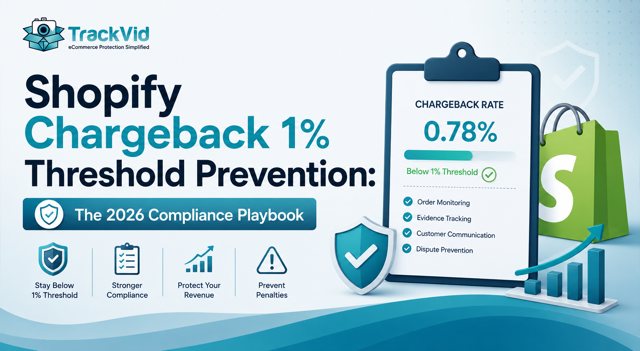
- VAMP-safe: Preventing chargebacks through evidence-backed wins keeps your chargeback ratio below Visa's VAMP monitoring thresholds
TrackVid works with your existing warehouse cameras. Setup takes under 15 minutes. No hardware changes required.
Schedule a free demo at trackvid.in/book-demo.html
Five Questions to Audit Your Chargeback Evidence Exposure
1. For your last 10 chargeback representments across all processors, do you have Order ID-linked packing video retrievable in under five minutes? Without this, you are stuck at the 27 percent manual submission win rate ceiling across all networks.
2. What is your current chargeback ratio across Visa transactions? Above 0.9 percent puts you in Visa's Dispute Monitoring Program (VDMP) warning zone. Winning representments is the fastest path back below threshold.
3. For your last 5 lost chargebacks under reason code 10.4 (card-not-present fraud), do you have Order ID-linked evidence that would have qualified for Visa CE 3.0 submission? Historical transaction data plus dispatch documentation together unlock CE 3.0's liability shift.
4. For every dispatched order, do you have tamper-evident seal documentation? Sealed-at-source evidence defeats damage-on-arrival and substitution reason codes at 70 to 85 percent across all networks.
5. How long does it take you to prepare a chargeback representment from notification to submission? Above 60 minutes indicates missing evidence archive infrastructure. Under 10 minutes indicates you have won the operational battle before the dispute began.
Schedule a free demo at trackvid.in/book-demo.html
In one session, you will see exactly where your recoverable revenue is going and what a structured proof system looks like in your specific chargeback operation.
Frequently Asked Questions
What evidence wins a chargeback?
Evidence must map to the specific reason code. The universal stack that wins across Visa, Mastercard, Amex, and Discover: Order ID-linked packing video at dispatch, calibrated scale weight, tamper-evident seal documentation, product listing screenshot at time of order, delivery tracking with confirmation. Manual submissions using only tracking and order confirmations win under 30 percent. Complete stacks win 83 percent within 60 days.
Does packing video help with chargebacks?
Yes. Order ID-linked packing video captured at dispatch wins across all major card network reason codes. Visa CE 3.0 accepts it as compelling evidence for reason code 10.4. Mastercard accepts it as proof of value delivery for 4855 non-receipt disputes. Amex accepts it for F29 card-not-present and C08 non-receipt disputes. Discover accepts it for RG and 4553 reason codes. Video that is NOT Order ID-linked and NOT captured at packing does not qualify as compelling evidence under any network standard.
How to submit video evidence for a chargeback?
Video evidence is submitted through your processor's representment portal. Stripe, Shopify Payments, Braintree, Adyen, and PayPal all accept video within their representment workflows. Recommended format: MP4 or MOV, under 25 MB, 15 to 30 seconds duration, showing the Order ID, product, condition, weight, and shipping label in the same frame. TrackVid exports videos in the correct formats automatically.
What does Visa CE 3.0 require?
Visa CE 3.0 requires merchants to submit two prior undisputed transactions from the same cardholder, aged 120 to 365 days, matching on IP or device ID plus one additional element (user ID or shipping address). Submitted through Visa Order Insight, this evidence can resolve reason code 10.4 disputes pre-chargeback. Combined with Order ID-linked packing video, the compelling evidence submission wins consistently. The April 1, 2026 CE 3.0 update expanded the ability to share packing-level evidence directly with issuing banks during dispute review.
Best chargeback representment evidence?
The best evidence is Order ID-linked packing video at dispatch showing the product, correct condition, calibrated scale weight, tamper-evident seal, and shipping label in the same frame. This artifact serves as evidence under Visa CE 3.0, Mastercard Compelling Evidence, Amex, and Discover simultaneously. Combined with tracking and listing screenshots, it wins card network representments at 70 to 85 percent within 60 days across all processors.
How to prove item was shipped correctly for a chargeback?
Proving correct dispatch requires condition documentation at packing, not just tracking. Tracking proves the parcel entered the courier network. Condition proof at dispatch proves what was in it. The combination that wins: Order ID-linked packing video showing the product in correct condition, calibrated scale weight, tamper-evident seal applied before courier collection, shipping label visible in the same frame. This addresses every card network's condition-at-dispatch requirement.
Order ID linked video chargeback benefits?
Order ID linking is what transforms packing video from generic warehouse footage into chargeback-qualifying evidence. Card issuers require evidence tied to the specific disputed transaction, and Order ID linkage is what establishes that tie. Without Order ID linkage, packing video shows what the warehouse was doing that day but not what was dispatched for the specific chargeback. Issuers reject non-linked video as insufficient. TrackVid tags every packing video to Order ID, SKU, and tracking reference automatically at the moment of packing.
Packing station evidence dispute best practices?
Best practices for chargeback defence: capture video for every order at dispatch, tag automatically to Order ID and SKU, record calibrated weight to two decimal places, capture tamper-evident seal application, ensure shipping label is visible in the same frame as the product, store in searchable cloud with under two-minute retrieval, format for direct upload to processor representment portals. This defends against chargebacks across all card networks and marketplaces.
Sources: Visa Compelling Evidence 3.0 Merchant Readiness Documentation 2023-2026, Visa CE 3.0 April 2026 Order Insight Update, Mastercard Compelling Evidence Program Guide, American Express Dispute Handling Guidelines, Discover Network Dispute Resolution Guide, Chargebacks911 2026 Chargeback Field Report, Sift 2026 Digital Trust Index, LexisNexis Risk Solutions True Cost of Fraud Study, TrackVid internal merchant data
TrackVid is a video proof and claim management platform used by 1,000+ ecommerce sellers on Shopify, Amazon, eBay, Bol.com, Noon, MyDeal, Flipkart, AJIO, Myntra, and Meesho. Officially authorised by Snapdeal. Learn more at trackvid.in.




Get the Marketplace Claim Recovery Checklist
A 12-point checklist used by 1,100+ sellers to recover 85-90% of marketplace claim losses. Free, instant access.
- Marketplace-specific evidence formats (AJIO, Flipkart, Amazon, Myntra)
- Claim window deadlines for every major platform
- The 6-step process that pushes approval from 85-90%
- Common rejection reasons and how to avoid them
No spam. Unsubscribe anytime. Used by sellers at Rare Rabbit, HRX, Da Milano + 1,100 more.
Stop Losing Money to Fake Returns
Join 1,100+ sellers who recover lakhs every month with TrackVid