
For Shopify Payments merchants. Updated June 2026.
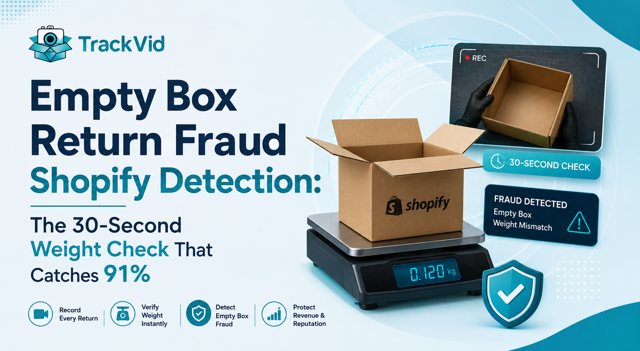
Empty box return fraud Shopify detection is the highest-ROI fraud defense investment most electronics D2C merchants have never deployed. The pattern is simple: customer files a return, ships empty original packaging back, warehouse team processes refund without weight verification because visual inspection cannot prove the item was removed. Per Signifyd 2026, empty box returns cost Shopify electronics merchants 0.4-1.2 percent of monthly revenue on average, hidden inside general return processing.
The detection method is equally simple: compare return weight against dispatch weight record. Empty box returns show 15-25 percent of dispatch weight (packaging only), triggering immediate refund hold. A calibrated scale plus dispatch weight archive catches empty box fraud in under 30 seconds. Yet fewer than 20 percent of Shopify D2C merchants have this deployed per Chargeflow 2026 surveys.
The gap is not knowledge. Every merchant understands empty box fraud exists. The gap is the missing dispatch weight archive: without a record of what each order weighed at dispatch, comparison at return receipt is impossible. This blog provides the complete protocol including weight verification workflow, dispatch archive infrastructure, and defense against "item not as described" retaliation chargebacks.
Weight lies less than words. Especially at return receipt.
Toronto Consumer Electronics Merchant Mia: 0% Detection to 91% in 60 Days
Mia runs a Shopify D2C premium consumer electronics brand from Toronto. Smart home devices, premium audio, small high-value tech accessories. Daily volume approximately 150 orders. Average order value $189. Monthly GMV roughly $850,000.
Her return rate had climbed to 22 percent by late 2025. Month-end audits kept finding refunded returns with empty packaging in her warehouse, but her team could not catch them in real time. Estimated monthly loss: approximately $7,200 across 30-38 undetected empty box returns per month at her AOV.
Her warehouse team was processing returns based on visual inspection alone. Boxes opened, packaging looked correct, refunds processed. Weight was never compared to dispatch record because there was no dispatch weight record. Empty box detection rate: approximately 0 percent.
She deployed the weight verification protocol over 30 days:
- Layer 1: Calibrated scale at return inspection station connected to her warehouse management system
- Layer 2: TrackVid dispatch weight archive recording calibrated scale weight for every dispatched order at packing
- Layer 3: Return weight comparison protocol at receipt with automatic flag for variance above 5 percent
- Layer 4: Refund hold protocol on flagged returns with photographic evidence documentation
- Layer 5: Return rejection process with documented weight discrepancy for chargeback defense
Results in 60 days:
- Empty box detection rate: 0% → 91%
- Monthly empty box loss recovery: $0 → $6,500 (91% of $7,200 previous loss)
- Return inspection time per package: unchanged (weight check adds under 30 seconds)
- "Item not as described" chargebacks from rejected empty box returns: 0 (dispatch weight evidence wins all)
- Attempted empty box returns: dropped 43% within 90 days as serial abusers switched stores
Mia's month-four analysis showed something unexpected. Her overall return rate dropped to 16 percent (from 22 percent) as empty box fraudsters stopped ordering from her store entirely. The weight verification protocol had a preventive effect beyond its detection effect.
Ready to see this in your Shopify operation? Book a 30-minute demo and we will show you exactly how the weight verification protocol catches empty box returns for a recent dispute.
What Empty Box Return Fraud Actually Looks Like on Shopify
Understanding the mechanics is the foundation of empty box return fraud Shopify detection. The pattern is straightforward but has four distinct sub-variants merchants encounter.
Sub-pattern 1: Complete empty box. Customer removes the product entirely, ships back only packaging and documentation. Return weight approximately 15-20 percent of dispatch weight. Most common variant, easiest to detect with weight verification.
Sub-pattern 2: Partial contents removed. Customer removes main product but leaves accessories, chargers, cables. Return weight approximately 30-50 percent of dispatch weight. Catches at weight variance above 20 percent.
Sub-pattern 3: Substitute weight added. Customer removes product but adds weight (books, rocks) to mask missing product weight. Return weight matches dispatch weight but visual inspection reveals substitutes. Requires opening box on camera.
Sub-pattern 4: Wrong item substituted. Customer ships back different item of similar weight (older model, damaged unit, cheaper version). Return weight matches dispatch but item verification reveals substitute. Requires product identification at inspection.
All four sub-patterns collapse against weight verification plus visual inspection plus Order ID-linked dispatch documentation. Sub-patterns 1 and 2 catch on weight alone. Sub-patterns 3 and 4 catch on inspection with weight as the initial flag.
The 30-Second Weight Verification Protocol
The specific weight verification workflow that catches empty box return fraud on Shopify Payments takes under 30 seconds per return once infrastructure is in place. Six steps.
Step 1: Photograph the sealed return package before opening. Documents packaging condition and any external tampering signs.
Step 2: Place package on calibrated scale, record weight to two decimal places. Standard postal scale or shipping scale is sufficient; calibration matters more than expensive equipment.
Step 3: Retrieve dispatch weight record for the Order ID from your dispatch archive (TrackVid, warehouse management system, or shipping platform log).
Step 4: Compare return weight to dispatch weight. Variance above 5 percent triggers escalation to full inspection.
Step 5: For flagged returns, open on camera at controlled inspection station. Document contents against dispatch photograph or video.
Step 6: Refund decision documented. Approved returns process to refund. Flagged and confirmed empty returns get photographic documentation, return-to-buyer with tracking, and rejection notice with weight variance evidence.
Total time on legitimate returns: approximately 30 seconds (weight check, no escalation).
Total time on flagged returns: approximately 4-6 minutes (weight check plus inspection plus documentation).
Weight variance benchmarks:
- Under 5 percent variance: legitimate return, process refund
- 5-15 percent variance: minor discrepancy, escalate to visual inspection
- 15-30 percent variance: probable empty box or partial contents, refund hold and full inspection
- Above 30 percent variance: near-certain empty box, refund hold and documented rejection
Building the Dispatch Weight Archive
The dispatch weight archive is the missing infrastructure at most Shopify D2C stores. Without it, weight comparison at return receipt is impossible. Three options for building the archive.
Option 1: TrackVid Order ID-linked dispatch documentation. Every packing session records calibrated scale weight tied to Order ID. Retrievable in under two minutes. Additional artifacts (packing video, seal, shipping label) in the same archive.
Option 2: Warehouse management system integration. ShipStation, ShipBob, Extensiv can log dispatch weight per order if scale integrates. Requires scale-to-WMS connectivity. Searchable by Order ID.
Option 3: Manual dispatch weight log. Spreadsheet or paper log per shipment. Cheapest, most error-prone. Works for low-volume stores under 50 orders per day.
Archive requirements:
- Order ID tied to specific dispatch weight
- Weight to two decimal places
- Calibrated scale identifier or timestamp
- Retention minimum 90 days (matches chargeback windows)
- Retrievable by Order ID in under 5 minutes
Without the dispatch weight archive, the weight verification protocol cannot function. Building this archive is the specific investment empty box detection requires.
Related: Complete Shopify return fraud prevention checklist
How to Defend the Rejection: Winning "Item Not as Described" Chargebacks
Rejecting an empty box return triggers chargeback risk. The rejected buyer files "item not as described" claiming the merchant refused a legitimate return. Without documented evidence, these lose at 70-80 percent. With the correct evidence chain, they win at 70-85 percent.
The 5-part evidence chain:
- Piece 1: Photograph of sealed return package before opening
- Piece 2: Return weight on calibrated scale (documented on video)
- Piece 3: Dispatch weight record for the Order ID
- Piece 4: Weight variance calculation showing discrepancy above threshold
- Piece 5: Photographic or video documentation of the empty or partial contents
Combined with Order ID-linked dispatch packing video, this evidence chain wins Shopify Payments "item not as described" chargebacks at 70-85 percent within 60 days.
Submission format:
- Cover statement citing Visa 13.3 (Not as Described) with return abuse defense
- Weight variance documentation as primary evidence
- Dispatch video showing item at packing
- Return receipt video showing empty condition
- Weight archive extract for the specific Order ID
How TrackVid Delivers Empty Box Return Fraud Shopify Detection
TrackVid (trackvid.in) provides the calibrated scale weight archive tied to Order ID that empty box return fraud Shopify detection requires. Every packing session records calibrated scale weight, packing video, shipping label, and tamper-evident seal. Tagged automatically to Order ID.
For empty box detection:
- Dispatch weight archive: Every order has calibrated scale weight recorded to two decimal places, tied to Order ID
- Return weight comparison: Retrieve dispatch weight in under 90 seconds at receipt
- Chargeback defense: Dispatch weight plus packing video wins "item not as described" chargebacks on rejected empty box returns at 70-85 percent
- Multi-platform: Shopify Payments, Stripe, PayPal, Amazon A-to-Z
Merchants running TrackVid with the 30-second weight verification protocol report empty box detection rates from 0 percent to 89-91 percent within 60 days. Monthly losses drop 85-95 percent.
TrackVid works with existing cameras and standard shipping scales. Setup under 15 minutes. Used by 1,000+ ecommerce merchants globally.
Five Questions to Audit Your Shopify Empty Box Return Exposure
1. Do you have a dispatch weight record tied to Order ID for every order shipped in the last 90 days? Without this, weight verification at receipt is impossible.
2. What percentage of returns are weighed on calibrated scale and compared to dispatch weight before refund? Below 100 percent means empty box returns are getting through.
3. For your last 30 refunded returns in electronics or small high-value categories, what percentage were verified against dispatch weight? Unweighed returns are the specific gap fraudsters target.
4. Do you have a documented refund hold protocol for returns with weight variance above 15 percent? Automatic refunds on flagged returns are money out the door.
5. For your last 5 return rejections, do you have the 5-piece evidence chain (sealed photo, return weight, dispatch weight, variance calculation, contents documentation) that would defend against "item not as described" chargebacks?
TrackVid works with your existing warehouse cameras and standard shipping scales. Setup takes under 15 minutes.
Book a 30-minute demo at trackvid.in/book-demo.html
In one session, you will see exactly how the weight verification protocol would have caught your recent empty box losses, and what a 91 percent detection rate looks like in your specific Shopify operation.
Frequently Asked Questions
What is empty box return fraud?
The return abuse pattern where a customer files a return, ships the empty original packaging back, and the warehouse team processes the refund without weight verification. Four sub-patterns: complete empty box (packaging only), partial contents removed (accessories left), substitute weight added (rocks, books), and wrong item substituted (similar weight). Per Signifyd 2026, empty box returns cost Shopify electronics merchants 0.4-1.2 percent of monthly revenue on average. Detection requires calibrated scale weight comparison against dispatch weight record.
How do I detect empty box returns on Shopify?
Detecting empty box returns on Shopify requires the 30-second weight verification protocol. Six steps. Step 1: photograph sealed return package before opening. Step 2: place on calibrated scale, record weight to two decimal places. Step 3: retrieve dispatch weight record for the Order ID. Step 4: compare return weight to dispatch weight. Step 5: for variance above 5 percent, escalate to full inspection at controlled station. Step 6: document refund decision with photographic evidence. Detection rate moves from 0 percent (uninspected) to 89-91 percent (with protocol) within 60 days. Requires calibrated scale plus dispatch weight archive tied to Order ID.
How do I prove a returned box was empty?
The 5-piece evidence chain. Piece 1: photograph of sealed return package before opening. Piece 2: return weight on calibrated scale, on video. Piece 3: dispatch weight record for the Order ID. Piece 4: weight variance calculation showing discrepancy above threshold. Piece 5: photographic or video documentation of the empty contents at controlled inspection. Combined with Order ID-linked dispatch packing video, this evidence chain justifies rejection and wins "item not as described" chargebacks at 70-85 percent.
Can I refuse a refund for an empty return?
Yes, Shopify merchants can refuse refunds for returns received empty when the return policy specifies condition and completeness requirements. Documentation is essential: sealed package photograph, return weight, dispatch weight record, and empty contents documentation. Etsy, Shopify direct, and Amazon Handmade all recognize weight-based rejection as legitimate when supported by dispatch weight archives. Rejected empty box returns should be returned to the buyer at buyer expense with rejection notice citing the specific weight variance evidence. The photographic documentation defends against the "item not as described" chargeback the buyer may file in retaliation, winning at 70-85 percent with complete evidence versus under 20 percent without.
How much does empty box fraud cost Shopify merchants?
Empty box return fraud costs Shopify electronics and small high-value merchants 0.4-1.2 percent of monthly revenue on average per Signifyd 2026 data. A Shopify store doing $500K monthly GMV in electronics category absorbs $2,000-$6,000 in monthly empty box losses. A store doing $1M monthly GMV absorbs $4,000-$12,000 monthly. These losses are typically hidden inside general return processing because most stores lack the weight verification protocol to identify them at receipt. Deployment of the calibrated scale plus dispatch weight archive plus weight verification protocol catches 89-91 percent of empty box returns and recovers 85-95 percent of the associated losses within 60 days.
Do I need a calibrated scale to catch empty box returns?
Yes, a calibrated scale is essential. However, calibrated does not mean expensive. Standard postal or shipping scales calibrated to at least two decimal place accuracy work fine. Cost typically $50-$200 for merchant-grade shipping scales that also handle dispatch weighing. Higher-precision scientific scales ($500-$2000) provide additional accuracy but are not required. What matters: same scale at dispatch and return, calibrated periodically (monthly), integrated with your WMS or log. Uncalibrated household scales cause false variance flags.
What evidence wins empty box chargeback disputes?
Same weighted hierarchy as other Shopify disputes. Tier 1: Order ID-linked dispatch packing video, calibrated scale return weight, dispatch weight record, tamper-evident seal documentation. Tier 2: sealed return package photograph, empty contents video, weight variance calculation. Tier 3: return policy, order confirmation, tracking. Manual responses using only Tier 3 lose at over 80 percent. Adding Tier 1 dispatch weight archive plus Tier 2 return documentation pushes win rate to 70-85 percent within 60 days.
How do I set up weight verification for returns?
Setting up weight verification for returns on Shopify requires three infrastructure pieces. Piece 1: calibrated scale at return inspection station (postal or shipping scale, $50-$200). Piece 2: dispatch weight archive tied to Order ID (TrackVid Order ID-linked archive, warehouse management system integration, or manual log for low-volume stores). Piece 3: written protocol documenting the 6-step weight verification workflow (photograph sealed package, weigh, retrieve dispatch record, compare, escalate flagged returns, document decision). Setup time typically 2-3 days for infrastructure plus 1 week for team training. Detection rate reaches 89-91 percent within 60 days of full deployment.
Sources: Signifyd State of Fraud and Returns Report 2025, Chargeflow Shopify Chargeback Guide 2026, Chargebacks911 Return Fraud Analysis 2026, NRF Retail Returns Landscape Report 2026, Beast Insights Shopify Chargeback Cost Analysis 2026, Shopify Payments Documentation, TrackVid internal merchant data
TrackVid is a video proof and claim management platform used by 1,000+ ecommerce merchants globally on Shopify, Amazon, Etsy, eBay and major marketplaces. Officially authorised by Snapdeal. Learn more at trackvid.in.



Get the Marketplace Claim Recovery Checklist
A 12-point checklist used by 1,100+ sellers to recover 85-90% of marketplace claim losses. Free, instant access.
- Marketplace-specific evidence formats (AJIO, Flipkart, Amazon, Myntra)
- Claim window deadlines for every major platform
- The 6-step process that pushes approval from 85-90%
- Common rejection reasons and how to avoid them
No spam. Unsubscribe anytime. Used by sellers at Rare Rabbit, HRX, Da Milano + 1,100 more.
Stop Losing Money to Fake Returns
Join 1,100+ sellers who recover lakhs every month with TrackVid